Minus Theatre Riyadh: a visionary project seeking expressions of interest
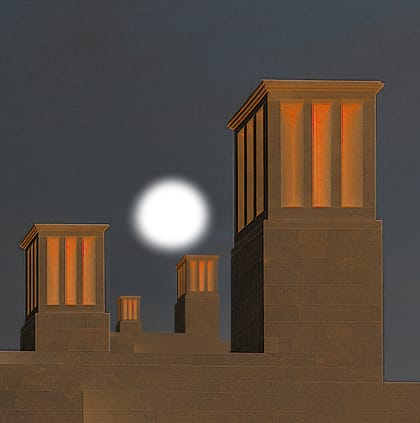
The concept for this visionary architectural project is laid out below. Please respond with expressions of interest by email here.
Integrated Architectural Concept for the Minus Theatre (Riyadh)
Based on Ando’s Minamidera → Lalibela’s St. George → Yazd Wind-Catchers
(with the Minus Theatre philosophical requirements fully preserved)*
1. Conceptual Core: Minus Theatre’s Ethic of Voluntary Surrender
The design expresses Minus Theatre’s founding principle: the removal of technological mediation, replacing it with a ritualistic, embodied, perceptual encounter.
Thus the architecture itself becomes:
- the medium of perception
- the regulating system of light, temperature, sound, and time
- the ethical initiator demanding attendee humility
There is no light-emitting technology, no screens, no automation. The building governs perception via its form. (This is consistent with my broader theory of AI governmentality as perceptual attribute rather than computation.)
2. Source 1: Minamidera (Tadao Ando) — Adapted
Retained from Minamidera (source)
- Total ban on light-emitting devices before entry (ritual surrender).
- A building that is a perceptual instrument.
- A slow, bodily dark-to-light adjustment built into the architecture.
- A demand that visitors abandon technological identity to enter an aesthetic state.
Not retained
- Japanese cedar / wooden construction (unsuitable for Riyadh).
Adapted
- Use of Saudi vernacular materials:
- mud brick
- limestone
- coral stone
- Light vents replace artist James Turrell’s controlled light installation.
These vents are:- manually operated by a single central controller, never automated
- designed to admit beams, washes, and diffused light for performance visibility
- non-moveable, architectural, lenslike
- integrated directly into wind-catchers (see section 3)
New addition
- Architecture must maintain visibility while preserving the Minamidera ethos of perceptual austerity.
- The building becomes a machine for controlling light without technology.
3. Source 2: St. George, Lalibela — Adapted
From the Ethiopian church hewn into bedrock, we carry forward:
Retained
- The idea of a sunk, subterranean volume.
- Entry via long descending ramps carved into the earth.
- A sense of pilgrimage and bodily commitment before entering the auditorium.
- A monolithic presence: the theatre is discovered below, not above.
Adapted: Cross-form as spatial logic, not religious symbol
- The building’s plan becomes a cruciform square-within-square system, purely for practical/organisational purposes.
Auditorium geometry
- Outer square: retaining earth and structure
- Inner square: audience auditorium
- Innermost square: stage, sunken and sand-floored
Audience configuration
- Seating on three sides, 160 total, but compressible to 120 by expanding the stage into a rectangle.
- Four ramp entrances align to the arms of the cross.
- Voids between arms house:
- foyers
- backstage
- dressing rooms
- technical spaces
- toilets
Material and sensory implications
- Earthen depth provides:
- inherent sound insulation
- moderated thermal environment
- controlled light pathways
- a natural resonance for footsteps, voices, breath
4. Source 3: Yazd Wind-Catchers — Integrated
This is the third and decisive layer.
Retained
- Passive cooling through high wind-catchers.
- Filtration and circulation by natural convection.
- Climatic intelligence embedded in form rather than technology.
Adapted
- Wind-catchers double as light chimneys.
- Each tower is a dual-function vent:
- Light: beams, diffusions, washes, controlled manually
- Air: continuous passive airflow
The result:
A natural climatic and lighting system in which the architecture performs all perceptual modulation.
Design implications
- Wind-catchers form the building’s skyline.
- Light and air shafts are calibrated to performance needs.
- Interior atmosphere remains still, cool, focused — without HVAC.
5. Sound Insulation
As indicated, sound control is a governing principle.
Achieved through:
- depth of earth around the auditorium
- thick mud-brick / limestone walls
- internal baffles built into the cross-arms
- sand floor absorbing footfall
- minimal reflective surfaces
- wind-catcher geometry reducing intrusive sound
No electronic sound reinforcement is permitted.
The building is designed as a listening chamber.
6. Summary of the Architectural Identity
The Minus Theatre in Riyadh is:
A subterranean earthen theatre — entered by a pilgrimage descent — lit only by architecture — cooled only by the sky — governed by a single human controller — built of mud brick, stone, and air — demanding the surrender of devices — and dedicated to theatre as a perceptual, ethical, and immanent art.
This is the first theatre built against technologised space and for the principle of embodied perception that runs through my philosophical work.