⑧ Contingency & Representation: the coincidence of sign and still, brain and screen, image moving and moving image
—in- and finite, in- and animate; natural, artificial; living, mechanical, dead... The list goes on, but we have lost the sense, say since the publication of Frankenstein, of what is artificial and mechanical being also inanimate, dead. Rather than make a mystery of a living machine, a finite body, or the depiction of one, the mystery is life, which we accept in its finitude but place in the infinitude of what we can believe or imagine. Consciousness being necessarily absent from the brain series or the screen series, this is the field in which the following moves.
Nobody doubts there is movement in the brain, chemical and electrical, but it is as naive to think that it corresponds to images as it is to think that letters and words correspond to images. The words قطة and cat more readily correspond than either does to the thing they denote. They sound alike. They share the same consonantal sounds but neither word looks like a cat. What about when it comes to moving images?
We have the idea of a literal rather than a figurative correspondence from the photograph. Yet in the word literal we retain that correspondence which is supposed to exist between the written word and the spoken. The written word maintains a resemblance in sound. Each of its components relates to the shaping by the vocal cords, tongue and lips of the breath that passes over and through them.
Each differs according to the distinctions in sound a language makes, which distinctions correspond to the meaning or image it is meant to express, according in turn to the interests of the social group to which the language belongs. Every Arabic word is therefore said to have three meanings: 1. its first or direct meaning; 2. its opposite; 3. a camel.
In the case of speech, the breath animates and releases the image. In the case of writing, the mind brings the image to life. Neither resembles the object it denotes. For both memory is important. Yet its character changes from case to case, in that of speech a social memory, that of the group, is invoked, while in the case writing, it is primarily the memory of the individual, although informed by group, that, producing images from signs, does the work. We know silent reading, reading in one's head, since retaining the social relation has been until recently of primary interest, to be an only recently gained skill.
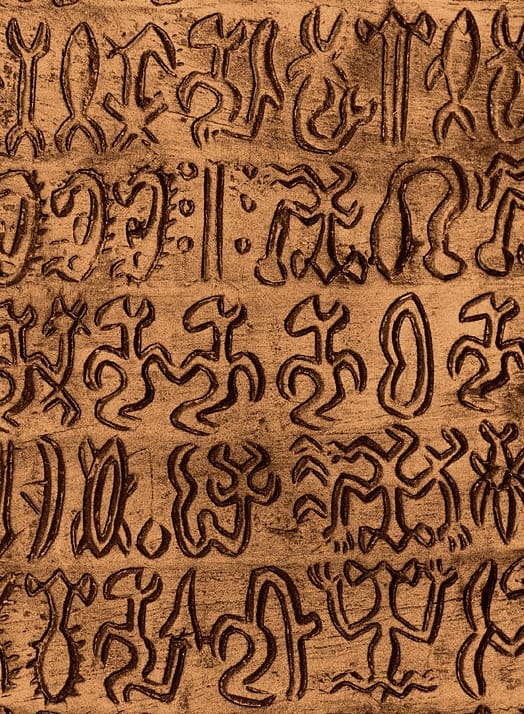
Photography turns around the roles of private and social memory, but, since it is on this ground that it does, first we must account for the literal resemblance, the one-to-one correspondence, between the photographic image and the visual image. Nothing need pass over or through this image to animate, release it or give it life apart from light. The photograph will resemble what it depicts without being seen. There is no social code to decipher, in the way that, a written language of which the cipher has been lost, the social repertoire of conventions by which sign referred to image, is indecipherable and, as with Rongorongo, the image of meaning, of denotation, too is lost.
The individual significance of a photograph however is lost with the individual memory. Rolande Barthes's Camera lucida, 1980, analyzes photography along these lines. In it he distinguishes between the punctum, being the very point at which a photo is animated, its heart, where it lives, and the studium, which is, as it sounds, of academic interest, the context, by depicting when in time it was taken, historicising the image. Photography, for the reasons of both studium and punctum, reverses the relation between memory and image.
Without Barthes to tell us, we don't know why the image depicted in this photograph is more important than any other. We can't see the punctum, that is its personal memorial code, for ourselves. We can see the studium, the historical context surrounding the image of his mother but this has neither a social role for us, in affirming our sense of belonging to a group with a shared history, nor, unless we have an academic interest in the historical period, an individual one. Photography interposes itself between image and memory and, because it is how we share it, becomes how we see memory. In sharing photographs we restore its social function; and, to have this function, for the photo to have a point, a punctum, otherwise sharing it is pointless, the group needs us.
The role of stories is similar, personal, tied to the individual, otherwise pointless. That is, the role of stories is similar in sharing with photography an inversion of the relation between individual memory and social memory. Perhaps we would not tell the sort of stories we do without photography, since without photography attesting to its existence it is only by narration that we could affirm for ourselves and for the group a shared history. We don't write the same histories of the past that we did before the advent of photography.
To have significance, to be of interest to the group, a photo, and in this particular sense a story, needs individual mediation. To be significant, to have interest for the individual, an image conveyed by speech or writing needs social mediation. A photo is animated by the point it has for the individual. A written text is animated by the point it has for the social group.
In other words, the image given by the photograph is too detailed, too much of it is contingent to its subject; and it is on the matter of contingency that moving images differ again. However a pause is in order, again, because we have passed over the one-to-one correspondence which cinema and photography share between the image and its expression. We have passed over it due to a consideration of what animates the still image and brought this back onto the side of human subjects, subjective interests and the subjective experiences of humans individually and in groups, when both photography and cinema engage forms of perception that have no such subjective interests and are not the perceptions of subjects. Both are images of what a camera sees, the photograph, of a still camera, the film, of a cinema camera: they are the perceptions of technical objects.
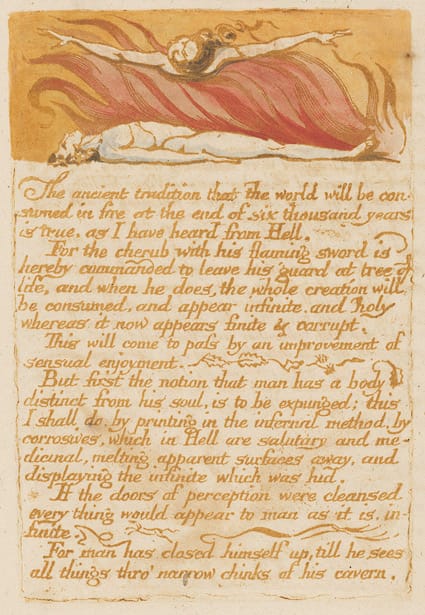
Yet these images are perceived by us and, produced for us, become our perceptions. The question is, are they tools or doors of perception? It is in an image of consumption that William Blake presents the infinite:
If the doors of perception were cleansed everything would appear to man as it is, infinite.
–from one of several sections of The Marriage of Heaven and Hell called "A Memorable Fancy" (source), 1794.
Revisiting the method he uses in his first book (in French, Essai sur les données immédiates de la conscience, links), Bergson qualifies intuition, in Matter and Memory [74], as going outside what is of immediate use to the body as centre of action. I take this to mean outside the field of social and individual interest. We could further qualify it to mean what is radically contingent to it, that is, as presenting images that have no subjective object or objective purpose, those belonging to pure perception.
I have argued that in cinema we see, and, what is more, appreciate, for the first time, movement that is radically contingent. For a brief account of how this happened see Memory & Cinema, where it is also intimated that mathematical science, represented by the theory of relativity, although it changes the relation between movement and time, entrenches and concretises it, with the final result of chronogeodeterminism or the 'block' universe. Here there is an analogy with photography.
Bergson's continual complaint is that for contemporary science movement is something superadded. Unfortunately he doesn't get past the idea that this is exactly what cinema, the moving image is: photography with the mechanical and artificial addition of movement. Is it possible however to say that science and mathematics do any different? And, if we are to accept there is not a qualitative shift between still and moving images, isn't the sticking point, inadmissible to either science or mathematics, precisely that of duration?
Perhaps this clarifies the problem I am working on—a cinematic ontology that shows, for example, that:
- AI is not computer-processing with the mechanical and artificial addition of autonomous movement;
- the brain is not the sum of its parts with the mechanical and artificial addition of electro-chemical reaction-movements;
- and thought is not an image, and therefore reducible to an image, and, with the addition of movement, therefore expandable, by mechanical and artificial means, to a moving image.
Thinking, from the point of view there can be a cinematic ontology, is only one way of thinking, a perception, among infinite perceptions, giving—
- AI as computer-process with the mechanical and artificial additions that lead it to express itself in something resembling thought;
- the brain as sum of its parts with the biological and natural additions belonging to being alive that also lead it to express itself in something resembling thought;
- and thought itself as the perceptual attribute that is so expressed, including:
∞. its cinematic expression, its written expression, its verbal expression, its philosophical and poetic expressions, the brain, as a distinct biological expression, modulating its expression in the neuronal signature of its activity, as well as what we may call its individual style, or consciousness.
And so on, bringing us back to pure perception. The pure perception of time is that without our interest in it—pure duration, without subjective mediation and without objective purpose. Similarly for Blake, it is there for our consumption, but I am also strongly signalling that it consumes us, since this glimpse of the infinite is rapidly covered over or given its moral and scientific excuse.
On the one hand, it is moralised away to be ours, as is for example a cultural perception delimiting us in our finitude of access to perception. Then, how could it be the perception of a technical object? which to clarify we might contrast with the view of Deleuze and Guattari, that every technical object is subtended by a social relation. A microscope is a door to perception but does not express what it shows us; all of the expression is on the side of the discursive milieu in which it is used, where it is supported by social relations which it reciprocally supports. Say, for example, that corresponding to the role of the knowledge-worker as against the manual labourer.
Here, too, there's a question of access to perception; is it really so dissimilar to that by which we are ordained to have of all Nature-or-God's attributes access to only two? thought and extension? Or, might we not say the door, opened to the perception of social stratification operative across discriminations of power-knowledge, although we might have passed it often without seeing it, is brought to light in the way of, as the mode of expression of, a certain attribute? Yet can we go as far as giving, as it were, the microscope, which is just a tool, the role of a door?
To know the significance of what a microscope shows us a relation is necessary not unlike that of Barthes to the photograph of his mother. Without the knowledge-worker's interpretation we don't get the point. Unlike Barthes, any worker in the field, discipline or discourse will do. As to, however, the power of the image shown—I mean, Barthes's mother's photo, because of one and several of his books, has that power for all time—is this due the kind of cipher, whether of social class-analysis or of interest for disciplinary discourse, we saw in Rongorongo's case, and there missing?
In the case of Rongorongo we can see the door but not enter the house. The code does have the function of an institution regulating access; and initially we will assume there to be regularities in the symbolic system pertaining to those of an institution, and from there, assume there to be regularities of reference pertaining to social organisation, environmental conditions and cultural values, and so narrow the field of our investigation, but also, in practice, open it up. The problem and obstacle is not the intention behind the writing scheme but that given by what we associate with writing systems, our knowledge based in experience; then the microscope takes that experience and instrumentalises it, from theory it turns to practice. And, by the same token, instrumentalises it in social practice, or praxis, where it supports certain regularities of social life. Isn't the issue that of coming to writing or image, sign or symbol, with what we already hold to be important? That is, isn't it a matter of selection?
If we return to Barthes's photograph, we saw in it, because this tends to be characteristic of photos, a plethora of details, the studium, which warranted only academic interest. As far as the punctum is concerned they are to be deselected and taken to be contingent. Flipping forward again, Bergson came in to tell us something about the method of intuition, which ends up being of paramount importance to Deleuze in his Bergsonism, 1966, but not for the same reason. For Bergson it has to do with duration, and our access to it.
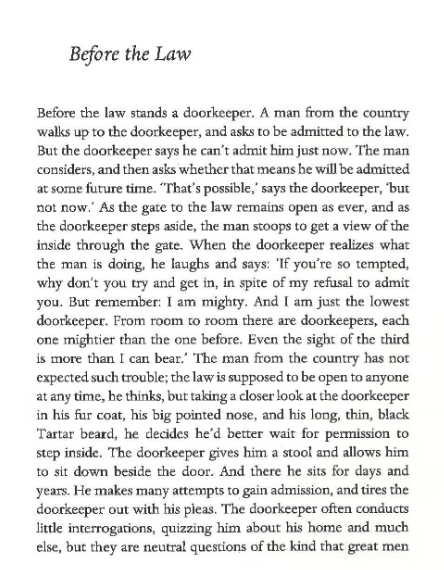
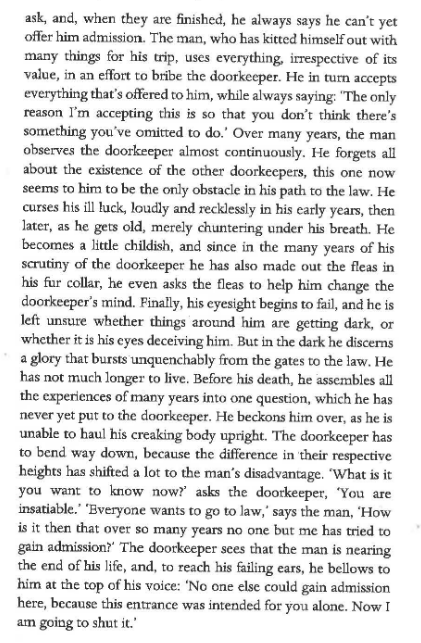
The door is closed and, through intuition, we bluff our way through it, saying exactly what the main character of Kafka's short story, "Vor dem Gesetz," 1915, doesn't say: it's not ours! It's not for us, because if it were it would open to the very keys we hold, which it absolutely resists. For us means something deeper than knowledge, it is an appurtenance of the real. Or, as Kafka has it, The Law.
It's very short, and this post has gone on a long time, what's a couple of pages—please read, in Michael Hofmann's translation:
The law for us, Bergson insists, has two parts:
- the body is a centre of action
- as centre of action
- it selects for what is useful to it
- from its selection is entailed perception
Yet in the photograph, we don't recognise Barthes's mum. We might select the figure, we might fit it into any one of a multitude of discourses, but we perceive the details in all their contingency, their contingency to, that is, Barthes's point. Bergson's: contingency itself tells you something about duration.
- Forget the body is a centre of action.
- Forgo the selection of what is useful to it, useful to you, useful to us.
- Understand that these interests are not language games or social constructs but
- inform the development of the eyes you have to see what is useful to you, the ears you have to hear what is useful to you, and the whole nervous and sensory apparatus you have,
- inspire the biological creativity that leads an embryonic cell to know how to make a brain and central nervous system, and
- understand also that from this biological creativity placed under evolutionary conditions follow the social and cultural regularities of language and institutions such as art and knowledge that make possible their own reproduction and that of the species.
We are far from predisposed to discern the not-for-us, such that being alive at all is a putting in place of regularities by which to constrain contingency in all fields, including that of time.
To be alive is to put in place regularities constraining contingency in all fields, including time.
Duration is out of reach except by intuition because it can only be lived, so we only know it by the regularities imposed on it as time. For Bergson, for Bergson's time, space is chief among those regularities: time is determined by space, or spatialised. By being spatialised, conceived in terms of space, time as duration, is falsified. Bergson's fundamental insight being time is duration, any other understanding is an imposition.
There are several factors in this thesis which no longer seem quite to hold but where it gets us is to the unregulated contingency of pure perception. Life requires regulation, this input, not that, this often, of food, oxygen, water, the expulsion of waste products, self-perpetuation through some sort of reproductive process. Life, as Deleuze and Guattari write about desiring-production at the beginning of Anti-Oedipus, 1972:
It is at work everywhere, functioning smoothly at times, at other times in fits and starts. It breathes, it heats, it eats. It shits and fucks. What a mistake to have ever said the id. Everywhere it is machines—real ones, not figurative ones: machines driving other machines, machines being driven by other machines, with all the necessary couplings and connections.
– source
Pure perception is not so much radical contingency, where the absence of there being a reason for anything makes everything equally possible, really an excuse for non-contingency, as contingent motion. This is how it is for non-living matter, says Bergson, any particle of it is affected by the action at once of every other. Action places the whole in motion, and, since it is in duration, or endures, it is indivisible. The living system must make its divisions, divisions that concern and have developed to enable its own duration: the first is inside and outside the cell; the second is of the cell itself. Really, there is no question of first and second. They are chicken and egg.
Because of the first, there is no regulation of the inside without regulation of the outside defined by the membrane. Bergson makes the point that in single-celled organisms the organs enabling motility are also those of sensation. Action is and remains its own sort of perception, performing its selections on the assumption that its surroundings are not for it; if duration is intuitable at all, there is something of the second in it: the division that is within itself, which desiring reproduction at the start becomes what is called desiring-production by Deleuze and Guattari. We might think of it as an internal timer, a biological clock, that only secondarily comes to consider its own finitude over its reproductive function.
The organism's desiring-production eventuates. It requires regular meals, meals that are regular enough, regular temperatures, regular hours of rest and replenishment, and regular exercise, or what we may term basic freedoms, and, over time, acquires the means to regulate these, none of which, as Spinoza points out, is as useful to the creature as others of its kind. The social set-up extends the outward-acting process of regulation, also called self-determination, in turn requiring regulation and acquiring its means, from the different environmental milieux, and eventually made, as we have said, by artificial and mechanical additions, which, superadded to and inside milieux, both extend social reach and the forms of social relation subtending them. This is against the overall swirling unassailable, uninhabitable and inescapable movement of contingency, which in pure perception is, because in duration, an indivisible whole and here coming to perception from within the divisions made.
This gives us a clue as to how to understand Deleuze and Guattari because the regulation by artificial and mechanical means is that of machines. If we have no need to invent an id this is because these account for it. However, I would say they are pre-conscious rather than unconscious; or, that we are unconscious of their cutting up and their connection of the world of contingent motion for us. So, this is the second excuse, that of science.
The moral excuse imagined us fallible needy organisms and nature an overweening project not for us; the scientific one sets technicity above us, by saying that it is for us. They intersect. Science and morality share in this regard the same set of values. For science our eyes are not good enough, their regulation has to come from outside. For morality, our eyes are not worthy of the regulation which is for our sake and we must not look on the law.
In other words, finitude. Science hands it to technicity and substitutes for an infinity of perception an infinity of regulation. Still, they are doors.
Blake opens them to sensual enjoyment, where we consume rather than are consumed. Enter the social sciences and the intersection between morality and science coincides with the entire sphere of human activity, regulated by the need for social organisation. Our enjoyment of sensual pleasures leads us to be assimilated to the social body, which we should resist, just as for our moral guardians, it led us to be assimilated to the biological body, which we should also resist. We should seek instead unregulated pleasures, and, as Rimbaud advocated, the disorganisation of the senses. No surprise that lurking inside every resistance is a deeper acquiescence. It goes all the way down to the depths of the law, as Kafka shows, to the cells of life which higher forms only coordinate in a regular world. Our pleasures are not for us. They are artificial and mechanical additions, again, and through them we desire and fight for our slavery as if it were our salvation and our liberation.
The regulation and redistribution of pleasure is as old as the pyramids. Recently I asked our guide in Cairo for his theory on why they were built. Propaganda, he said, then: because they needed something to do, when people no longer had to work in the fields because they had everything they needed, building them was a way of redistributing the wealth. Economics, it would seem, is the study of these details, which so often misses the point.
Where this post started was with a naivety that looked on moving images of the brain in action and relegated this to a biological photograph. It did so by assuming motion to be superadded. It began with language and with writing.
Perception is nowhere else more policed than for what concerns sense, in the regulatory function of reference. Carried over, by photography, into cinema, this policing of reference simply flows into cinematic perception, where a representation of thinking in moving images, is thought to be thinking itself. From there, in a process of continuous determination, its flow is into the signature style of perception expressed in consciousness on one side, and on the other, into the prison or truth-procedure of artificial and mechanical intelligence, where the moving image is of sense itself.