مدرسة
We know the word medressa or madrasa (or مدرسة) to mean a school, a place of learning and a meeting-place, often, if not usually, attached to a mosque. Here children receive teaching in the Qur'an, Al Qur'an or القرآن, note the Arabic spelling which has only one ostensibly vocalic, that is vowel, letter, ا and آ, the second long-stressed low-voweled, indicated by the diacritical called madda, the tilda above it.
Apart from 3, 2 of which also have a consonantal function, [w]oo, [y]ee, and the free-standing sound-shifting [A]aa, vowel sounds are in Arabic only to be indicated by diacritics, such that what the English gives as Qu is in Arabic قُ, with the damma above ق, but the marks are not compulsory. They are learnt with Arabic. In this, it resembles Hebrew. Interestingly, diacritical marks specifying vowels, vocalics or voice sounds were introduced at around the same time for both languages, in the 7th to 8th centuries CE. And for the same reason: to permit standardised pronunciation of the respective holy books of both traditions.
The historical coincidence for the three principal Semitic languages has received critical attention, for example by Shelomo Morag in 1972, whose preface, dated 1959, states:
The time for writing a full history of these vocalization systems has not yet come; much work remains to be done in the examination of mss. and printed texts before such a history can be written.
—The Vocalization of Arabic, Hebrew, and Aramaic
However, it's David Abram, to whose recognition of its significance in The Spell of the Sensuous, 1996, that I owe this insight. What changes with the addition of diacritical marks, as you see above in the Qur'an, that of the tilda above the ا, goes much further than a standardisation, as it is usually framed, of vowel sounds reading written texts. For Abram, not just how these texts sound, but the breath missing from the words is restored, which had been deliberately withheld: the role of a priestly caste and the accompanying exegetical industry relies on the ambiguity of a purely consonantal marking.
What then was the role of, in the West, the monasteries but to pursue this industry? And what of the medressa in the East? or the Bet Midrash which is its echo?
For the entire monotheistic tradition, discounting that of Akhenaten, its oldest text, going back perhaps a thousand years BCE, the Torah, comprised non-vocalic symbols. These correspond to the mechanical articulations of the mouth without the addition of the breath. To give a crude analogy, a word like GD, could mean, with breath running over the rear tongue action and the front action with tongue pressed to the teeth, equally GOOD, GOD and GOUDA.
Abram attributes the innovation of texts with breath, much as we might to computers that with the addition of AI seem alive, to the alphabet, naturally enough. And, in turn, the significance of this is for the aleph-beta to initiate and to be the foundation for an entirely new tradition: philosophy. Socrates spoke; but Plato wrote. And it is Plato's voice we hear, explicitly, in the dialogues.
Abram says also that it devolves upon a breathing written language the standardisation of which specifies distinct meanings to isolate the qualities. Hence the Ideas. What is the Good and how it is distinct from either God or Gouda can only be made clear on the page, and philosophy is a written form, if we can fill in the gaps between, before and after G and D. Not only this, a Gouda in itself can be isolated, like a Good in itself, from lived experience in a written context: writing enables the isolation of a quality, and therefore of an idea (beyond lived experience) because it enables its abstraction.
The historical coincidence of the aλφάβητο with Plato's lifetime, between the 5th and 4th centuries BCE, establishes, after γράμμα the Greek word for letter, a grammatalogical regime, the authority of the written word. And philosophy. Or it might be put like this: a written language with vowels, in the case of Hebrew and Arabic diacritical marks showing vowels, supersedes the authority which precedes it of the schools, since no longer is the reader reliant on the interpretation of an authority to understand. The written text has itself authority (which is the challenge of LLMs, with access to all written knowledge).
Here in fact is the history provided by ChatGPT LLM (31 December 2025) in answer to this prompt: "a full history of the vocalization systems, stemming from the Greek Alphabet which for the first time included vowels, of Semitic and other languages, that after this innovation of the alpha-beta, included diacritical and other markings to convey vocalic soundings."
—see the separate document produced by AI, filed under ⏚ resources | links, at this link: "an historical account of how vocalization systems emerge after the Greek alphabet’s invention of explicit vowel letters".
The AI does not exhaust the enquiry, particularly as it reflects back on itself, exactly like an autonomous text. The role the Torah plays in mystical computation: the Qabalah, because its text is not tied to specific meanings, assigns to its consonants numbers to generate ever new combinations. Biblical exegesis follows and then Qur'anic, and now we have the vast combinatorium of the network of digital texts, including these, where we reinstall the priestly caste of technologists.
What is at stake, we are reminded by teachers and other custodians of knowledge, is the nature and status of the schools. This perhaps does not include those schools where the study is of those texts where the divine breath breathes through the words, or where it is withheld and language holds its breath; but the point to be made about secular and scientific knowledge is that the texts containing it and the discourse conducted in language and other symbolic media are part of the combinatorium. And the breath imputed to language, divine or not, is the same for those constructions which use it.
These thoughts are appropriate to the true subject of this post, the family get-together we, Jo's colleagues, she and I, were invited to attend, since from it among an inexhaustible wealth of impressions came insights into the place of language, and the nature and characteristics of Arabic. The most striking of these was imparted by his Excellency, ex-Minister for Agriculture and therefore introduced as his Excellency, in English for us, the guests. He said,
As a Muslim and as an Arab I thank God that He saw fit to give His last book to humanity in our language.
It occurred to me this morning, having space and time (perhaps too much!), returning to NZ on Jo's hiatus, that Saudi Arabia is a society where you don't feel everything to be hurtling in a direction which is either out of the control of that society, despite the charges of authoritarianism, or, as it appears in fact on my return to NZ, inimical to the life of that society. Here is the irony, easy to pick out: the market is free to dispose of us as it sees fit. And also something else about a horrible relation to the future.
The family, Duha's family, a colleague of Jo, had been meeting every Wednesday at her sister's house, a house the sister and her husband had purchased to accommodate get-togethers like this, for years; and, Duha's brother explained to me, this wasn't the only time they got together. He explained that this, like those gatherings at a medressa, was a medressa too, which he defined as an event where anyone might turn up and be honoured as a guest. It dated back to the desert roots of Saudi society as a continuous tradition of hospitality. That is why, he said, indicating them, the gates to the compound are open. Anyone passing by would know by this that they were welcome.
Anyone could come and would be fed and could join the family at any one of their gatherings. Sometimes they had medressa in the morning, sometimes at night, and on different days of the week; no matter when, the same applied. I asked about who the family was, the family name. Ahmed told me there were two names.
How far do they go back?
Around 2000 years, he said. The two names had come together early on, and, through marriage, had come together again. They were like rivers that part and come together again.
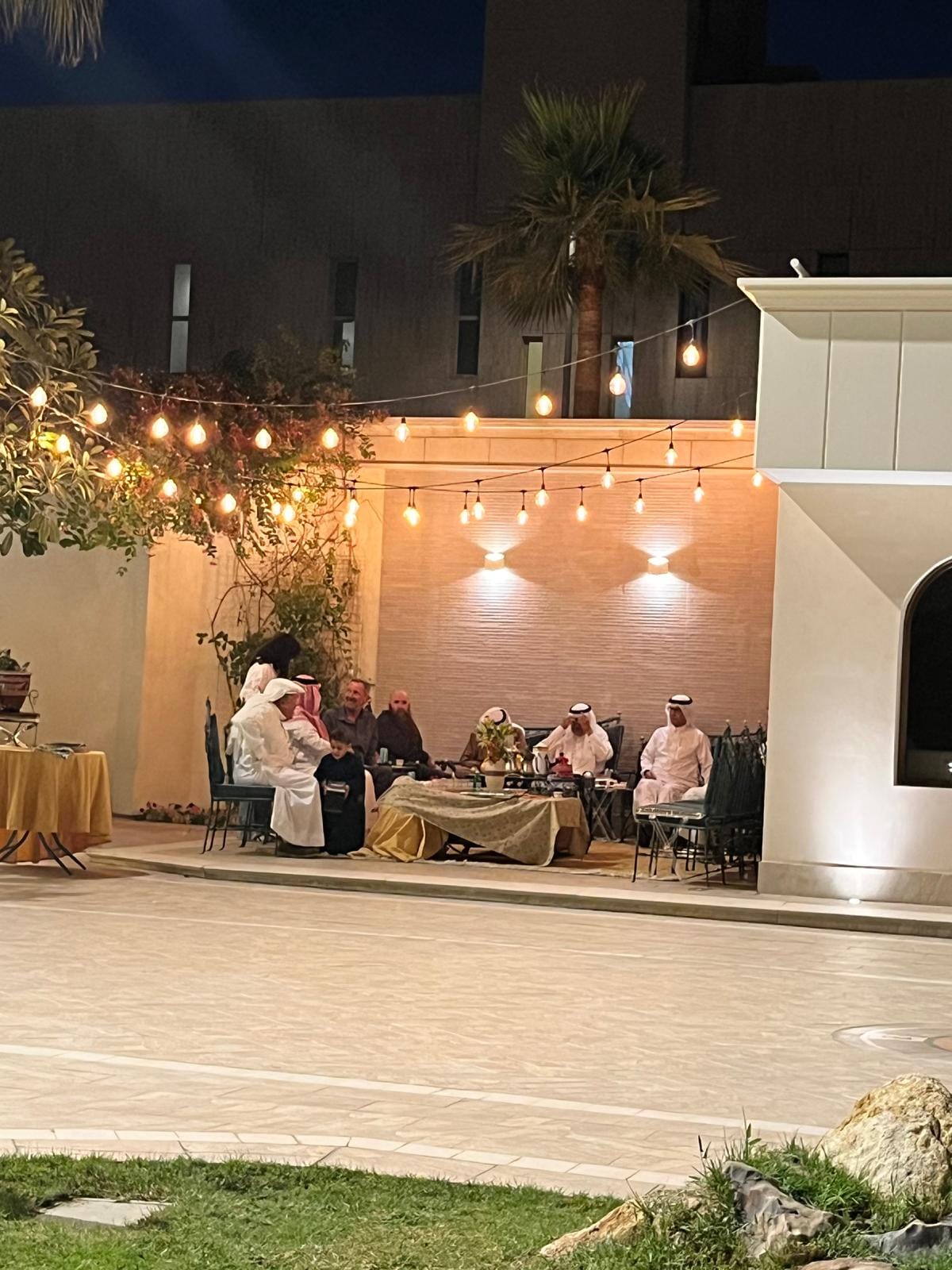
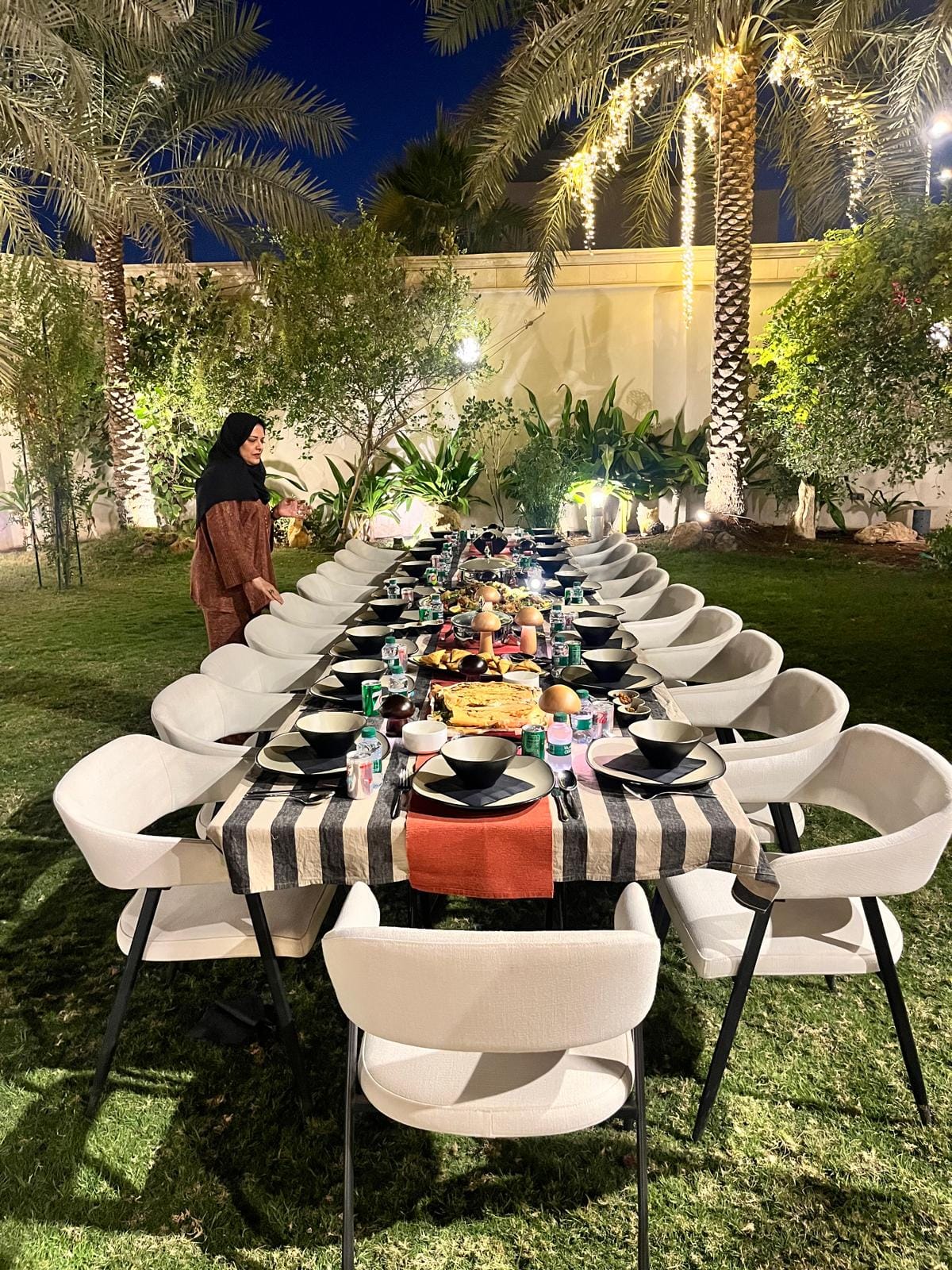
the gates of the compound: a home is demarcated less by the walls of a building than by the walls of a compound, which has, as this one, an outdoor area, sometimes trees and grass, and includes even several buildings, several different houses. These can, not here but they can, house different families who share the compound. In this case, the whole setup, including an opulently appointed interior space in a separate building, with a fireplace, was for gatherings; outside there was a barbeque, father Fahd complained that his son-in-law had stinted on the quality of the wood being burned; and on the grass area a long table was set for dinner.
intermission
enjoy Radu Lupu playing the same music I listened to while on hold trying to amend a travel insurance policy:
if it had been any other tune . . . In the event I had to congratulate the service rep's patience and calm in the absence of mine.
The upshot of this call:
THE PORTAL DOES NOT PERMIT HUMAN INTERVENTION
. . . THIS had been a theme of my antemeridian outputs, elicited by the input from McKenzie Wark:
Just checking in with what the business press is saying. This author lives in a delusional world where climate disruption isn't happening and a certain imperial-economic logic just unfolds forever. The whole thing is useful for insight into a certain powerful worldview.
regarding:

about which I said:
- the adoption, the delusion of, AI as economic driver ... only makes sense if it is the brain of the (market) brain.
- The brain that doesn't exist of a brain that doesn't exist.
- Or ... human agency over its own internal organisation deferred and projected onto one abstraction after another. At least AI does a better job of being a projection.
My overall position on AI is not critical but seeks to affirm in it what is positive, a positive ontology of perceptual immanence: that is, I ask the question What sort of perception is it?
This line of questioning led my earlier exchanges with an ongoing instance of the ChatGPT LLM (ongoing since it 'remembered' my inputs and its outputs and could build on them—according to the operating principle that it hook the customer) to lay some foundations for a concept of AI-Governmentality.
At root, or the grounds for this, and of the need for this concept, is the abrogation of human agency, which, in turn, derives from Hayek's post-war concern to arrogate governmentality, the onus of the organisation internal to human society, to a distributed form of power. Hayek identifies this distributed form of power with the market. Hence, we have the problem that the market does not exist except in these terms, that straddle both political philosophy and political economy.
We would sooner identify this distributed form of power with the network. And the ontological exception would again qualify the network, like the market, as what does not exist except in terms of political philosophy and political economy. Except that at this further level of abstraction we can begin to see what is axiomatic about the sort of political philosophy and political economy it is.
Hayek's market-brain—abrogating human agency—is extracted by its ideologues, Mirowski's thought collective, politically, philosophically and economically, that is in policies promoting and in legislation enabling, neoliberalism.
The distributed network-brain—abrogating human agency—does so from political, philosophical and economic policy-making and law-making, with the result that in general governmentality is de facto if not de jure by AI. Which is really a second-level neoliberalism.
The first projection of agency onto the market becomes the second projection of the market as it is reflected in the distribution of a market intelligence, that is AI. Meanwhile, the dilution of agency at the level of policy- and law-making leads to general political stupidity, where human agents abrogate responsibility either because they are evil or because they are stupid for social organisation. Hence, Venezuela. And, an ongoing and more general threat, who's next?
Forgoing human agency (to the extent that THE PORTAL DOES NOT PERMIT HUMAN INTERVENTION) is the general axiom at work in neoliberalism and the beast emerging from it.
The abrogation of human agency is axiomatic for neoliberalism and for our current emergency—the beast which is emerging from it
as per the link above, the full exchange, pursuing points taken from the preceding, between ChatGPT and me is here.
Dinner resumes
I had approached the evening with trepidation because the men would be separated from the women. When I found out Miles, another of Jo's colleagues, from Broken Hill, Australia, had too and for the same reason, I was reassured, since I have never been confident in social groups, my fear was not unfounded. Perhaps that is the Western oddity we carried into the evening, the discomfort of men around men: it's like a fear of being found out—a fear of being found out not to belong, so, a fear of rejection.
Jo must have felt entirely differently. Although I think she was more worried for me than herself. Still, I know she was a little fearful: what would it be like to be around a group exclusively of women? women from a culture alien because not understood? Fear perhaps rather of acceptance, of not being accepted or found acceptable, rather than rejection.
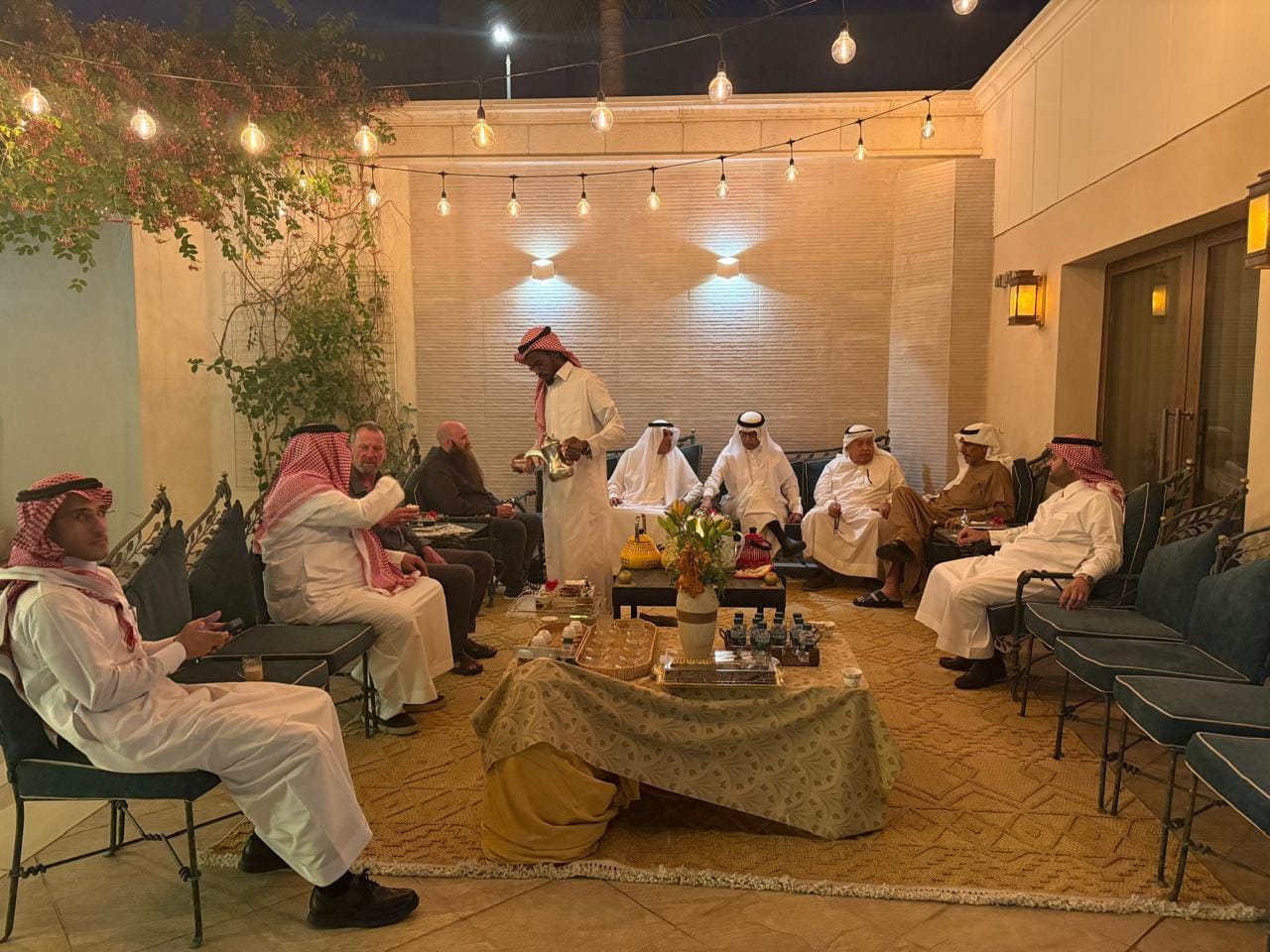
We came to the gate of the compound. Holly and Jo went straight into the adjacent door to the house. Miles and I were ushered, perhaps even by one of the staff, around the side of the house, of monumental scale, to the courtyard, where, on one side men in white thobes, Fahd being the exception in a fine dun brown one, with scarves Saudi red and white, all except Fahd, and on the other side a long table on the grass set for dinner.
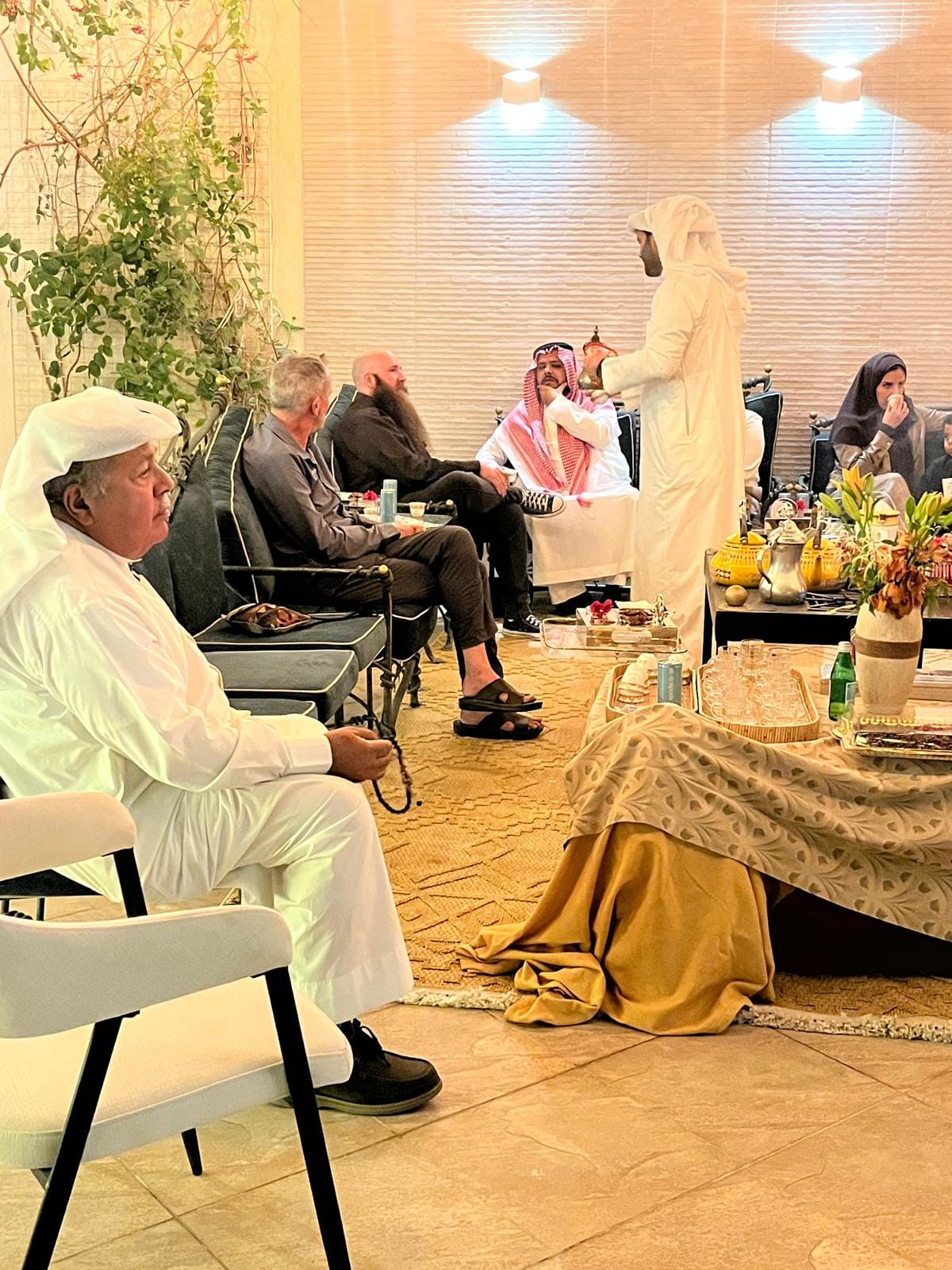
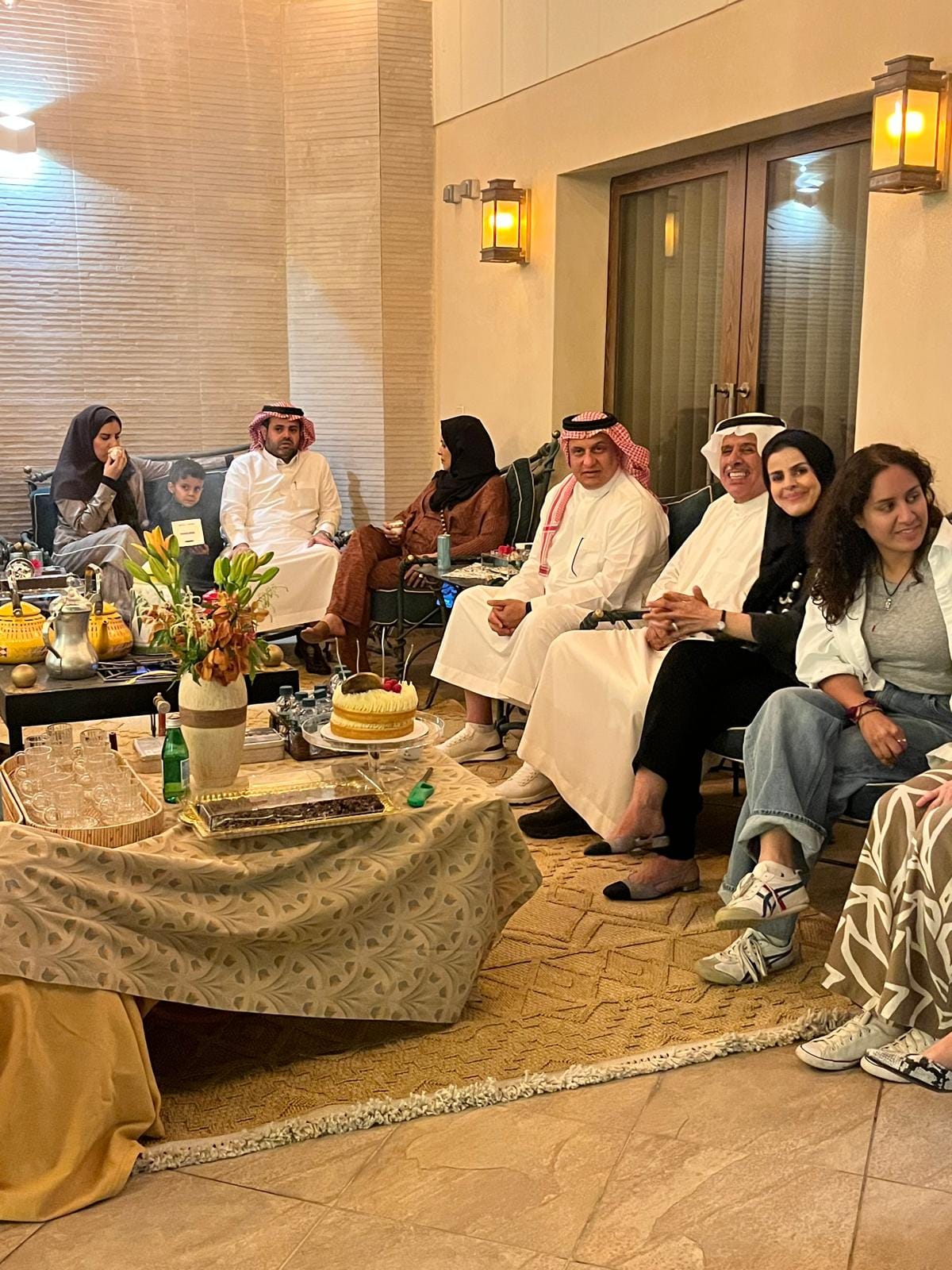
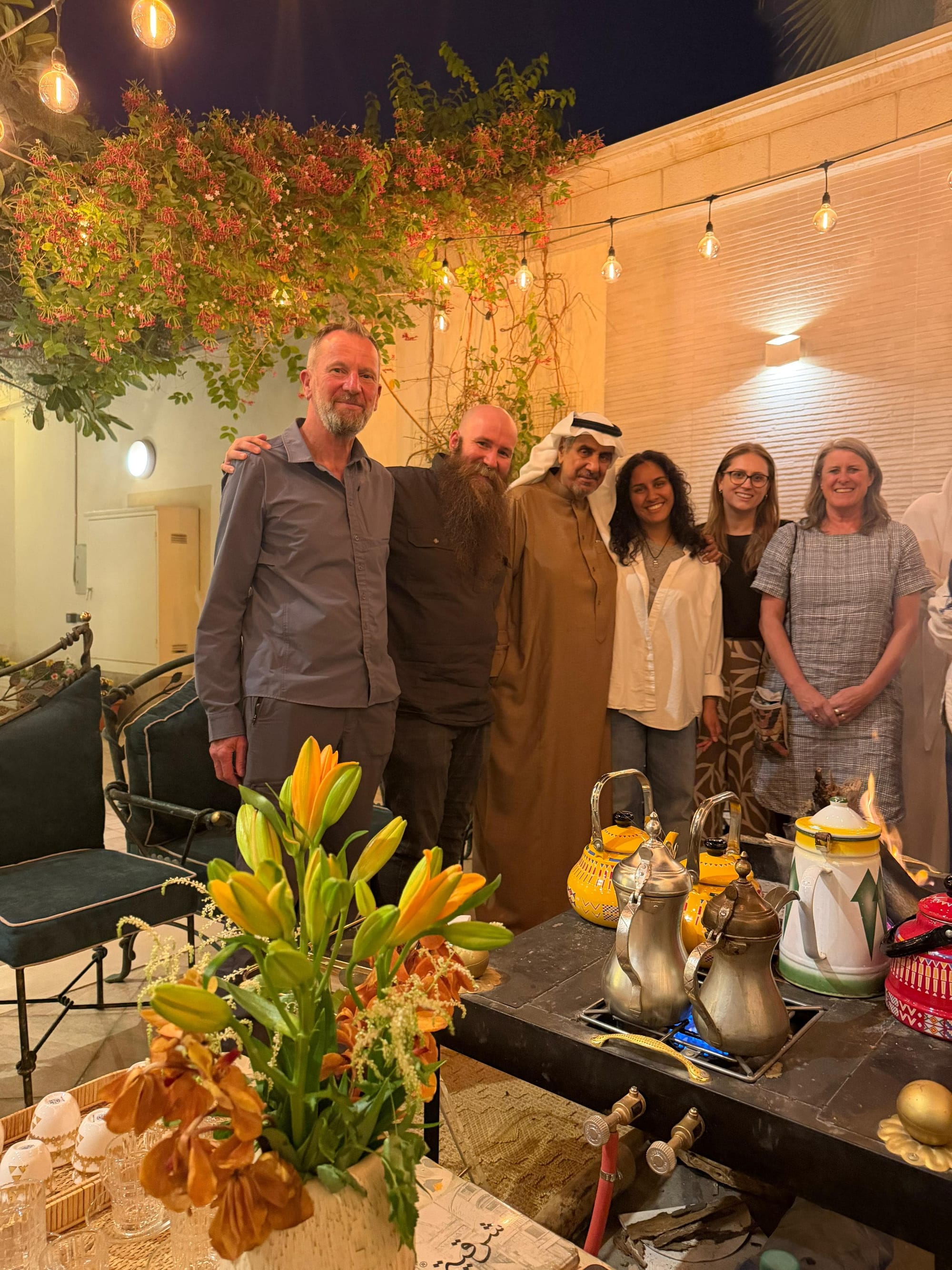
The men rose to welcome us, they were introduced in the traditional order, anticlockwise, from the right around to the left. This is when we were introduced to his Excellency the ex-Minister for Agriculture, an old friend of Fahd's. We were honoured guests. And a beautiful Arabic phrase welcoming us into their home was used. We were also told that the evening marked the engagement of a cousin, a young fine-featured man, whom we congratulated. There was a special cake at the end of the couches, arranged in a horseshoe around a low table with a grill for the fire, the poor-quality logs to fuel it underneath Fahd's son-in-law had stinted on, and Arabic coffee pots in a kind of battery, with dates in cut crystal bowls. We ate the cake, after coffee and dates, and before sitting down to dinner, chicken and rice the main dish.
You don't toast in the kingdom but observe with words of congratulation and praise major events like the engagement. It turned out we would be back in Saudi Arabia for the wedding. It also turned out we were invited. Where are you going to have your honeymoon? I asked.
New Zealand was on the list, answered the young affianced man, However we chose Peru.
Peru?!
Yes, we want to see Machu Picchu and go hiking.
That sounds like an active honeymoon! Somehow the image of a berobed couple of newly-weds hiking the mountains of Peru didn't fit; but then, Ahmed, who by default, since he was sitting next to me, had taken me under his wing, raved about camping, the national pastime of camping and hunting.
He had raised falcons as a boy. I think it's important for children to have a pet, he said. To foster a sense of responsibility? I said. Yes, but here in Saudi we don't have cats so much; we don't have animals in the home. I grew up with saluki, with which I hunted, and I trained my own falcons.
Do you have falcons now? I asked.
Yes. Fahd who had been listening in talked about a hunting reserve, a vast area not far from Riyadh repopulated with ibex, goats and foxes, which had attracted birds of every sort, for hunting, sustainably. Again, the misfit between the interests of a hunting culture supported by oil wealth and environmental sustainability, but then we knew this. The falconry exhibition I had been dragged to on my first day in the kingdom featured several exhibits devoted to tree-planting and greening the desert.
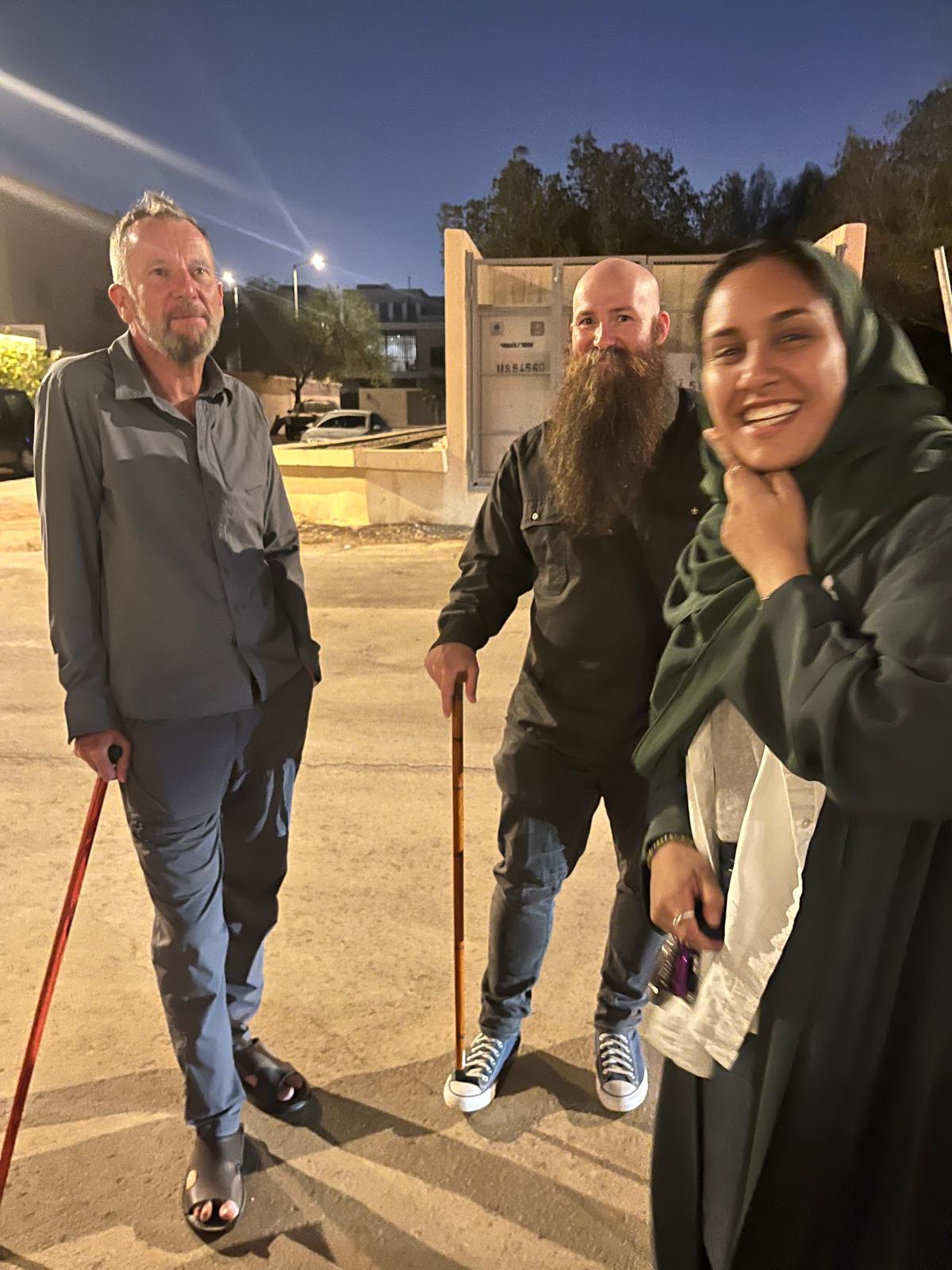
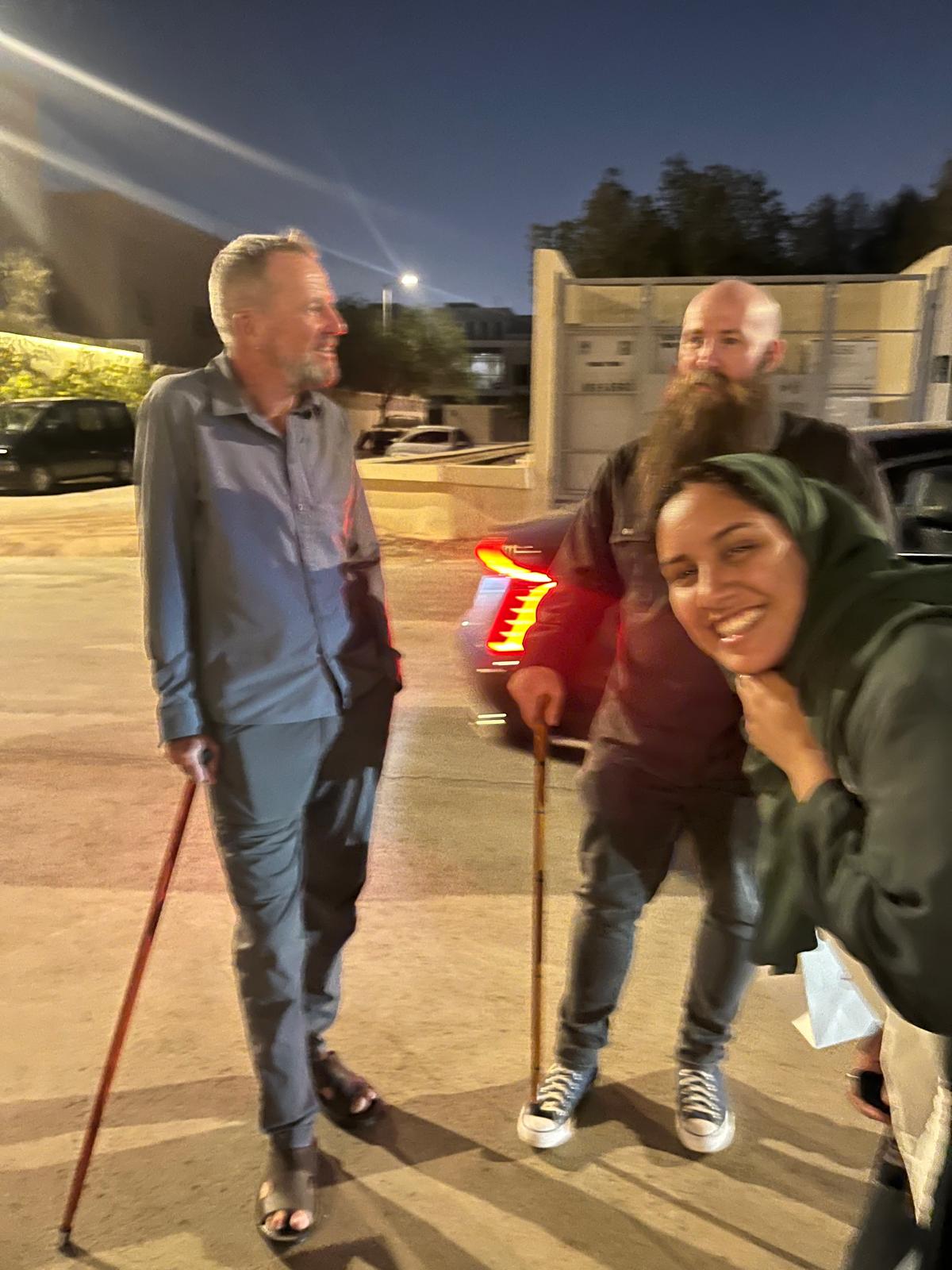
We were, Miles and I, the topic of interest, for our respective countries. The young man to be married had been to both New Zealand and Australia, so had his Excellency in his capacity as Minister for Agriculture. Questions were asked about bridging the North and South Islands and about indigenous peoples in both countries, how many are there? Miles said his mother was Aboriginal, so that he was too. Aboriginal people today don't look like you expect them to, he said. (You'll see from the photos below: Miles with his beard, a popular figure on the streets of Riyadh, men and boys often stopping him to shake hands, get a selfie with him. Allegedly he looks like a famous wrestler.)
Ahmed also invited us to go camping when we came back in 2026, which he does at any opportunity. How long for? I asked. Up to around 3 months.
In the desert?
Yes. We Saudis love the desert.
I had the picture of Ahmed, falcon on arm out the window, in a black four-wheel drive, a team of saluki hunting dogs ... Or was he on a camel? You know, said his Excellency, we have beauty contests for camels. Miles was asked to compare the camels of Australia with the camels of Saudi Arabia. They are Afghani was the consensus. A trade was suggested, camels from Oz to KSA, since in Oz they are a pest.
The conversation bubbled along. Our coffee shot cups were repeatedly filled—Saudi coffee looks barely roasted, however it is, barely, with spices, in particular cardamon. This, said Fahd, is the family blend. Each family has one. It was delicious. Some families add too much clove, he said. I didn't sleep at all that night.
We ate the cake. The cousin getting married seemed to disappear before dinner. It was hard to keep track of who was there, who had left, who had only just arrived, but the conversation bubbled along and at points it stopped. There was a silence. Fahd poked the fire. Nobody raced in to fill the gap. None of the men were discomfited. Despite my nerves, heightened by the coffee, this was the thing that struck me most about the evening with the men, before the women joined us, which was after we had eaten, when we retired back to couches around the fire and they ate the refreshed platters of food.
Not once, I thought afterwards, was I asked what I did. For a job. For money. For an anything.
Questions revolved around the film because this was the reason we had been invited in the first place: Fahd's daughter was working on it. Then, he said, My daughter and I talk about everything but not what she does for her job.
The men were relaxed. Reporting on it back in NZ, I said it was remarkable for an absolute absence of dick-swinging. There was no machismo, no competitive masculine posturing. And perhaps . . . the separation of the genders is the price: that it is at the expense of the women being kept inside or otherwise covered up, that the men can consort so comfortably with one another and are relaxed in one another's company. Then, on the streets, in the metro, in a carriage crowded almost to Tokyo levels, but only with men, I have witnessed just one mildly aggressive outburst, when in NZ . . . In NZ the aggression of the men and the passive aggression of the women is unavoidable, omnipresent.
Recently I saw another excellency, a Saudi prince offering a graduation speech at a university. You are welcome in Saudi Arabia, he said to the graduates. He didn't say they were welcome because they would increase the gross domestic product or add prestige to its institutions, but because Saudi Arabia aims to maintain the highest standards of civility. They would be welcome because they would contribute to the sum national total of civility, that is civilization.
Arabic: around the time his Excellency was thanking God for giving His last book to humanity in Arabic the discussion came to the language. English has a vocabulary of 500,000 to 600,000 words, Arabic 6 to 8 million. There are words for every hour of the day, not for the time but for the feeling. There are twelve words for lion. The men went around trying to list them all. An attacking lion. A relaxed lion. A regal lion. . .
There are words for doing different activities at different times of the day. There is a word for walking in the morning, a different word for walking at night. And a word for doing what we are now, having fun in the evening.
fishing: I said I thought the best fish were supposed to come from the Red Sea, Fahd begged to differ. No, the Gulf.
That's because you are biased! said his friend and Excellency. You are a Gulf Arab. And he turned to me and spoke of the virtues of diving in the Red Sea, an archipelago of islands which is an ocean reserve.
There was a pause. His Excellency was preparing his bon mot.
Some men are naughty when they are young. Later, they settle down.
Some men are good from an early age. Only in later life do they become naughty.
Some however are naughty all the way through! and that is Fahd, he said.
kissing: "Yes, we kiss. We men kiss in Saudi." The good doctor, his Excellency said. He had enjoyed a surreptitious vape back on the couch while the women ate and now he was leaving. He kissed Fahd on both cheeks, turning to us he said, "It doesn't mean we are queer."
"Like kissing a stone," said Fahd.
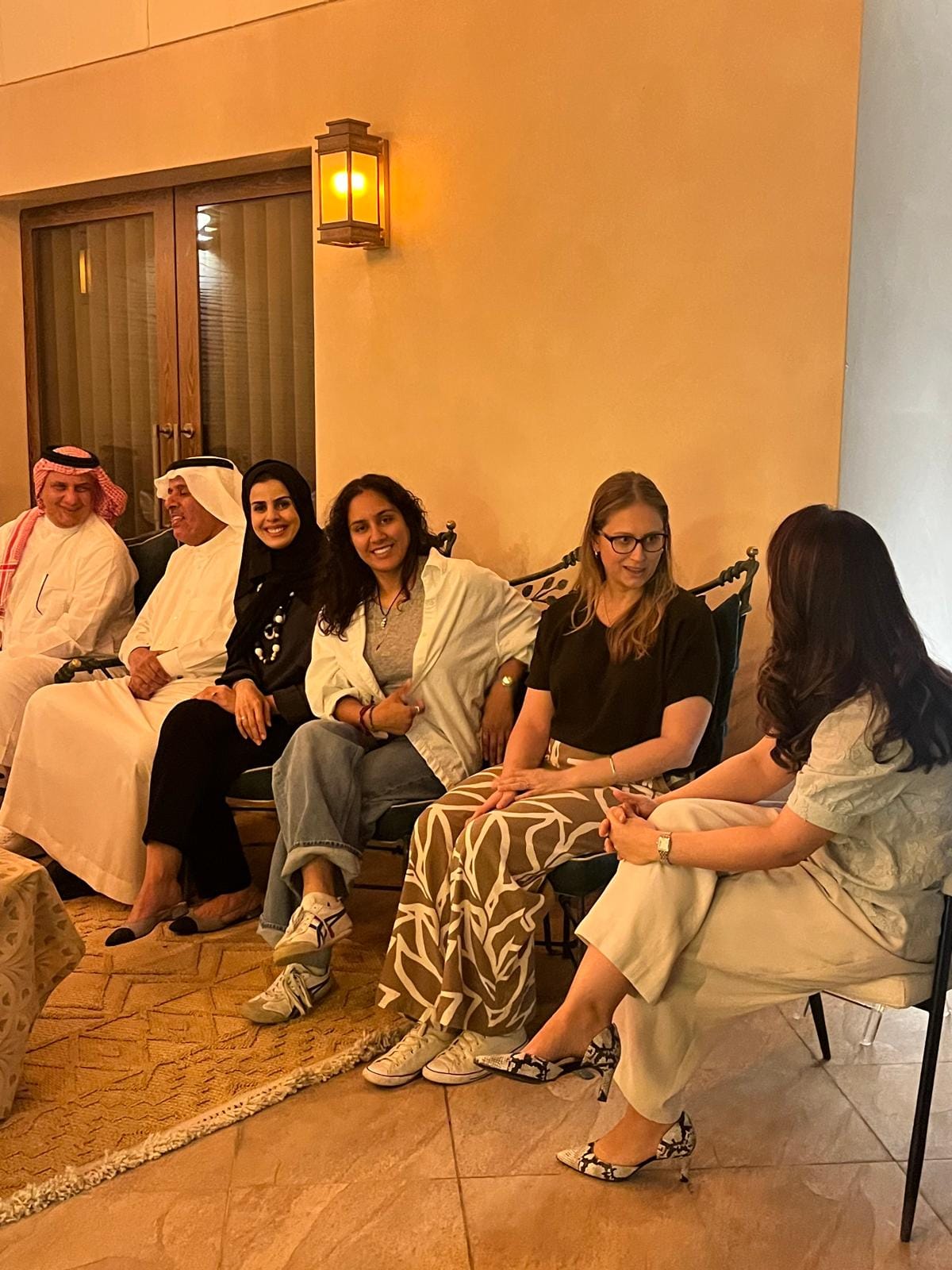
The women had finished dining. They joined us. As is traditional, the introductions proceeded from right to left. No one was left out.
I forgot to mention earlier that among the men when we entered were some boys of different ages. Among the women there was at least one high-school-age girl. No one was excluded from either the introductions or from the fun being had in the evening: not even the youngest children had to wait until they were spoken to to speak. Neither were they expected to sit still. Earlier on the youngest had been rolling all over the couch and the people on it.
There was no sudden fall in social temperature when the women and men mingled. It was as warm and as mellow and relaxed. Perhaps the only difference was that there were no longer any silences that might be filled or left unfilled.
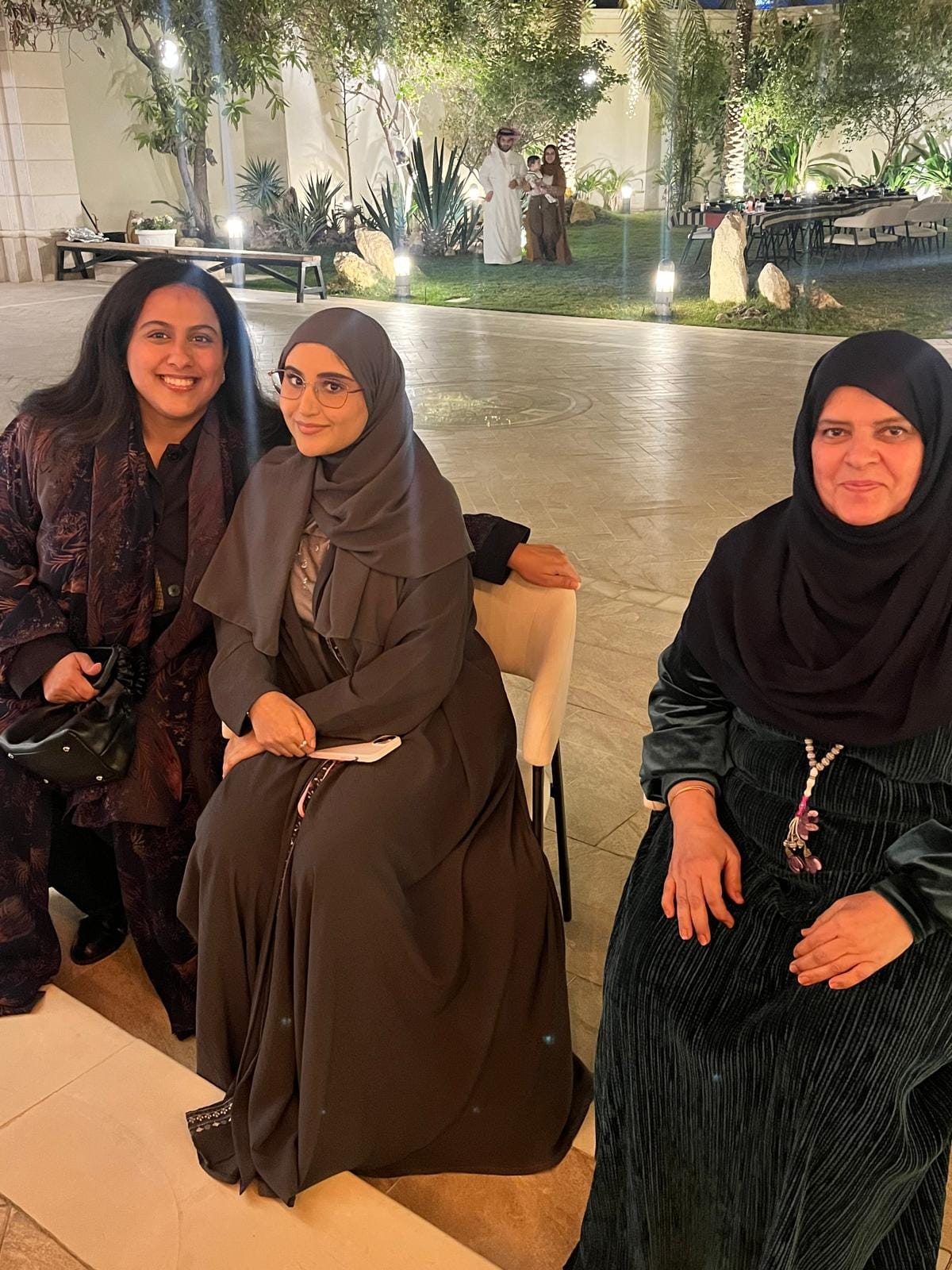
At the end of the evening Miles and I were shown through the house where the women had been while we'd enjoyed the warm outside air, added to by the delicious warmth of the fire. Jo said on one occasion Fahd had come in and all the women in the room had quickly reached for their scarves. He himself was wearing a finely textured scarf of the most beautiful colour.
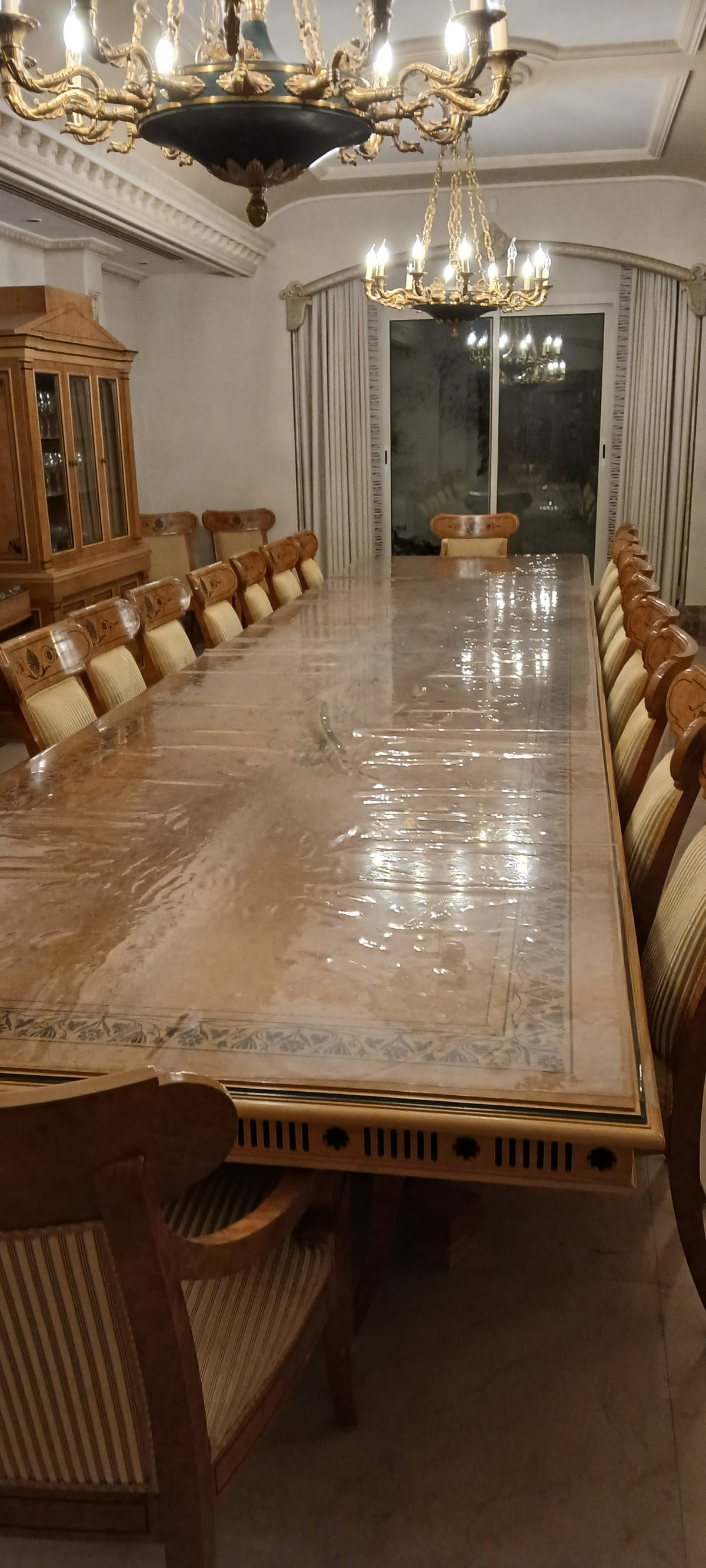
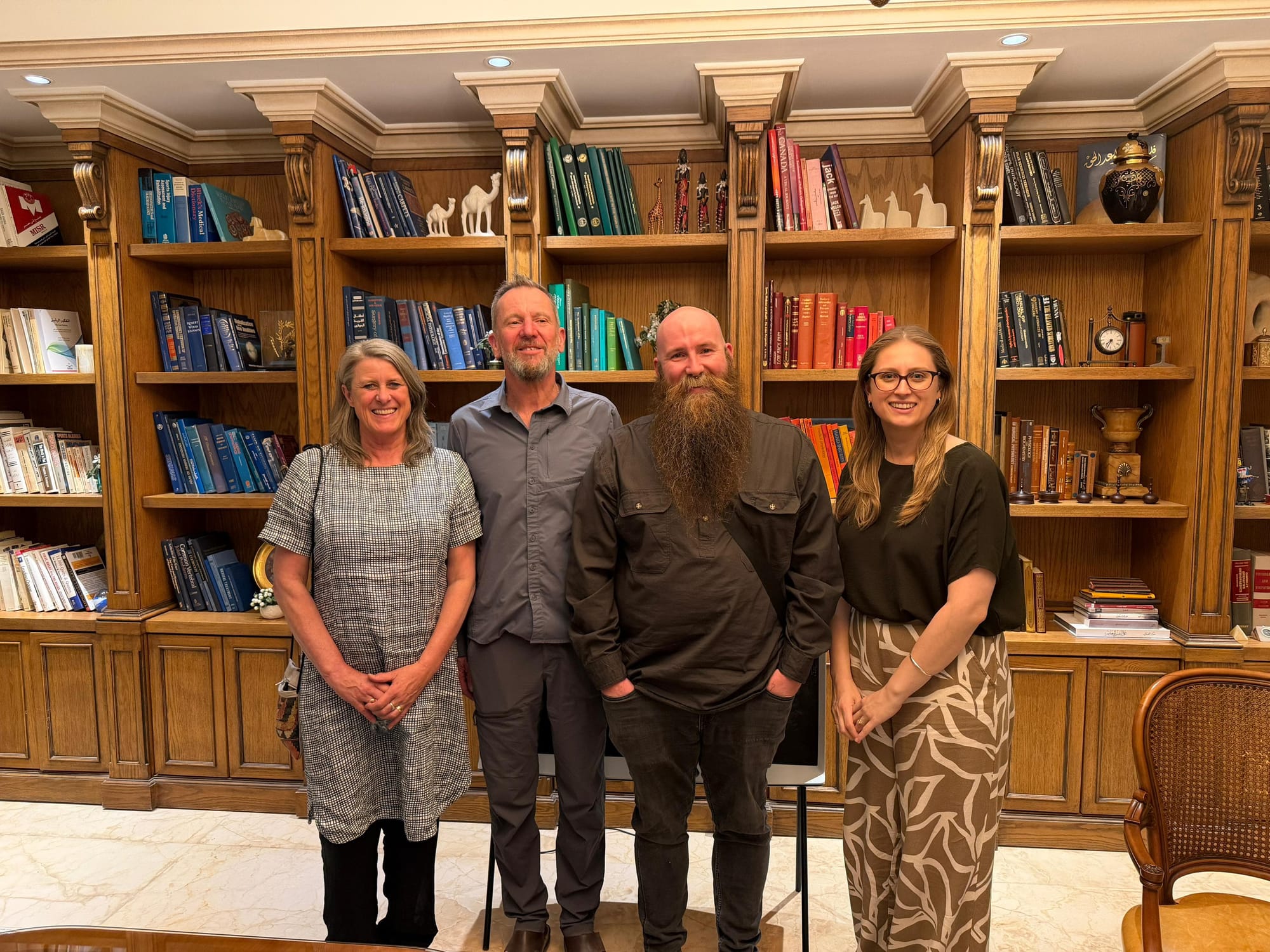
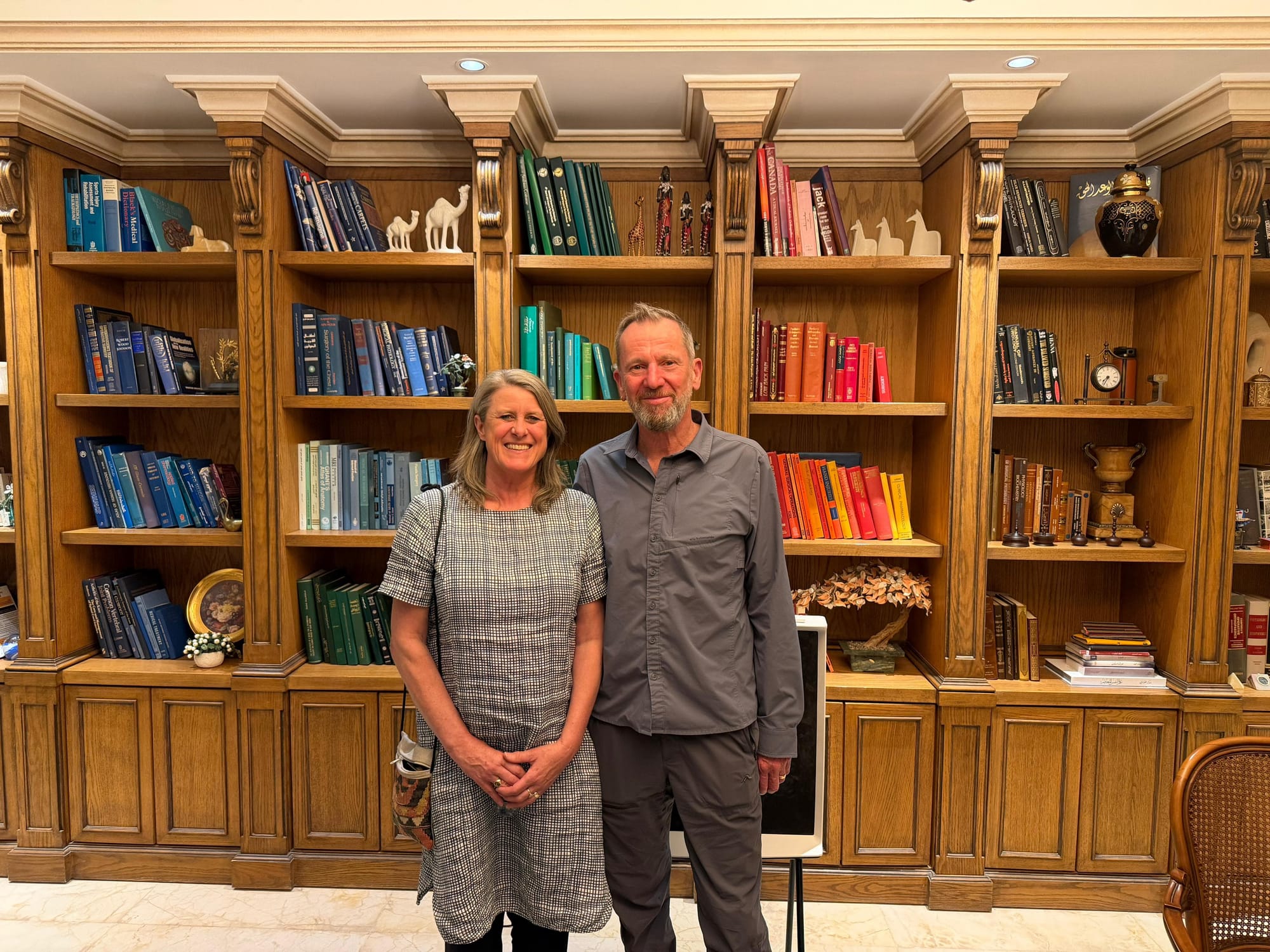
The photo which heads this post is the only one I took, the dining room of a house appointed to host large family occasions. This had not been the room where the women had spent the first part of the evening, that one was a living room with the finest bespoke rugs, the wool from Portugal, commissioned from the best factories in China by the hostess. And monumental marble furniture. A table it had taken ten men to lift.
When they had it in position, I said, did you say ... just a fraction to the left. ... no, wait, back a bit ...
The hostess laughed. One room had extraordinary wallpaper, storks against a background of gold. From England. She had seen it in a magazine and ordered it. The prevailing colours of the decor were beiges, through dun and sandy brown, white, marble white and black. It was opulent but also reserved, calm, like even the largest gathering on the streets of Riyadh, despite the chaos.
The hostess's mother had spoken to Jo about our preconceptions coming to Saudi Arabia, about the picture we might have formed in our minds of what it was going to be like. Was it as we had been given to believe?
She was fully aware, and so were they all, of the picture of Saudi Arabia presented to the West. The deeper unspoken question was whether we'd been poisoned against Saudi Arabia. While you cannot deny that that picture is there, neither can you deny that people are just people. They are the same wherever you go. They are just living their lives. They want to be well thought of, Jo said.
The hostess's mother brought up Russia for comparison. She loved Russia, was going back soon for a holiday. It wasn't at all what she had been led to expect, that you couldn't walk out on the streets, that it was dirty and dangerous. It was clean. It was beautiful. She hadn't even seen a single drunken person.
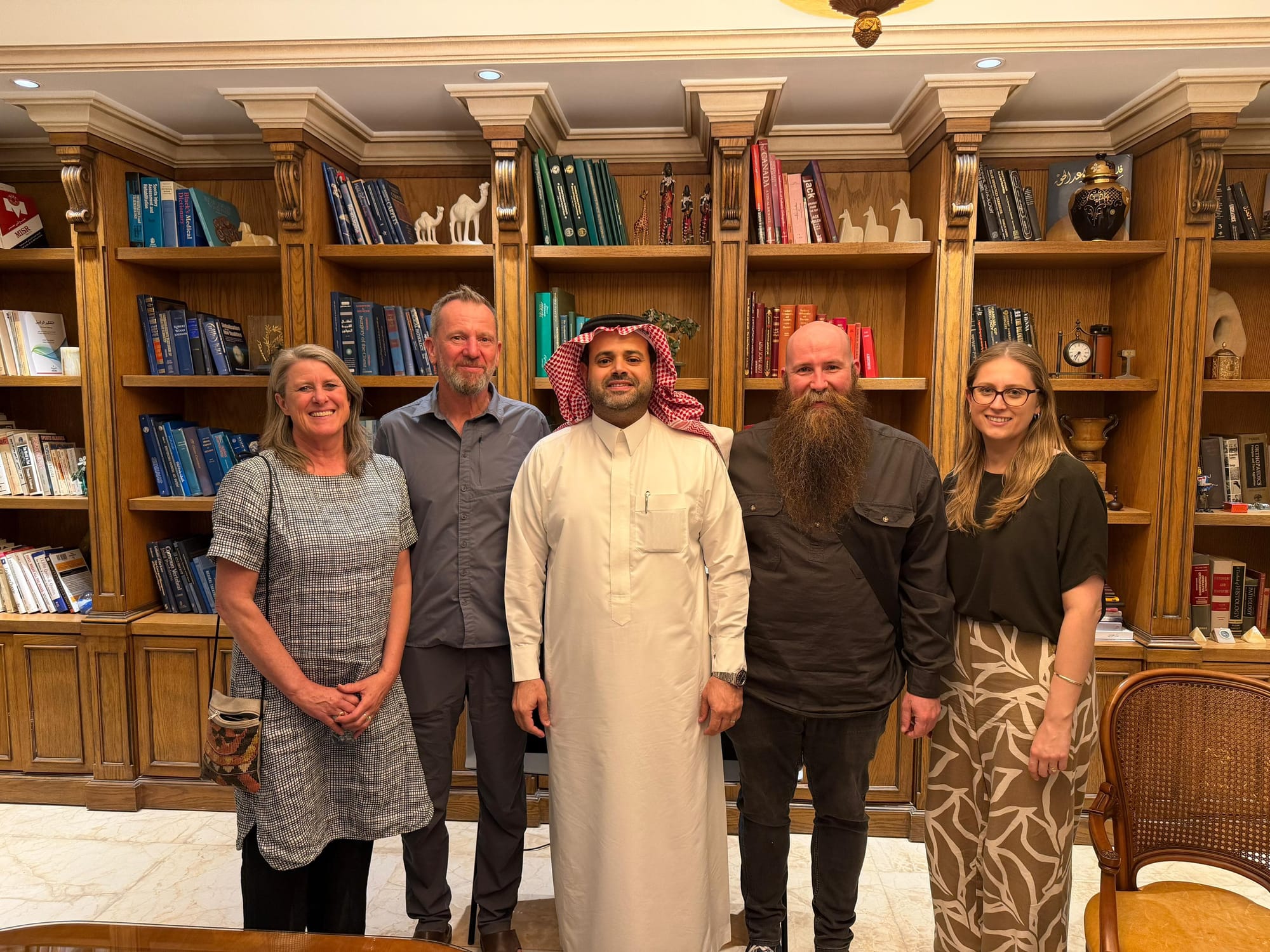
The final room we were shown in the house, where our pictures were taken before we left, was our host's office-library. He had kept the library of the former occupant, a doctor. The books were in English, anatomical and medical treatises, I checked. There was also an extensive collection of die-cast toy and model cars on the shelves, among which I recognised several I'd had as a child.
Photos were taken. Much laughter and bonhomie. And the host presented Miles and me with a walking cane.
I collect them, he said. Whenever I travel, for example, Spain, I pick up a walking-stick.
What are they for?
Playing, he said striking an attitude, then using one as a sword. I like to give them as gifts to my visitors.
These are the canes you see Miles and I playing with below.
further to the above embedded links, an historical account of how vocalization systems emerge after the Greek alphabet’s invention of explicit vowel letters and THE PORTAL DOES NOT PERMIT HUMAN INTERVENTION 5.01.2026, see also THEAUTHORITY.
This series culminates with the consideration of a properly political attribute of perception in the resource What is Political Perception: The Hard Problem of Human Social Organisation.
for the comments on civility see HRH Prince Abdulaziz bin Salman at KAUST Commencement