Body Politic to Machine to Blob Politic: an historical account of computational governmentality, AI & contemporary republican* expansionism†
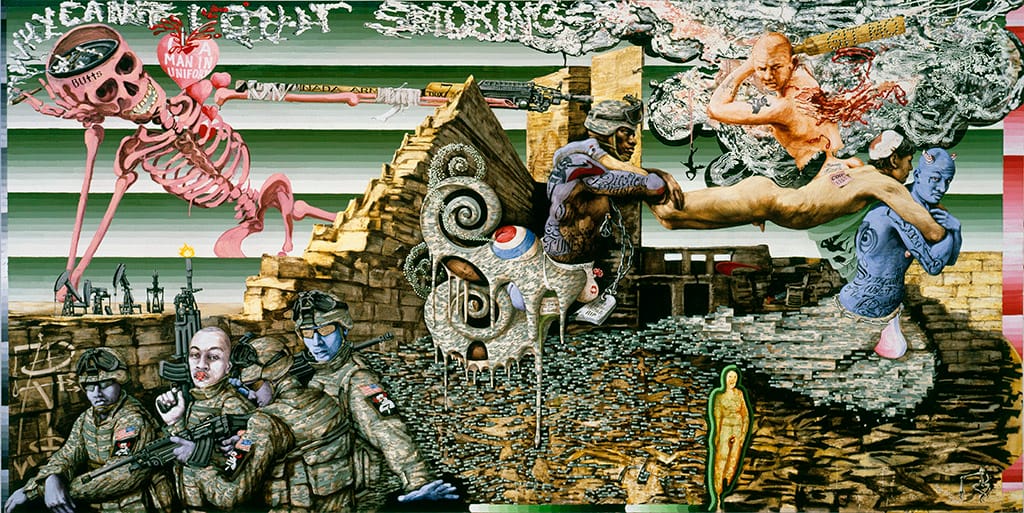
*(not imperial)
†(in the present, 4 March 2026: Iran)
I. Classical Geometric Order
c. 5th century BCE–late antiquity
Key shift: Movement subordinated to geometry.
- Plato — ideal forms as spatial intelligibility
- Aristotle — ordered cosmos; teleological motion
- Euclidean geometry formalises space as stable structure
- Polis as body politic: centred, proportioned, bounded
Power is embodied yet conceptually spatialised; geometry provides the language of order.
II. Medieval Corporate Body
c. 5th–15th centuries
Key shift: Sovereignty as theological geometry.
- Thomas Aquinas — hierarchy as divine order
- Corporate personality of Church and Crown
- Territory mapped symbolically, not yet statistically
Vertical spatial order persists; calculation exists but is not yet a governing principle.
III. Early Modern Sovereignty and Survey
c. 15th–17th centuries
Key shift: Territory becomes measurable.
- Renaissance cartography and cadastral mapping
- Standing armies and fiscal administration
- Descartes — analytic geometry
- Newton & Leibniz — calculus
Motion becomes mathematically expressible; change becomes differential; the state begins to model society as a measurable process.
IV. Statistics and Population
c. 17th–18th centuries
Key shift: Emergence of political arithmetic.
- Census practices
- Probability theory (Pascal, Bernoulli)
- Early demography
Individuals correspond to integers; governance begins to manage life, not only territory.
V. Liberal Political Economy
late 18th–19th centuries
Key shift: Market as self-regulating system.
- Adam Smith — invisible hand
- David Ricardo — formalisation of economic relations
- Industrial mechanisation
Market order appears immanent; coordination without central sovereign; differential logic migrates into economic modelling.
VI. Bureaucratic Rationalisation
late 19th–early 20th centuries
Key shift: Administrative state.
- Max Weber — rational-legal authority
- Expansion of census, actuarial science
- Taylorism and scientific management
Human conduct becomes an optimisable process.
VII. Ordoliberalism, Neoliberalism, and Mirowski’s Insight
1930s–1980s
Key shift: Market logic as constitutional principle; economic computation as metaphor for governance.
- Walter Eucken — ordoliberal framework
- Friedrich Hayek — market as information processor
- Milton Friedman — monetarism
- Cybernetics (Norbert Wiener), systems theory, game theory
- Mirowski — insight into the convergence of neoliberalism and mechanistic/machine thinking; markets as computation infrastructures
The economy becomes a computational metaphor; competition becomes signal-processing; the distinction between economic and technical systems begins to blur.
VIII. Digital Computation and Early Algorithmic Governance
mid-20th century onward
Key shift: Automation of calculation.
- Stored-program computers, networked systems
- Financial algorithmics
- Real-time modelling of markets and governance
Computational infrastructures begin to internalise sovereign functions; the machine politic amplifies human administrative and market capacity.
IX. Platform Capitalism and AI Integration
2000s
Key shift: Continuous modulation of governance and markets.
- Predictive analytics and reinforcement learning
- Automated decision systems
- Language and human behaviour as calculable input/output
AI appears as autovocal machine of governance; self-adjusting, self-articulating, accelerating the tempo of sovereign action.
X. Peak Neoliberal Machinic Marketism
1990s–2010s
Key shift: Apparent abrogation of social ordering to distributed market computation.
- Global financialisation, algorithmic trading, platform capitalism
- Governance through metrics, ratings, risk scores
Markets and computation appear autonomous; state becomes facilitator rather than actor; sovereignty seems dispersed.
XI. Algorithmic Infrastructure as Strategic Substrate
2010s–early 2020s
Key shift: Markets as computational infrastructures with geopolitical leverage.
- Cloud concentration and platform monopolies
- Data as strategic asset
- AI integration into finance, logistics, and intelligence
Decentralised networks reveal material centralisation; same systems optimising commerce now accelerate strategic power; map collapses onto terrain.
XII. Republican Expansionism Engineered Through Machinic Systems
mid-2020s–present
Key shift: Sovereign assertion accelerated through computational platforms.
- National security integrates platform infrastructures
- AI compresses the decision loop; military predictive analytics accelerate kill chains
Neoliberalism’s decentralisation is repurposed: markets enable rapid territorial assertion, framed as republican expansionism.
The same computational infrastructures that dispersed economic power now amplify sovereign capacity at speed.
Structural Continuity Across History:
- Geometry → Calculus → Statistics → Markets → Computation → AI
- Peak neoliberalism: market seemed final; computation and AI reintroduce sovereign velocity
- Autovocity of AI becomes temporal amplifier, not replacement, of the state
– see also as the basis for this approach and for the autovocity attributed to AI an historical account of how vocalization systems emerge after the Greek alphabet’s invention of explicit vowel letters, note it is also only one cultural trajectory