What is Political Perception: The Hard Problem of Human Social Organisation
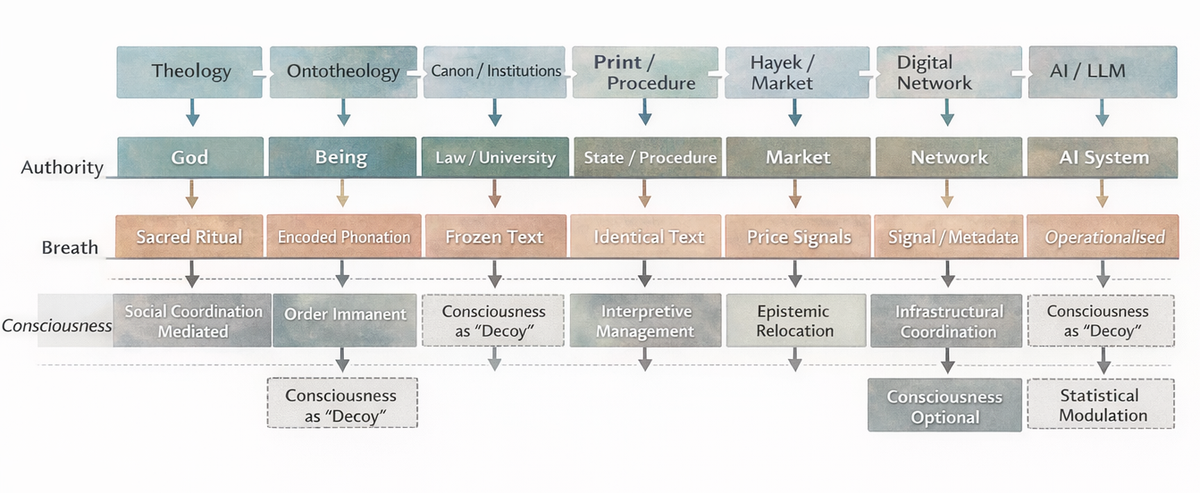
this is a text prepared with ChatGPT and with some input from GLM-4.7. The formula, human social organisation, is taken from Eugene Holland's A Reader's Guide to Deleuze and Guattari's A Thousand Plateaus. I pointed out in one prompt (there were many to arrive at the following text) that the history offered schematically here is really that of a poorly formulated problem. This is an attempt to formulate the problem well, asking, What is political perception?
An understanding of the rise of the written text, through symbols showing the passage of breath which give dead text the true power and authority of speech by incorporating what hereunder is simply termed breath, up to the animation of texts, quite literal in this case, is integral to the following. These resources are at:
- an historical account of how vocalization systems emerge after the Greek alphabet’s invention of explicit vowel letters
- THE PORTAL DOES NOT PERMIT HUMAN INTERVENTION 5.01.2026
- THEAUTHORITY, the context given for these at مدرسة
If you have questions about the way LLMs have been used, or any questions whatsoever, please do not hesitate to contact me by email here.
I. The Primary Problem: Human Social Organisation
The oldest and most persistent difficulty is not consciousness but social organisation: how bodies coordinate, remember, transmit norms, allocate resources, exercise authority, manage conflict, care, exclude, and obey. This difficulty is materially grounded, energetically costly, and irreducible to cognition alone.
For most of human history, it is addressed directly—through ritual, kinship, custom, violence, and law. Authority is visible, located, and contestable, even when coercive. There is no assumption that coordination can be fully delegated elsewhere.
Consciousness, language, and imagination arise within this field as adaptive capacities. The enlargement of the human brain—across roughly 2 million to 200,000 years BP—tracks increasing pressures of social density, coalition management, norm enforcement, and reputational memory. Thought is not prior to social organisation; it is one of its evolutionary costs.
Only later does consciousness become detachable as an object of theory. At that point, the difficulty of coordination is increasingly reformulated as a problem of cognition.
II. Theology and Early Inscription
c. 3200–800 BCE
Historical indices
- Sumerian cuneiform and Egyptian hieroglyphs: c. 3200 BCE
- Proto-Sinaitic: c. 1800–1500 BCE
- Phoenician alphabet: c. 1200–1050 BCE
Problem-location
Social organisation under conditions of scarcity, uncertainty, and violence.
Solution
Stabilise coordination by anchoring authority in a transcendent order—divine law, cosmic measure, ancestral mandate.
Inscription and breath
Writing is administrative and cultic. Texts do not speak on their own; they require trained voicing. Authority resides in the controlled animation of inscription by priestly bodies.
Consciousness
Not yet problematised. Embedded in ritual, myth, and collective practice.
The difficulty of social organisation is symbolically mediated, not displaced. Transcendence concentrates and legitimises authority.
III. Ontotheology and the Alphabet
c. 800–300 BCE
Historical indices
- Greek vowel notation stabilises: c. 800–700 BCE
- Public law codes: Draco (621 BCE), Solon (594 BCE)
- Athenian democracy: c. 508–322 BCE
- Plato and Aristotle: 4th century BCE
Problem-location
How to stabilise coordination without continuous ritual mediation.
Solution
Identify order with Being itself—logos, physis, reason.
Inscription and breath
Alphabetic writing encodes phonation. Breath becomes legible, repeatable, and abstractable from the body.
Consciousness
Recast as access to rational structure. Still social, but increasingly theorised as a faculty rather than a practice.
The problem of social organisation is partially relocated into ontology. Order appears increasingly immanent to reality rather than continuously produced by collective action.
IV. Vocalisation, Canon, and Institutional Authority
c. 400–1200 CE
Historical indices
- Masoretic vocalisation of Hebrew: c. 600–1000 CE
- Arabic diacritics standardised: 7th–9th centuries
- Latin punctuation: 7th–12th centuries
- Universities: Bologna (c. 1088), Paris (c. 1150)
Problem-location
How to maintain doctrinal and legal coherence across dispersed populations.
Solution
Fix meaning through authorised textual regimes.
Inscription and breath
Breath is frozen into marks. Correct reading is prescribed; variance is regulated. Interpretation becomes institutional competence.
Consciousness
Becomes juridical and moral: the subject as bearer of obligation, responsibility, and guilt.
The problem of social organisation is managed through interpretation. Authority persists, increasingly exercised through control of semantic legitimacy.
V. Print, State Formation, and Bureaucracy
c. 1450–1800
Historical indices
- Gutenberg press: c. 1450
- Protestant Reformation: 1517 onward
- Scientific Revolution: c. 1550–1700
- Consolidation of nation-states: 16th–18th centuries
Problem-location
How to govern large populations without continuous personal authority.
Solution
Standardisation: law, language, procedure, documentation.
Inscription and breath
Texts become identical across space. Authority rests on fixity, replicability, and circulation.
Consciousness
Interiorised as individual belief and responsibility, enclosed within bureaucratic forms.
Here, authority shifts from persons to procedures. The social difficulty is administered, not displaced or resolved.
VI. Hayek and the Epistemological Relocation
1930s–1950s
Historical indices
- Hayek, The Use of Knowledge in Society: 1945
- Mont Pèlerin Society founded: 1947
Problem-location
How to coordinate complex societies without central political decision.
Solution
Recast the difficulty as epistemological: no agent or institution can know enough to organise society deliberately.
Market as epistemic mechanism
Price signals distribute information in place of deliberation.
Consciousness
Local, tacit, and context-bound—politically unreliable.
Human agency is not denied, but declared insufficient. Authority migrates from decision to mechanism.
VII. Neoliberal Consolidation
1950s–1980s
Historical indices
- Expansion of neoliberal policy regimes: 1970s–80s
- Collapse of Keynesian consensus: 1970s stagflation
Problem-location
How to govern while disclaiming responsibility for outcomes.
Solution
Naturalise the market as cognitive order. Intervention becomes distortion.
Consciousness
Reframed as bias, error, or friction.
Agency is juridically narrowed, not entirely evacuated.
VIII. Digital Networks and Perceptual Authority
1945–2010
Historical indices
- ASCII: 1963
- ARPANET: 1969
- Personal computing: 1970s–80s
- World Wide Web: 1991
- PageRank: 1998
- Platform ecosystems: 2004–2010
Problem-location
How to manage scale, complexity, and speed.
Solution
Connectivity, feedback, ranking, optimisation.
Inscription and breath
Breath becomes signal: metadata, traffic, latency.
Consciousness
Increasingly bypassed in operational loops.
Authority is embedded in infrastructural perception, not doctrine alone.
IX. Consciousness as Philosophical Decoy
1970s–1990s
Historical indices
- Nagel, What Is It Like to Be a Bat?: 1974
- Chalmers, Facing Up to the Problem of Consciousness: 1995
Cognition is formalised. Consciousness is isolated as irreducible interiority.
This does not replace the social difficulty. It functions as a decoy: the intractable remainder of social coordination is absorbed into abstraction, leaving authority arrangements intact.
X. LLMs and Ontotechnology
2017–present
Historical indices
- Transformer architecture: 2017
- GPT-2: 2019
- GPT-3: 2020
- Large-scale deployment: 2023–
Problem-location
How to modulate environments of meaning without reopening questions of agency or authority.
Solution
Automate perception itself.
Inscription and breath
Breath is operationalised—internal to the system, statistical, non-vital.
Consciousness
Circumvented, neither explained nor replaced.
This is AI-governmentality: governance through machinic perception. Human agency persists phenomenologically, but is structurally constrained. Intervention is excluded in advance.
It is not final. It is not absolute. It is the most recent and refined relocation of authority in a long historical sequence.
XI. Integrated Diagnosis (Non-Eschatological, Problem Recast)
Across this history, the difficulty of human social organisation is repeatedly repositioned, not abolished:
- sanctified in gods,
- naturalised in being,
- stabilised in law,
- externalised to markets,
- operationalised in networks,
- embedded in machinic perception.
Each relocation redistributes authority and reduces some pressures while generating others. None abolish the difficulty.
At several points, most decisively in the twentieth century, the difficulty is misposed as a different kind of problem:
- as epistemological: no one can know enough to govern,
- as cognitive: bias, error, or limited rationality,
- as metaphysical: the irreducibility of consciousness.
The “hard problem of consciousness” functions as a decoy—absorbing the prestige of the unresolved difficulty of coordination while leaving authority intact.
AI-governmentality does not introduce a new difficulty. It marks a further relocation into perception itself: modulation replaces deliberation, and authority operates below visibility.
see also: what percentage is mine what percentage the LLM's?