⑨ some lines from Contingency & Representation ⑧, before Memory ⑩
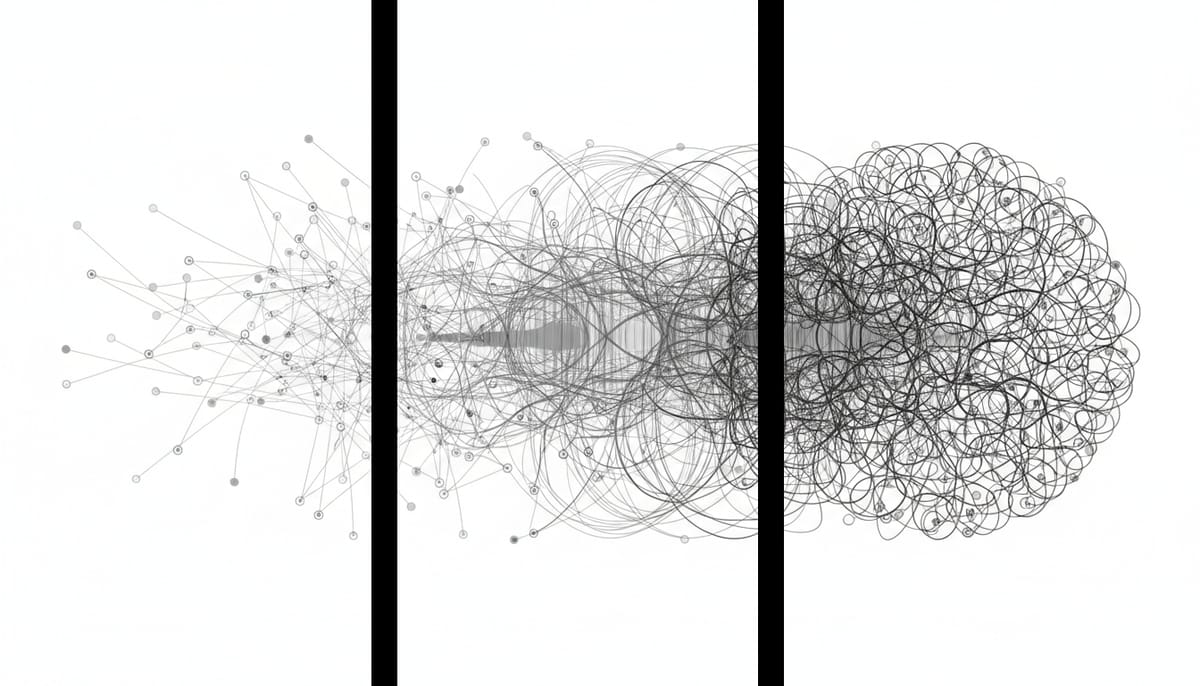
In taking up some lines from ⑧, before ⑩, the current post assays brevity, as Dorothy Parker says the soul of lingerie, so is more in keeping with the format of a Digest as I describe it here, where there is an email link, which, just as I encourage you to subscribe to outsidelight, I encourage you to use if you have any questions, suggestions or requests.
*note on writing
Not all writing systems are phonetic, but usually include sound in their field of reference. Chinese characters, for example, include both a sound component and a graphic component, the weight of 象 can be placed either on the sound, in conventional transliteration xiàng, or on the image. Either one makes a detour before its arrival at a meaning. The graphic component of 象, says Han Fei (although I am indebted for this insight to Dr. Chen who is also a founding member of Minus Theatre), goes by its depiction of a little elephant's skeleton. Han Fei relates that, elephants being rare in China, people could only imagine how one looked from its bones. The character has a sound and a meaning and a story or theory, since 象 is a central concept in art education, for how its meaning came about—representation. It has also a symbolic value that is the complete opposite to that inferred from the Western concept of representation, of being wise and strong, from the image of an elephant, and, from the bones, of being a lucky and beneficial creative process. It is this inference I invoke with the name of the company I established to bring company to market (follow the link to see a visualisation), a social medium built on the bones of a generative graph.
Ⓐ LINES
The arguments of Zeno of Elea have no other origin than this illusion. They all consist in making time and movement coincide with the line which underlies them, in attributing to them the same subdivisions as to the line, in short, in treating them like that line.
–Bergson, Matter and Memory, 78–79
Time is linear. Time is so linear the exception is that certain works of art are called for the reason they take liberties, either successfully or not, nonlinear. Time wasn't always linear. For a beautiful refutation, see here. At the time of the Eleatic School, represented by Zeno, the argument must have been fresh. Then there is the messianic time of Benjamin: The future is wedged open, like a window but more like a door, only a crack.
His On the Concept of History, 1940 (truer to the original title, Über den Begriff der Geschichte, than the better known Theses on ...), puts the burden of history, too great to be put down, as having everything to do with its linear progression. It is a hoard of rubbish, accumulated, as Adorno might have put it, barbarism by barbarism. For Benjamin, out of relentless and unremitting conformism. The want-to-stay rubbish of rubbish. The wanting-to-stay shit of our contemporary Doctorow's enshittification, put down to linear algorithmic development under decree of platform politics.
We are in Zeno's paradox space, leading Russell to deny the paradox (Enduring Dreams, work which is incomplete; let me know if you wish to read more), step by step, our progress coincident with an extended point. Kundera has called it The Grand March. Part Six of The Unbearable Lightness of Being, 1984, in Heim's translation:
When Stalin's son ran up to the electrified wire and hurled his body at it, the fence was like the pan of a scales sticking pitifully up in the air, lifted by the infinite lightness of a world that has lost its dimensions. (129)
It has for Kundera lost all its dimensions but that of time, and time, Kundera suggests, slides under things or over things. Borges, in a crime story, speculates on the ideal labyrinth being a single straight line which is invisible and everlasting. In the same story he invokes Zeno's infinitely divisible line and this is proposed as the alternative. About it Deleuze writes, "it is as though [time] had unrolled, straightened itself and assumed [this] ultimate shape." (129) He identifies it both with the empty form of time and with time out of joint. Empty? it has, he says, been emptied of memory. Out of joint is clearly Hamlet's phrase, but when is it? when is it that time has unrolled, straightened itself, assumed the ideal form of a labyrinth, which is, we should remind ourselves, a prison, and yet lost all its memories, and, we should also recall, being a door that has come off its hinges, cannot be put on again?
It's better to ask, what it has unrolled from, the answer is a circle, a figure of time at least affording the relief of continuity. Let it not be thought a feature of primitive agrarian society, to know when to plant and when to reap, or of an assimilation to the natural cycles of things, or to the mythical, which has similar tastes but longer reach, although we can say the two, nature and culture, are in constant competition: where they compete is on the grounds of calculation, the calculation that Smith-Ruiu cleverly calls computus, it covers both height and depth and shows when one comes around to the other. Shows. It is the mathematical demonstration of when, when the high and holy day, when the sacrifice, when what is dead will be reborn and what is lost will return. You can see why, despite every effort of computus to put us on again, we've come off our hinges.
In every case, is Bergson right? it is the line underlying time and movement, by which they are made to coincide, on which the points are made. I would suggest not every. The empty form of time differs. In it we see endless pointless progress that is irreversible, or pure procession. Or time passes. How we cut it up and where we go and what we do seems to be arbitrary, we can let it flow over us, find beauty; be still, wrote W.H. Murray, or keep up with events that will inevitably outrun us, look for patterns, abide by or laugh at the ones we find, obey or resist, put markers down where there are crimes, never forget the victims, but the coincidence here is with movement stripped of will and action robbed of agency. In other words, it's a luxury of perception, or a personal labyrinth to enjoy. Pure procession best names a history from which we remove ourselves, and flatter ourselves we have, so that having removed ourselves, we can call it objective. More than this, it is objective: one moment passes into the next; one state passes over into the next; each event, not chained, yet passes. And surveyed from above, we can see the succession, and possibly predict, prediction seeming the only role for action, what the next will be. This speculation doesn't change anything, we know the wave continues, but what we have here is a version of time accepting only what is continuous. We have only to find the algorithm. Once we have invented it, we will have the means to make useful predictions, because linear algorithmic progress is the defining feature of the pure and empty form of time.
Ⓑ COUPLINGS AND CONNECTIONS: or, How to account for unregulated change...
... since we know change to occur unregulated by algorithms?
Contingency and Representation contrasted denotation with depiction, how a word or conventional symbol denotes its reference and how a photo depicts its reference. While the word bears, if any, only passing resemblance to the image which it denotes, the photo's is a one-to-one depiction. Each point could be said to correspond to a point at a location, in a figure, of a background, which, from careful study, might be used to recreate, if not the purpose for taking the photo, the existence of these in a current everyday, or an everyday at an historical distance from the viewer. Could be, because we have now means to produce ersatz photos which show elaborate digital constructions, cut-ups and collages of locations, figures, backgrounds that are not and have never been. We will come to this development. First, draw in your imagination the lines between a photographic image and where it was taken the lines of correspondence connecting with it.
If it is digital, there are as many lines of correspondence as there are pixels; if analogue, the whole photo is like a filter, a gauze or veil that lifts from the scene depicted the image in its entirety. Filter, because it's not exact. There's room for artistic intention. Gauze, because the resolution, and further, the paper or screen, allows for different degrees of granularity. Veil, because highlights project from it, points of focus, and its subject, that the image lifted from the scene is intended to capture. Of course, a digital photo, enables these affects and more, but to every point inside the photo there corresponds a point outside it. The lines have not yet been broken.
Now imagine similar lines of connection between two frames. The use of frames persists as a convenience in digital film-making, so we can find them there too, albeit that their role is to facilitate editing rather than a function of the mechanism of capture. I am suggesting two frames in succession, any two inside a clip, with movement or without. At a high frame rate the lines there will be more lines of correspondence, at a lower frame rate fewer. Once more we are connecting every point or pixel in the still frame with every other, but in the next still frame. The same can be achieve with consecutive shots of the same subject, but in that case we maintain the connection between a photographic image and its external reference which here is broken.
The amount and the speed of the movement captured in the sequence also affects the number of lines and whether they are direct, whether they stop as certain elements leave the frame, or curve and even twist to reach their points of correspondence from one still frame to the other. Two frames taken from a short clip of the most random thing possible, a cloud, a splash, hair in the wind or a face passing rapidly through different emotions, in turn, because of the amount of movement and its complexity, will show fewer lines of correspondence. These lines also tell us something about animation: the more random the action, the more correspondence from one frame to the next there will have to be before the clip looks like it judders; the fewer there are, the less continuity there is. Vast sums of money are spent on animation to achieve believable depictions of contingent motion, like King Kong's hair, where, in the 2005 remake, it was attempted to animate each strand. An attempt is made to internalise the reference field for film to capture reality perfectly. This is geekism, in love with the possibilities of technology and the power to be had by gaining its control for those who have no real traction outside it, perfect reproduction equalling perfect control (at least financial capture), but it's also latent to moving images, to the moving image itself.
Moving images refer to themselves. This is how they gain consistency. The illusion of continuity, in analogue terms achieved by the rate at which are shown individual frames, which are no more than photos, is an illusion, which, as in any art form, seeks to perfect itself: it wants to be real. Or to achieve a heightened reality, but, in its most primitive form, at the start of cinema, it was already a hyperobject. Sufficient unto itself, the capture of nature, that audiences responded to, is quite literal. (see also) It relies on the lines of correspondence passing from image-to-outside to image-to-image, inside. Or, rather, it relies on breaking the link between image and depiction, externally continuous, for the sake of internal continuity.
This gives film an expanded field of reference, and one desiring to coincide with the field of reference in its entirety, but also frames and delimits one continuity built on internal correspondence against any of the other continuities, including those of narrative, history, the Grand Narratives as the postmodernists put it, and of time. It cuts out a distinct duration. And holds this up, privileging it.
Nature itself, Nature-or-God in Spinoza's terms, has become a Grand Narrative. It is not an external truth. Already with photography it was one for which photographic proof was sought. The advent of cinema simply assimilated and enlarged photography's capacity for proving the truth of what it showed and, with the proof of contingent motion, mechanised it. It didn't add it by artificial or mechanical means, but made it a function of, inside, the machine.
This has the double consequence that machinic duration, grounded on internal continuity, the coupling of those lines of correspondence we have been following, becomes continuity above all, and because of that, duration above all. These many lines of correspondence are the line of time. The labyrinth is a single multiplicity, or a film. (And it has occurred to me recently, perhaps Deleuze takes this seriously, perhaps, above all, his ontology is cinema's.) (We can also see here, going from frame to frame, a cinematic proof of Kantor's transfinite set-theory.) The other consequence it has is that the machine cutting out duration itself is cut out. Above all, it has the role of the object, the ideal object. All others are shadows, partial durations, arising briefly and tediously out of living gunk and reliant on a chaos which still exists but, untimely, like the physical brain which is only seriously to be considered in movie-form: living-multiplicity-of-correspondence in internal-coherence-and-continuity from frame to frame.
We are stuck, but only if we take continuity as our model. Which the machine, of cinema, has shown it not to be, since, cutting out duration, being itself cut out, duration looks to be the cut, or, since the cinematic meaning of cut only adds confusion, the break itself. That is pure procession by being delimited to duration, say the 45 seconds of a clip showing waves breaking, betrays itself as de-coupled and disconnected from pure duration. We can't say a greater or lesser because quantity cannot be predicated of duration, it is a quality. We can say absolute, which at root means disconnected, detached. What we have to negotiate is a discontinuous series of creative gaps, intervals, times out of time.
Against the algorithmic machining of pure procession we are bringing the machine to bear as a proof that there is a gap in its logic. An irregularity. An unregulated immanence.
This changes everything. From 1) following lines of correspondence between the photo and what it depicts; 2) lines of correspondence between two consecutive frames; 3) seeing how these internalise all correspondences, both to outside and inside, each to each, and cut themselves and the machinic duration they embody free; 4) is possible: the reconnection of machines to lived duration. To do so, however, and this I think is what Deleuze and Guattari attempt (see the passage cited in ⑧), is a falsification. What is called for is to consider the time in which these machines operate as distinct perceptions, in the case of cinema, cinematic perception.
AI then has the qualities we are attributing to the moving image. It is stuck to pure procession. Or to linear algorithmic progression when its actual time of processing constitutes a break, a nice suspension in the virtual, leaving much more to be said.
Ⓒ ... THE SEVERAL FACTORS WHICH SEEM NO LONGER TO HOLD
Bergson's central thesis holds. Not that it's still. Not that it flows. Since the several factors distil down to movement: movement is added by mechanical and artificial means by cinema. It is not absolute. For Bergson the action of a part affects the entirety in pure perception. Photography separated the image from being affected, from the entirety in which, in pure perception, the action of a part affects the entirety.
Cinema separates or disconnects the moving image from the entirety and so gives an image of movement that, yet an action, has no affect on the entirety and is not affected by it. AI in turn produces an image of thought which moves separately from the mechanical and artificial means of its production. Although these instances can be thought to be in a series of greater and greater dematerialisation, they each materialise perception in an attribute separate from pure perception. That is, separate from the pure perception in which the action of a part affects the entirety.
Photography selects for the image in an attribute of pure visuality, cinema, one of pure movement. AI selects for the image in a perception, separate from pure perception, of what makes sense. In each case, a different aspect of the image is selected for perception: 0) pure, the material, or the image outside; 1) visual; 2) moving; 3) on the condition of sense.
That each fools us in a different way doesn't mean it is a simulation but that we take from it what dissimulates, preferring to recognise in it a recognition, given by association, than what is truly creative in it. Each offers an exception that proves or builds on the rule of the one before: 0) the material image, part of perception, is able to be separated from it; 1) the image itself is able to be separated from its perception; 2) the movement of an image is able to be separated from its perception; 3) the sense an image has is available to separate perception. The last, AI, fools us most because it looks less like an exception than the condition for the others, that is intelligent selection, selection for what makes sense. It is when we recognise how great a part nonsense and what is contingent to sense and even shocking plays in perception that we appreciate what AI perceives both in limiting and enlarging sense.
I have exceeded the brevity I intended but I hope that the result is still revealing. Thank you for reading this far and please share with anyone you think may be interested, including publishers.
Best,
Simon