art after genocide, part II
Simon Bennett, director, writes in his valedictory for Tom Stoppard, recently deceased,
He gave us some good shit to sink our teeth into.
The New York Times obituary is equally a travesty:
A voracious reader but otherwise remarkably undereducated ...
He didn't go to university.
I forgot, I was in Rosencrantz and Guildenstern Are Dead, at school. Then I was expelled, I like to say. In fact my parents withdrew me, voluntarily. I was not getting the education I wanted.
The show was being done as part of protests at the unremitting stupidity—has yet to remit—of education policies; an agitprop was also being devised in which, told I resembled him, I played Merv Wellington. Mum and Dad helped me find a suit and I found the signature glasses, square, with wire frames. Stupidity peaked in 1984, before it took a neoliberal twist, with Minister for Education Merv Langlois Wellington introducing flag hoisting in schools, to which, Di Cleary, speaking for the Women's Action Group, "declared," says the source,
that flying the flag in school was a 'blatantly sexist phallic ritual'. She demanded that the Minister of Education 'give an immediate explanation of why he is introducing phallus worship into the core curriculum, while continuing to ignore public demand for sex education'.
My one regret leaving Onslow College was letting down the group by not getting to perform, but my one achievement was performing. I was rep when the Student Union took every public secondary school in Wellington out on strike. What are the teachers going to do? run the schools without us?
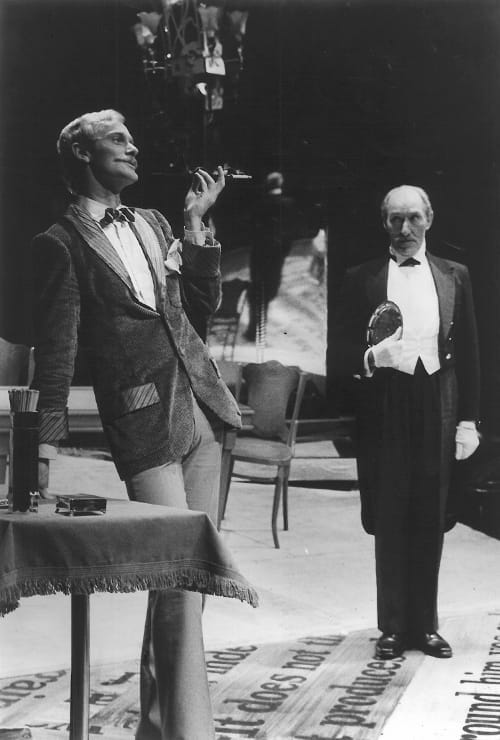
The play, in which I was cast as the Player King because I died very well, premiered at the Edinburgh Festival in 1966, the year I was born, with the title Rosencrantz and Guildenstern Meet King Lear and after it, goes the fantasy, Stoppard never looked back, to see one in the audience and 6 critics who all panned it: "a clever revue sketch which has got out of hand", wrote Allen Wright, "peppered with incriminating phrases that could be taken down and used in evidence against it." (These details appear, in an unattributed column, here.) Except one. Ronald Bryden called it brilliant, "an existentialist fable unabashedly indebted to Waiting for Godot but as witty and vaulting as Beckett's original is despairing". Rosencrantz and Guildenstern, writes Yvette Alt Miller in an article called "Tom Stoppard’s Jewish Identity," which is where the segue comes in,
... tells the story of Hamlet from the point of view of two minor characters in the play; though they try to stop the tragedy that is taking place, they fail ...
At the end of his last play, Leopoldstadt, 2020, there is a list of Holocaust victims. Miller describes a parallel in Stoppard's life. In 1993 a Czech relative contacted his mother wanting to meet. Stoppard recorded the conversation, cited by Miller, as follows:
“Sarka, we were Jewish?”
“What do you mean?”
I adjusted.
“I mean, how Jewish were we?”
“You were Jewish.”
“Yes, I know we were Jewish, my father’s family….”
“You were completely Jewish.”
I looked at the family tree. I went left to right.
“What happened to Wilma?” (Stoppard’s aunt)
“She died in Auschwitz.”
“Berta?” (Another aunt)
“Auschwitz.”
“Amy?” (A third aunt)
“She died in a different camp. I don’t know where.”
“Ota?” (Stoppard’s uncle)
“He survived.”
"Aunts, uncles, cousins, friends," she writes, "—plus all four of his grandparents—were murdered in Nazi concentration camps." (ibid.)
On the occasion of the revival of an earlier play—Rock 'n' Roll, 2006, dealing with the Prague Spring in 1968—in a Guardian interview of 2023, Stoppard raises the problem of his political commitments and addresses his Jewishness in light of Israeli retaliatory action against Hamas. The interview with Claire Armitstead has the title: "‘Is my play still relevant? I don’t care!’ Tom Stoppard on his Gaza quandary and reviving Rock ’n’ Roll."
After the Palestine genocide, perhaps his play Leopoldstadt is also, as the puff line for ATC's Cabaret puts it, "chillingly relevant." Or maybe it's just Rock 'n' Roll. He says in the interview, referring to the evacuation of premature babies from a hospital attacked by Israel:
I had no problem at all knowing where I stood on the 8, 9 or 10 of October. But after a while, you have to think it through and ask yourself why you stand where you stand. And before you know where you are, you are not sure where you do stand. It’s a horrible one. All those premature babies.
Then, it's curious, this interview. When Armitstead puts a question to Stoppard using the word 'faith' it is faith in the British establishment she is referring to. Ultimately, she writes, he is more interested in the review of season 6 of The Crown—so bad, the review says, it's "basically an out-of-body experience."
Philip Hope-Wallace says at the end of his own review, of Rosencrantz and Guildenstern at the Old Vic in 1967, the pair
... find that they are due (aren't we all?) for extinction, to be written out of the script with a callous line and a sleight of hand by the Lord Hamlet on board the transport ship. But, in spite of temptation, they do not interfere with the destiny which at least will give them a name the world does not forget, albeit smilingly.