IT IS WHAT IT IS: recognition in cinema and AI is automated
We watch the recognition. We see the virtual image recognise itself in the actual image. Why didn't this happen in painting? or in photography? It does to a larger extent in photography, because of the instant (which becomes something of a fetish in photography). The instant has temporal depth to it, a distinct, and determinable, duration. Shutter speed determines the duration, the time-unit captured, but of course this is not the whole picture: focus and aperture play a part, as do granularity and other effects, either mechanical, chemical or digital.
In a photo we see something unavailable to the eye. The eye does not chop up time, into fractions or a second, or a prolonged exposure. Eyes are sensitive to movement. They lock on to moving prey, for the promise of biological gain; they respond to oncoming threats. An eye cannot freeze time, although that is not what is happening in a photo, which rather selects, shutter speeds, aperture and so on, for the finished, developed or screened, photo to have an effect. This is the art of photography, so that photographers come to see—with their eyes—through their practice. And here they exercise judgement.
In a photo we see an image which biological life withholds. However it is not at all artificial. Rather a photo results from a machinic perception, which, in viewing, we share in. Of painting, then, it is said that van Gogh taught us how to see sunflowers, or boots, a starry sky with whorls of white. Before we had his paintings (and his paintings reproduced in photos) we saw something different. Perhaps it was just as picturesque, as imaginative, and we might, had we the skill, have painted it—and so allowed others to see it as if for the first time.
In a photo what we see depends entirely on the photo; so Barthes can spend an entire book looking for one photo, which he remembers as capturing the essence of his mother who has died. (Camera Lucida, 1980, pdf.) What has it captured in the instant it records? You see, this is the problem. A photo does not capture what it does in the instant it records but through the intervention (and we can say invention) of photography.
Barthes withholds the photo from his book. It would be presumptuous for us to think, or believe, we might see in the photo of his mother in the Winter Garden what he does. Barthes is perhaps too polite to inflict that on his readers. Although a portrait of his mother, it is as if it is a photo of her by chance. There are, after all, so many other photographs of her. This is simply the one he prefers. However, wouldn't we be mistaken in thinking this absent, in the book, object of desire, as the one above all desired, were the product of that desire? the one onto which he projects his, let us say, his feelings, memories and associations? For his part, Barthes never presumes to say, You will never be able to recognise in the photo what I do.
The image, the photo, is set free of its time-line. The Winter Garden Photograph was taken from before Barthes was alive, so that it was already free of its time-line in his lifetime. It was taken in 1898, when his mother was five. It floated through his life from 1915, the year of his birth, until he was writing his book. In it he considers the feelings, memories and associations it has for him to be a body of knowledge, which he calls the studium. The punctum is what jumps out at you from the photo, its point. And of course the Winter Garden Photograph is absent from the book, but Barthes suggests that such is the case in general for those photographs that grab you, they have a punctum.
The art of photography might be said to widen the reach of the punctum and lessen the need for the studium. We might then come to a photo with wide appeal without any knowledge of who, where and what it captures, and still be struck by it. Does a photo therefore record an instant? or produce it?
Barthes writes that it is in what the photo doesn't show, in what is beyond it, that the punctum lies. He uses the phrase "blind field" for this beyond (in French this is "champ aveugle" (pdf. online, p. 90)). Comparing cinema to photography he writes cinema's "'blind field' constantly doubles our partial vision." (op. cit., p. 57) It may be beyond but it is still a field, that is, we cannot see it. We can however imagine it foreshadowed and this I think is the characteristic Barthes is drawing our attention to: the doubling of our vision by what lies for the moving image in the future and what is for the photo foreclosed.
Time has stopped for the people in the photo, who are captured in the instant of their capture. The blind field in cinema opens onto the future where the people in shot, the leaves and so on, continue moving, continuing to be alive. Partial vision refers to what we can see being limited to what we are shown, so that we can also imagine this shot being doubled by another which we are not shown. It would happen, then, as in Zeno's paradox, that we would never reach the next shot. The movement in this one would continue in the next, for which there would be another next, another double—but from where?
This is where duration enters as it pertains to movement. A movement broken down into its constituent parts, as for example in the timed consecutive photos of Eadweard Muybridge, is not the same movement, is never the sum of its parts, but is single and singular each time it occurs.
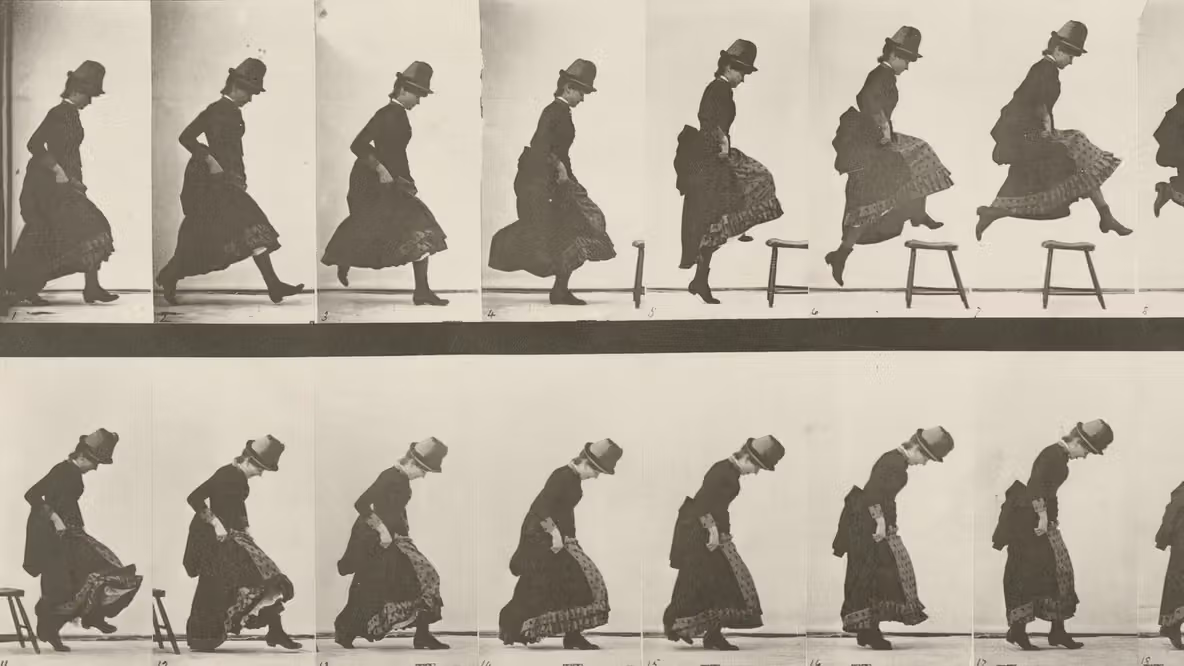
Any pause in the movement arresting its duration would issue in catastrophe. Along with it being a single movement, every movement has a singular duration belonging to when it occurs. When it occurs it is occurring. Or its image is. To say 'when it occurs' misleads us into thinking the movement is transferable without the subject or image moving. Like the photo of Barthes's mother, it can be withheld from us, occupying the 'blind field,' as it does of the book, an implied movement, just as movement is implied by the woman jumping, or exercising her straight high jump.
Is Barthes using implication, associations we make out of habit, to double the photo? in other words, is he reading in to photos what is not part of the image and not shown? Yes, of course. It is quite in the nature of the studium to do so. We bring our knowledge to a given photo, historicise it and generalise from there, endowing the woman in the photo, as Barthes does, with a "whole life external to her portrait", (p. 57), because of the detail of her necklace, which functions as the punctum. (Barthes makes this connection from a portrait of Queen Victoria and then says: "Robert Wilson, endowed with an unlocatable punctum, is someone I want to meet." (Ibid.) Referring to his reproduction, earlier in the book, of Robert Mapplethorpe's portrait of Philip Glass and Robert Wilson he explains what he means: Barthes can find no sign in the photo itself of why he finds one figure arresting. Here's a nice paper linking Robert Wilson and what the author calls 'post-dramatic' theatre, which I would rather call 'post-interpretative' theatre, to Roland Barthes. (pdf.) The two never met. The connection between Wilson with Victoria, which Barthes does not make explicit, is Wilson's show, with Christopher Knowles, A Letter for Queen Victoria, 1974 (audio excerpt). (see also for a discussion of theatrical lighting, in which Wilson and Barthes appear, Katherine Joy Graham's thesis))
Recognition is not recognising the original, for Barthes, or for us here. It is not recognising in the photo of Queen Victoria Queen Victoria, because of the punctum. The blind field lies beyond the photo, and the moving images of cinema, not the frame. In some ways the field to which the image is blind is the object of recognition. From it the aspect of the photo which grabs us gains its force, says Barthes; we might say that from here it takes its allure. It makes us want to see. It does not make us want to see what we can't see but what the photo doesn't itself perceive, which, it follows, the moving image does, or, rather, it can. This is the future. The object of recognition for photography always lies in the past.
A type of necessity captures us in moving images, which is simply to see what happens next. There is the well-known trope of images washing over us. With film we are always looking into the future, always looking into it and always finding it repeatable. Dull really. Hence the need for surprise. Then too many surprises and we are ready to enjoy the low-level excitation of the flow, which we want to slow down, to allow it to wash over us in a sensual way from which we gain aesthetic pleasure.
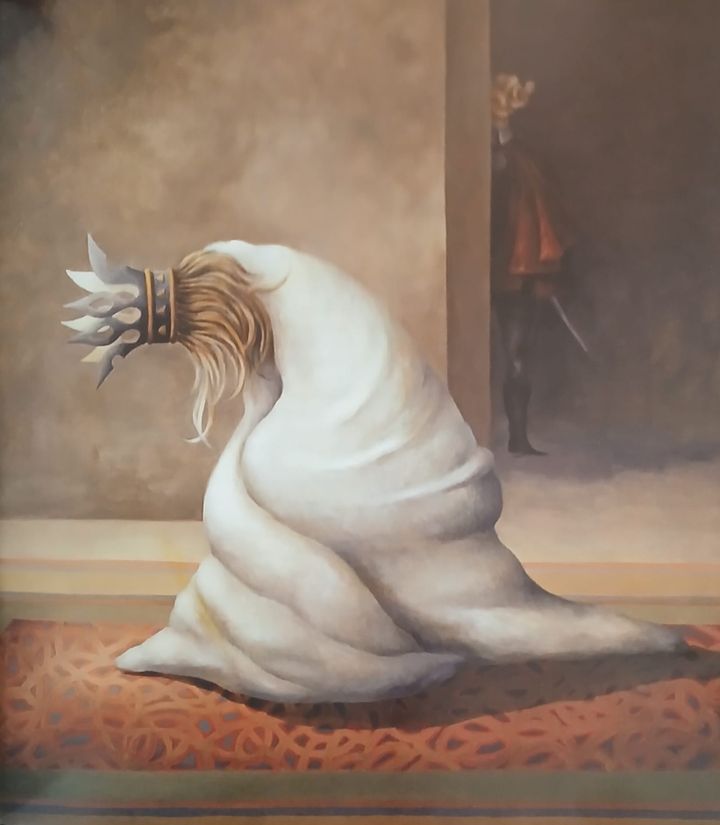
Narrative painting had a comeback in the 1980s. The work of painters like Steven Campbell, and the Glasgow School, Eric Fischl, and a painter whose work has featured heavily on this website Attila Richard Lukács, many others, turned against the injunction, on figuration and narration, in particular, human drama, in painting, which abstract expressionism, abstraction and expressionism, exemplified. As I was in West Germany in the 1980s, I have kept this word close to me, like a talisman: Repräsentationskrise. It translates as 'crisis of representation,' and although online definitions now associate it with the current crisis of democracy, it does not have this meaning for me. Rather it refers to the problem of what Deleuze and Guattari identify in What is Philosophy? as the shame of being human. Drawing on Primo Levi, they make the following qualification, that it is not only in the extreme situations described by Primo Levi that we experience the shame of being human:
We also experience it in insignificant conditions, before the meanness and vulgarity of existence that haunts democracies, before the propagation of these modes of existence and of thought-for-the-market, and before the values, ideals, and opinions of our time.
–op. cit., translated by Graham Burchell and Hugh Tomlinson, Verso, 1991, p. 107
You can see the two are connected, the crisis of democratic representation we experience now, with Nazism, with Auschwitz as its emblem. Adorno is overquoted, but:
Nach Auschwitz ein Gedicht zu schreiben, ist barbarisch.
We might form a connection here with the last lines of my post on 'crystal images':
What has happened between 1919 and 1961, between Paris Air and Artist's Shit? In Cinema 2, in one of his conclusions, Deleuze reminds us Nazism was, and would always be, in competition with Hollywood:
... it is true that up to the end Nazism thinks of itself in competition with Hollywood.
–The Weirdness of the Crystal Image
Deleuze is above all the philosopher of representation, or, as Dorothea Olkowski puts it in the title of of her book, the ruin of representation. (Gilles Deleuze and the Ruin of Representation, 1999) For this reason he is dear to me, but throughout his work, with Guattari as well, he manifests a marked preference for modernist art, for artists and writers belonging to the canon, like, for instance, Virginia Woolf, whose remark on modernity, in her 1924 essay, "Mr. Bennett and Mrs. Brown," is seen as announcing modernism:
on or about December, 1910, human character changed.
–pdf. online, p. 2
Deleuze and Guattari are writing in the period, the post-war period to the fall of the Berlin Wall, of the Repräsentationskrise. The artists they write books about, whose works they affirm for their experimentation, for giving us new forms of living, are not those that question the nature, status of artistic representation and the concept of art itself. The example I used in the "Crystal Image" post was Piero Manzoni's Artist's Shit, 1961. My allusion there was to the exchange of places in crystal images by which we recognise (automatically) in one thing its obverse, in that case, air and shit, or, it could be said, art and shit, images and shit, and identify the productiveness of the body with its waste product, or, as Deleuze goes on in his chapter on crystal images to say, cinema and money; and, as he further says, time and money. (Cinema 2, online pdf., ch. 4, pp. 77–78) Yes of course the shame of being human comes down to insignificant things. It is, after all, what it is.
The point is here that we recognise it both being what it is and what it is not. In the example given in What is Philosophy? the concept is an ad. (op. cit., p. 146) A longer citation is called for because it speaks, among other things, to the competition with which Nazism engages with cinema:
Opinion is a thought that is closely molded on the form of recognition—recognition of a quality in perception (contemplation), recognition of a group in affection (reflection), and recognition of a rival in the possibility of other groups and other qualities (communication). It gives to the recognition of truth an extension and criteria that are naturally those of an "orthodoxy": a true opinion will be the one that coincides with that of the group to which one belongs by expressing it. This is clear to see in certain competitions: you must express your opinion, but you "win" (you have spoken the truth) if you say the same as the majority of those participating in the competition. The essence of opinion is will to majority and already speaks in the name of a majority. Even the man of "paradoxes" only expresses himself with so many winks and such stupid self-assurance because he claims to express everyone's secret opinion and to be the spokesman of that which others dare not say. This is still only the first step of opinion's reign: opinion triumphs when the quality chosen ceases to be the condition of a group's constitution but is now only the image or "badge" of the constituted group that itself determines the perceptive and affective model, the quality and affection, that each must acquire. Then marketing appears as the concept itself ...
–op. cit., pp. 145–146 [I leave open the question of whether the "man" of paradoxes is to include women]
Art does not emerge from its (conceptual) crisis the same but perhaps it more forcefully can be said of art from the 1980s that it is what it is, without irony. What we recognise in art are increasingly private and personal codes, the badges of belonging to this or that artist who themselves takes on the mantle of the majority. The question is, which is the same as the one above, when we have its image, What is to be done with the body?
The cinematic seed of automatic recognition, on which is pinned identity, burst in art. We can no longer look at a photo or a painting in the same way, since, in immediate recognition of it, we know our act of looking to be repeatable: there I was in front of the famous Turner
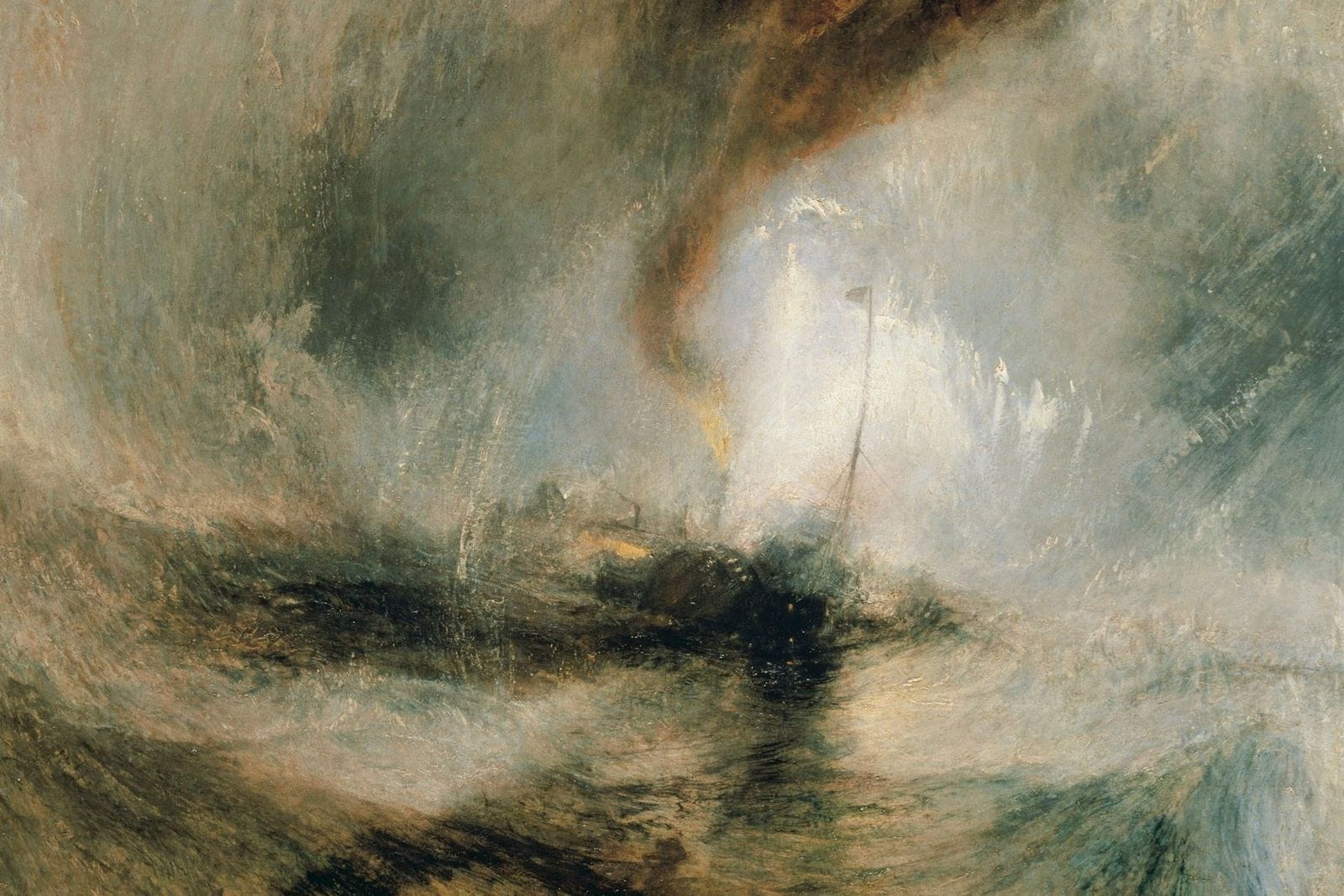
We watch the recognition. It is cinema's. We watch sense being made, and it is not ours, any more than the recognition in the image is, but the artificial intelligence's, belonging to the sense-units discretised by its perception. Both have the nature of being a montage of attractions, монтаж аттракционов.
...