The Weirdness of the Crystal Image in Cinema 2
Cinema 2: The Time-Image, Gilles Deleuze, is available online, in translation by Hugh Tomlinson and Robert Galata, University of Minnesota Press, 1989, courtesy of Monoskop; and in the original French, Cinéma: L'Image-temps, Les Éditions de Minuit, 1985, courtesy of Monoskop. The English edition will principally be cited, with page numbers, in the following.
Deleuze describes crystal images in chapter 4 of Cinema 2. They exist in reference to Bergson's circuits of recognition. Deleuze has Bergson's diagramme for the circuits of either memory or recognition, the latter being a test-case for what we might call today immediate or short-term memory, in a footnote to the preceding chapter, chapter 3, n. 3:
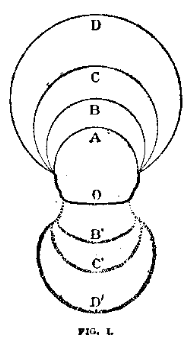
You see there is a degree zero, the shortest circuit (it resembles a screen, with successive rings resembling audience-galleries mirrored in it). It is this with which Deleuze is concerned.
For Bergson these circuits represent the enriching effect memory has on what is perceived. From being perceived, and then recognised, the image—we must note at once that Bergson uses image as a middle term, between the material and the ideal; because perception is outside, the image is outside the subject; sharing in both subjective and objective realities, it is both subjectively and objectively real—sets off deeper and deeper associations. (In Bergson's Matter and Memory this becomes something of a problem, causing perception to find itself, by the function of personal memory, increasingly bound to persons.) Some of these associations, by which the image is enriched, will be automatic. Cinema takes over this automatism.
Deleuze begins with circuits:
The cinema does not just present images, it surrounds them with a world. This is why, very early on, it looked for bigger and bigger circuits which would unite an actual image with recollection-images, dream-images and world-images.
–Cinema 2, p. 68
Cinema does this through the initial conditions of its production and reproduction of images: first technical, the images are separated from the structure of the mechanism—of recording and playback, or, when playback is simultaneous, registration—by that structure; then, where everything gets confused, the images are freed, they are set free of memory, dream and world. Free, they can as it were assert their independence, as here, by uniting an actual image, their own, with recollection-images, dream-images and world-images. What has happened, in the meantime, to the circuits of recognition and of memorial association?
Deleuze pursues the idea that the images have become signs. (Cinema is not for Deleuze primarily a visual sign-system. He does not reduce it to optical signs but is, as here, with opsigns and sonsigns, constantly on the lookout for new signs.) He writes:
We gave the name opsign (and sonsign) to the actual image cut off from its motor extension: it then formed large circuits, and entered into communication with what could appear as recollection-images, dream-images and world-images.
–Cinema 2, p. 69
Crystal images however are not simply these actual ones. They bring together virtual and actual aspects. What Deleuze is concerned with is a mirroring effect that occurs in time, which he calls, after Bergson, the virtual. To this effect, of the virtual, cinema gives a distinct space. His initial description is worth quoting. The point of departure for what follows, it doesn't contain only the distinction between virtual and actual but that between true and false, real and imaginary:
It is as if an image in a mirror, a photo or a postcard came to life, assumed independence and passed into the actual, even if this meant that the actual image returned into the mirror and resumed its place in the postcard or photo, following a double movement of liberation and capture.
–Cinema 2, p. 68
What is the ultimate, the degree zero, of recognition? Reflection, but Deleuze, although he returns to it, goes further than the example of a mirror or reflective surface, a shiny ring or reflective surface. Cinema conducts, and TV and digital film continue to conduct, a beautiful meditation on reflection. Scenic design loves transparent, semi-transparent, mirrored surfaces, sparkling with shards of light. Cinematographers love shooting through and across such surfaces. The medium is all to do with light. Only explaining it on the practical side of its aesthetic qualities, to say so doesn't explain the love-affair, which cinema conducts, continues to, without examining, or having examined, its own conditions. These are temporal and in Deleuze's conditional statement we can see them being covered: cinematic images' independence from the time of the phenomena being filmed is generalised to be the independence of actual images. Outside cinema actual images don't have this freedom; whereas the capture of actual images, in Deleuze's view, in a reflection, a mirror or a postcard, is generalised from its position in space, that is, in a mirror or reflective surface, and on a postcard. Actual cinematic images occupy these spaces like any other. What gives to them their virtual quality is time.
To simplify this statement: a pattern emerges. What is specific to cinema and to how it perceives is generalised for all of perception, for perception in all of its attributes. While the mirroring effect of the virtual, in the virtual image, is general, how this effect occurs, and under what circumstances and conditions, is generalised from cinema for other types of perception. Cinema has the advantage of showing us that it does take place, just as it shows us duration as such. It is as much a mistake to think of temporal effects like the virtual as being generalisable, from perception to perception, as it is to think of duration remaining the same for each form of perception, in every attribute. Each perceptual attribute has its own form of duration, its way of conserving duration and has its own distinctive mirroring effects in the virtual, which can be called its imagination.
If we consider a machine, a machine imagines it's a machine always on the shortest of circuits such as it belongs to cinema, in which case it gives rise, says Deleuze to crystal images. For a machine, and cinema is nothing if not machinic, the actual and virtual run in circles. The virtual is always the object of immediate recognition. Still, it is perceived, so there exists in machines a perception, but its imagination is limited by what it remembers and recognises as its task. For a typewriter, an example I talk about under the heading A Machine Perceives, the virtual—and, indeed, its virtuosity—consists in an ideal movement whereby the depression of the key, by mechanical means, causes the typebar to hit the ink ribbon, which is mechanically raised, with the slug, in order to transfer ink, within the ideal parameters of the symbol it carries, embossed in relief, onto, its existence also ideal, the paper page. It does not imagine anything else but this ideal, which, when it actually occurs, repeats itself, performing the oscillation between virtual and actual images that Deleuze attributes to cinema. Of course, an organism imagines something quite different, quite differently.
A tree, in the example put forward in a tree imagines it's a tree, for a start, will bring up for reference images that belong to each cycle, or, we might say, each ring, of its growth. Where will it bring these images up from? Its memory is the short answer. It will not generate its virtual form on the spot, as a matter of immediate recognition. A tree experiences the mirroring effect of the virtual as a matter of less intensity. This resembles what Bergson says about tensions produced by the need for action, which, in most animals, including us, are at their most relaxed in sleep, unless broken by a sudden need for action, and expressed in dreams. Bergson's diagramme then shows the different tensions, the most intense being that of an immediate need for action which is expressed in the image of immediate recognition. It has to be, otherwise the machine is broken or the animal, including us, submits to the threat—just as a road-sign not correctly read, its sense not correctly understood, can lead to death; or, for another example of immediate action being called for, just as the opportunity is missed if the promised prize is taken for a scam. The point to be made is that in these cases there is neither the exchange between nor the indiscernibility of the virtual and the actual—there being exchange to the degree they are indiscernible—which Deleuze finds in film and calls the crystal image. (The term, crystal, although it sounds like it, is not from Gilbert Simondon, but is more closely related to ideas found in Leibniz and Borges. The topic is covered very well, but indirectly, in episode 209 of the podcast hosted by Phil Ford and J.F. Martel called "At Home in the Labyrinth, with Murakami and Borges," 25 March 2026. I use some words and notions from this episode, including "rift" to mean a "pocket of indeterminacy," which marries nicely with Bergson's use of "zone of indetermination" when talking about consciousness; and, of course, the "weird" itself, which involves this rift, or zone, hence the weirdness in the title here.) You might, however, ask whether we are on the right track with this reading. Is the virtual a mirroring effect of time? Haven't we said Deleuze mistakes the time it takes, the effect's true duration, for the spatial disposition, in particular of the mirror and reflective surface being in the shot? Yes, but this accounts only for its immediacy which is the immediacy of exchange in the shortest circuit of recognition belonging to machinic perception. Deleuze writes, which, without time would not make sense:
Exchange or indiscernibility ... follow each other in three ways in the crystalline circuit: the actual and the virtual (or the two mirrors face to face); the limpid and the opaque; the seed and the environment.
–Cinema 2, p. 71
These three ways, because of the way they do in cinema, invoke the condition of instantaneous exchange, to the point of indiscernibility, of the virtual image for the actual, and of the actual for the virtual, in the same way. However, the exchange of the limpid for the opaque, or of light for dark, a luminous and well-lit face for a shadowy and dark one, and the exchange between the seed and the environment occupy different scales of time. Then, the shot condenses these different scales of time to produce the exchange. This is a different thing from saying the different scales of time are edited together, because, although they might refer to other durations, by being in the shot they now have only its duration. The same can be said of the "ever vaster circuits" Deleuze says will be able to develop, "corresponding to deeper and deeper layers of reality and higher and higher levels of memory or thought", that it is the image at its most condensed, and crystalline, where the oscillation between the actual and the virtual is intensest, which carries everything. (Cinema 2, 68–9) The exchange and the indiscernibility of one from the other, of the postcard or photo from the scene, have an intensity due to an action which is not in the scene but is cinematic, since it is the action producing the image. The seed and environment exchange recalls a tree imagining it is a tree, but perhaps a better analogy would be how this action, the action of the shot, is generalised and spreads out from the seed of cinematic perception to suffuse the infinite perceptions of our environment. Deleuze's most interesting observation, in light of such an analogy, is that of an environment which fails to form due to the seed being empty or to it containing an emptying. If the virtual form, as we have said, expresses imagination—for machine and organism alike—then this a failure of imagination.
What will be the seed with which we can sow the environment ... ? Or else, despite men's efforts, will the environment remain amorphous, at the same time as the crystal is emptied of its interiority, and as the seed is only a seed of death, fatal illness, or suicide ... ?
–Cinema 2, p. 71
Other perceptions we might say are suffused by the perception of the cinematic machine so that they are emptied of the virtual forms of their imagination and crystallise only as seeds of death, fatality and self-destruction. Deleuze is describing, in the sense he attributes to Alain Robbe-Grillet, both a novelist, of Nouveau Roman fame, and film-maker, the world not speculating about it:
We recognize here the very specific genre of description which, according to Robbe-Grillet's requirement, instead of being concerned with a supposedly distinct object constantly both absorbs and creates its own object.
–Cinema 2, p. 68
That we are acquainted with the scenario of imaginative failure on a global scale goes to this, but the genre of description that Robbe-Grillet requires closely approximates what perception does. Instead of being concerned with a distinct object, it constantly both absorbs and creates its own object, but from it we infer a substance being absorbed when perception is rather an attribute of that substance, and not any kind of procedure or process, even when issuing in creation, imposed or performed upon it. Perception then is an attribute of the world at large and it is this Deleuze is describing in terms of cinema and of crystal images. It is a world where, despite the facts, the real and imaginary can be indiscernible. Deleuze uses the word "coalescence," which he places in scare quotes, attributing it to Bergson:
In Bergsonian terms, the real object is reflected in a mirror-image as in the virtual object which, from its side and simultaneously, envelops or reflects the real: there is 'coalescence' between the two.
–Cinema 2, p. 68
Coalescence for Bergson refers not to indiscernibility but to perception. It refers to where matter and memory meet. In Deleuze, they exchange places.
If pure recollection is already spirit, and if pure perception is still in a sense matter, we ought to be able, by placing ourselves at their meeting place, to throw some light on the reciprocal action of spirit and matter. ‘Pure,' that is to say instantaneous, perception is, in fact, only an ideal, an extreme. Every perception fills a certain depth of duration, prolongs the past into the present, and thereby partakes of memory. So that if we take perception in its concrete form, as a synthesis of pure memory and pure perception, that is to say of mind and matter, we compress within its narrowest limits the problem of the union of soul and body.
–Matter and Memory, online, p. 99
Bergson uses perception to solve the problem of whether the world is real or imaginary. It is both, but as I have indicated, this humanises or personalises the problem. A theory of perception is necessary which entirely avoids their confusion, which Deleuze writes is simply an error of fact. In fact, virtual and actual, real and imaginary coalesce in crystal images, within the narrowest confines of reflection, but this does not affect their discernibility. (Cinema 2, online, p. 69) We can still distinguish between the two sides but not know with which we are dealing. If Deleuze comes down on one side, it is art. What we are concerned with here is not exchange to the point of their indiscernibility, but indiscernibility to the point of their exchange.
A Body Imagines It's A Body
Crystal images do not re-divide the body from the mind or spirit. They cause them to coalesce. Although they are not confused we cannot, in fact, tell one from the other. If we were to use crystal images to describe how a body imagines it's a body we would go first to the shortest circuit which carries everything, reflection. We would look for the virtual form which it actualises in the images of immediate recognition. And we would be wrong. We would have to be reminded of the fact of deoxyribonucleic acid being the biological blueprint, which mitochondrial ribonucleic acid more or less follows. Yet this would get us no closer.
Then, shouldn't we have to look at the roles of art and culture, politics and religion? Shouldn't we consider how bodies are constructed under historical procedures of subjection? How our cells contain memories that are impersonal and historical as much as they are personal and familial? How flows of resources come in even from the stars to fuel and feed them?
And then in terms of subjection we should have to look at the use others put us to and how our bodies are organised into larger social aggregates and by what flows these are informed, of knowledge and symbolic authority. We should not forget the role of violence and the role played in deferring it, that its suppression has. And we should above all not be confident we have included every possible body. The set should be open.
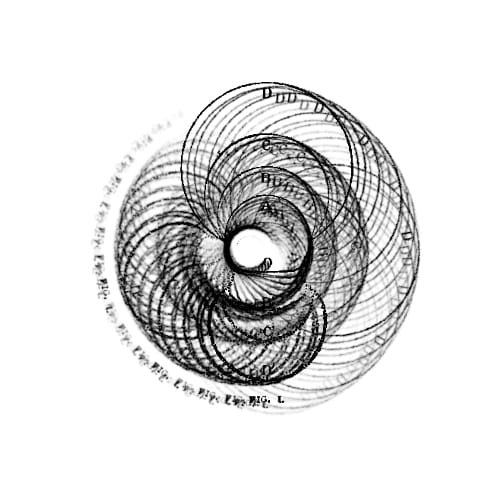
We have to consider the infinity of possibilities, like the infinite possible paths in the garden of forking paths (see diagramme). We might think of the rings, with Bergson, as durations, but in that case they would not cross. Deleuze's version is the world as it is, or, more precisely, it is in character, in the character of the world. The crystal is in the same relation to the body as the machine is to life. At the germinal stage there is resemblance. A seed is the catalyst, after that the crystal lays down uniform sheets of molecules (later in Cinema 2 Deleuze will use the phrases for time "sheets of past" and "peaks of present" (ch. 5, p. 98)). The body will develop with a similar automaticity, here, however, crystal images take over the body's automaticities.
What is striking about Borges's title is that it gives us a garden of forking paths, made of forking paths, without a garden. Its world, or, as Borges writes, worlds, since the story presents a definition of time in which every possible world exists, is in the same relation to the garden, and, the medium of growth, earth: an infinity of possible worlds is, ultimately, without a world or worlds; it simply describes perspectives, but these perspectives rest on nothing, they are without a landscape or subject. It is of this earth as cinema both conceives and perceives it that Deleuze writes:
The modern fact is that we no longer believe in this world. We do not even believe in the events which happen to us, love, death, as if they only half concerned us. It is not we who make cinema ...
–Cinema 2, p. 171
Perspectives without an object to have them on, possibilities without worlds, a garden without earth and infinite paths without a garden: these 'without's are not privative. They do not express a lack but are in every case positive and point to what is open, opening us onto an outside. Even from this perspective, outside, we cannot separate images from the world which they imagine. It is especially so with cinematic images since they occupy duration and, unlike in Bergson, these durations cross, or, can be made to, in crystal images, where we encounter not only doubles of the world but our own.
Following one of these pathways of the possible you meet your identical copy. Everything you thought you knew about yourself evaporates, every habit of thought is arrested. This is, from Difference and Repetition on, 1968, one of Deleuze's great themes: the imposter. The weird horror of the situation is you don't know which you are, the imposter or yourself.
The trope is old, as old as art, and engages every aspect of our mortality, including the promise of living on, in fact or in memory. Memory provides the same kind of pitfall for Deleuze as it does for Bergson, for opposite reasons, perhaps, but resting on the same nub. Deleuze proposes cinema as spiritual automaton, while memory is for Bergson the spiritual condition of man. For one memory is human and personal, a man's, like Bergson, and presumably a woman's too, for the other memory is impersonal, a spiritual double for the individual and the world alike. From cinema, it crosses over into technology.
The weirdest effect of the double is that the body is the double. The body is the imposter. The spirit, its mind and memory, spiritualised by the image, is the pure self. It has the purity of a crystal. The same can be said for the world spirit, or soul; in German, the Zeitgeist.
Deleuze comes down on the side of art but he is not, however, unaware of politics, its dirty double. Politics seeks to purify itself by culture, including religion (Modi's Hindutva) and nationalism (MAGA). And culture seeks to purify itself by politics (Wokeism). By means of, in light, in view of: to the extent that they become enmeshed.
Weird Politics
After a long time away from New Zealand, I came back knowing that the proximity to politics would be hard to take. Only because it has first been suffused by its image in the general culture, whether that image is kindness, or cruelty and misogyny, or the values of business, politics suffuses everything. The arts suffocate for lack of air (partly, in their willing adaptation to fit the general political image, this is deliberate). The kindness was weird but as presented by Jacinda Ardern (Rt Hon) it had a TV-special, Osmond-like, toothy genuineness and was inescapable as a hug, its warmth indubitable. Then, the cruelty and misogyny was, and is, weird too. It had factors of colonisation, was racially demarcated, with a similarly TV-ready Destiny Church religiosity, expressed as old-fashioned religious wrath and of course scape-goatism, running through it. The proximity I am referring to has, in this perpetually weird now of the contemporary political fashion, no history. It starts again, in the crystal. It has no share in the colonial past, either to right its wrongs or wrong its rights, as is happening now in NZ under a triumvirate of surpassing weirdness. Winston Peters (Rt Hon), who is of Māori descent and, reputedly Scottish, as well as, he alleges, Chinese, in the role of the ancient provocateur, leads the charge: remembering the political past is liberal breast-beating, to use a phrase, by misappropriation, of misogynistic caste. The Prime Minister and his second deputy, Peters would be first, are hardly worth mentioning, but for Rt Hon Christopher Luxon's profession to faith and others faith in him, despite his ineptitude in business, for representing its values. That the leader of the party in opposition is also called Chris is weird. People saying you cannot tell one side from another is in keeping with a Left which keeps to its own virtuality and a Right that declares for actuality, in the crystal. This actuality is the presence in politics of antipolitics, a sentiment, part of the general mood, that politics has let us down, as in the title for David Holmes's debut album, This Film's Crap Let's Slash the Seats, 1995 (Holmes recently did the music for Steven Soderbergh's The Christophers, 2026, a film reflecting on art and forgery which falsifies its only genuine element, in the performance of Ian McKellen). The Left's virtuality is of never quite acceding to politics because never quite accepting it as impersonal and a possibly inhuman (think Machiavelli) working through of the problem of human social organisation, that is, from the outside. The weirdness goes both ways, from an image of NZ to political culture, from political culture to what NZ imagines itself to be. This double movement too mirrors the exchange between actual and virtual, whereby images become signs enabled, as earlier for Deleuze, to enter into communication with what could appear, what could only appear, as recollection-images, dream-images and world-images. Here, free of any circuits of recognition but that belonging to the crystal, free of any but the most immediate memorial association, they are literally signs, signposts, advertising the crystalline beauty of mountain lakes, mountain peaks in serried rows, the Pacific Ocean, abundance in the fields, braided rivers, saying this way towards the harmony of peoples. Lowing like cows enjoying the pastoral idyll, they follow like sheep into the green ghetto. Every sign gains its release in this scenery of signs, like that of the billboard at the beginning of Lee Tamahori's Once Were Warriors, 1994, which, as the camera pans away from it, to the reality, caused its first audiences to cheer. It could just as easily pan back, push in, expand on with a sign welcoming us to Middle Earth, inuring us to mediocrity. New Zealand has always considered itself an imposter in the cultural sphere, subject to cringe and subjecting those who practice as artists and do not cringe to having their tall-poppy heads cut off. A young country, it is said, boxing above its weight and conscious thereby of its heaviness, its sheer long-cloud heaviness, it is also always only ever about to enter the world stage: which brings me to my final statement. I have been to places where politics is not so enmeshed with culture, to countries that have cultures which the successive governments belonging to the political economy of those countries support because they too belong. There is kitsch to be found in those places too, with images there is never purity.

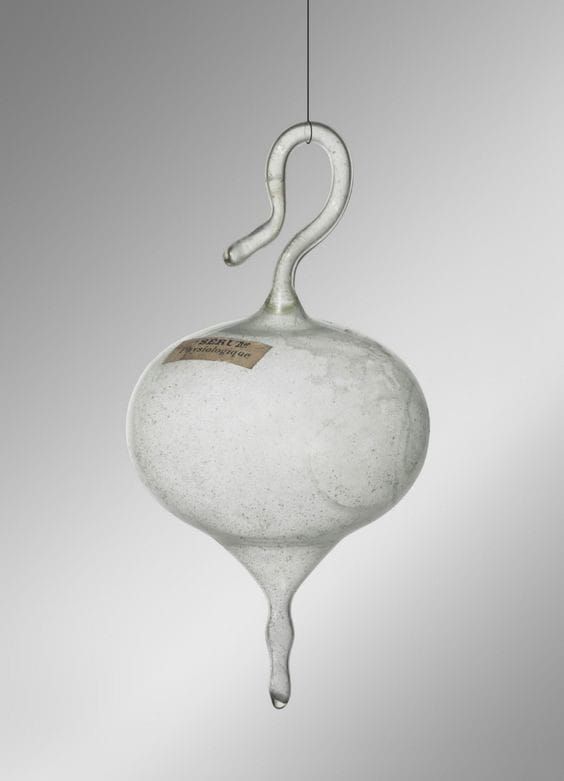
What has happened between 1919 and 1961, between Paris Air and Artist's Shit? In Cinema 2, in one of his conclusions, Deleuze reminds us Nazism was, and would always be, in competition with Hollywood:
... it is true that up to the end Nazism thinks of itself in competition with Hollywood.
–Cinema 2, p. 264