"The crisis continues..."
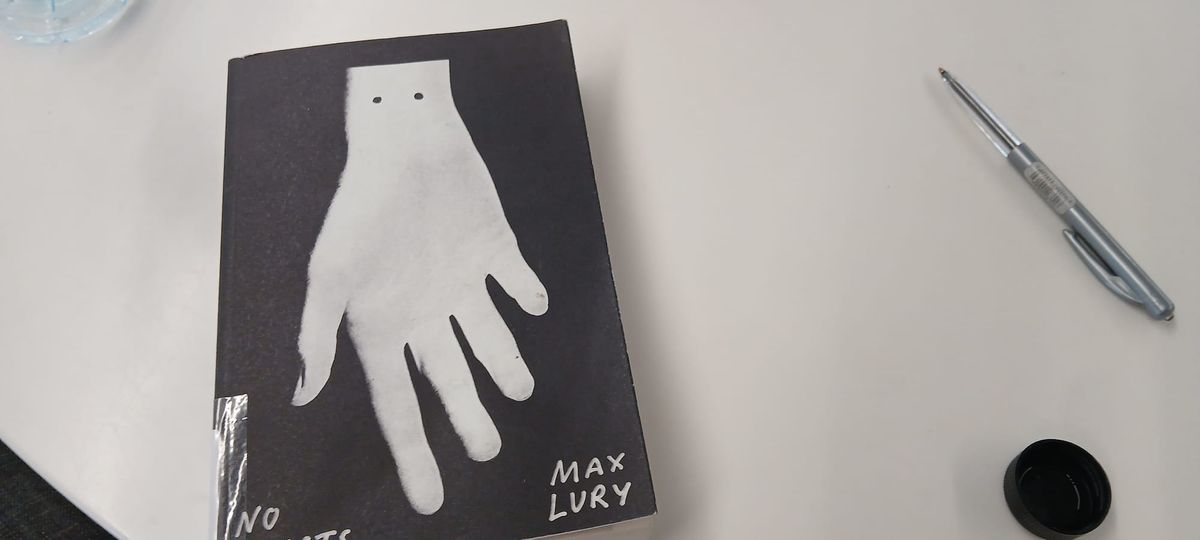
Title from the ACKNOWLEDGEMENTS, No Ghosts, Max Lury, Peninsula Press, London, 2026, p. 343 (all subsequent references to this edition)
Going from the end of the second of two posts dealing with crystal images, the first about their weirdness, the second about them as an effect of cinematic perception, both being and becoming are usurped by images. (This is the claim made in "Cinema Signifies a Change in the Fundamental Structure of Reality.") (outsidelight; herri) In the second of his two cinema books, Cinema 2: The Time-Image, it is Deleuze's contention that movement is separated from time and that in the crystal image the separation is complete. It is my contention that images separate movement from things and processes and join it with duration. In crystal images (which Deleuze also calls crystals of time) we see the fusion of duration (time absolute) and movement. These, going back again to the second post about crystal images, equal scenes. They are scenes without beings, subjects or objects. (In the "Cinema Signifies ..." article I also call them scenes but first and foremost put them as units of time, belonging to discontinuous duration.) In them the process of recognition is automatic and immediate. It results from a cinematic perception, but thinking that cinematic perception means cinema's perspective would be a mistake. Rather cinematic perception leads to the perspectivism whereby there exist only perspectives and no objects of perspective. Likewise, we can say that for cinematic perception there is no process of perspective. One image follows another with a movement that belongs to a flow which starts when the clip, scene or image-sequence starts and ends when it ends. The important thing to remember, that Deleuze also reminds us of, is that this is not the present. I contend that the film unrolls (or that the camera rolls) in a duration that is, unlike the present (or past, or future), discontinuous.
Unrolling, rolling up, cannot explain the movement of film, of image-sequences, neither can processes of recording nor camera-perspective, machinic interface, mechanical, chemical or digital processes, explain the duration in which images move. They are discontinuous time-units, scenes, with their own durations. What is shown by cinema, in cinematic time, are not objects, persons, things, which move; and what the camera sees is not from the perspective of a subject, say, a machine-subject: it's simply the time in which images move. Even when there is no movement, as we know from the world of digital images, there is a movement of time, in time, cut out by perception. For example, it is framed, which is how moving images are perceived, which is to say, how they are produced. Cinematic perception produces time-unit-images. Framing is part of that perception.
A different view of perception is necessary: something is created. Of course, it can be put to artistic purpose, to produce affect, but affect does not produce bodies. Affect is produced by bodies; and, in this case, images combine time and movement in singular bodies. The bodies are scenes and are recalled as scenes. They are recalled as scenes even where there is no image-content, by those with aphantasia, who bring to mind scenes with their moods, atmospheres as emotion-content. If crystal images are the sine qua non of perception, when we conceive them to be how our world is, or as the condition of perception in general, then these consequences follow:
- the world comprises scenes, not beings; and any development is from scene to scene, not the result of processes, neither can any scene be taken in media res;
- the cut is not absolute, for example the cross-section or slice we take of things in flight, but contains recognition and recognition operates over the cut, and so makes continuous the passage from scene to scene; (that is, we see it exactly as the cinematic perception does not: we see the continuous operation of what are for cinema discrete units of time;)
- we form an identity, which is not of resemblance, over the cut; the same is reflected in difference, which is to say it is differently reflected in a virtual image, belonging to it by contiguity; we give here to space what is given by the time of a duration of a discrete time-unit;
- both virtual and actual images are, according to their nature, real images; but that nature, of belonging to present, past or future, is preconceived, produced under the attribute of cinematic perception, as belonging to a time, outside these, only concurrent with the time of the scene;
- the past ceases to be past; the present ceases to be present; the future ceases to be future because no movement, in either past or present, can prolong itself into the future;
- every action, its movement concurrent with the duration of the scene, is limited to the scene in which it occurs; that is, limited to the discrete unit of time;
- the passage from scene to scene constitutes the continuum of our lived experience. The effect is immediately weird, since what happens is recognised (after all, it's part of the scene) but undetermined. Everything appears to be in conscious collusion. In other words, the zone of indetermination provided by consciousness is now occupied by the world. Its radical indeterminacy seems to be the result of conscious choice, of its determination, to which we have no access but must go with the flow.
Deleuze seems to be warning us with crystal images, and the cinema books in general, about where it is we are, but also asking what there is to be affirmed in a world of images. No Ghosts presents this world, and there is no doubt it is ours, so that the novel, as Steve Erickson writes for his blurb in the front matter,
... stands at the edge of a new fiction born of our age and also of our as-yet-undefined Resistance to it ...
"The username, all lowercase: blindfields."
–No Ghosts, p. 187
Max Lury sets No Ghosts in our time, in London mainly, with forays to other districts in the UK, and a major detour to an isolated live-in studio situation in the Scottish Highlands. The action revolves around missing person, Annie, who is triangulated back to Harlow and Kieran. They have shared an intense and formative friendship and the story itself turns on the absence, an absence parallel to the claim in the title: no ghosts. Annie has disappeared into the crystal.
Annie can't reach them as a ghost. Then, her presence is hallucinated by an AI's proprietary software belonging to Horizon. A company Harlow has been working for and returns to, it has grown from a start-up which generates crowds, for crowd scenes. It does so more cheaply than it would cost to hire extras.
Access to the source-file Horizon's AI uses to generate the people who form the crowds is password-protected, but has the username "blindfields." Roland Barthes uses the term "blind field" in Camera Lucida. I deal with this in IT IS WHAT IT IS, a title which is ironic, considering that, for crystals of time, a reflection is just as soon what it is not. The name, Horizon, might be said of the cut, across which continuity is established, the continuity of what it is with what it is not; or, for Annie, Harlow and Kieran, with what the world is becoming, its virtual image reflected in the AI crowds Horizon generates.
Barthes's blind field, he writes, doubles our partial vision, in cinema. (pdf. online, p. 90) It is the afterlife an image has which it never arrives at, but from which it derives its intensity. Simply said, the blind field is where the lives of the moving figures, people, things, ghosts, continue living. We don't see this afterlife. However, it exists, ghosting the present, in both senses, avoiding it, but felt. This is described by Mark Fisher as the eerie, an absence suffusing the scene, of what should be there but is not. (Fisher contrasts the eerie with the weird, which is what is there but should not be, in The Weird and the Eerie, London, Repeater, 2016. (pdf. online)) Of course, that I was writing about blind fields before coming across the term in No Ghosts is weird.
"Blindfields" is the username for the AI's file of assets, the images it uses as source information in order to build crowds. Harlow, we infer, although there are constant shifts of perspective in the novel and they are unmarked, speculates that
... these assets were then leering out at her from almost every film released in the past half decade. At least, from the films of anyone who worked with Horizon. Which was, by now, most studios. All these assets in every crowd. The twitch of an eyelid, a hand extended, all based on someone here ... They lingered on the other side of every image, behind every colour-graded still.
–No Ghosts, p. 223
Barthes uses the term primarily to talk about still images, where the blind field refers to what is outside the frame of the shot. His use of it in view of moving images seems to be an adaptation, but even in regard to photographs the blind field is not just the out-of-frame. There the force is found which meets the gaze of the viewer. It does so in exactly the type of details as Harlow speculates have their source in the file, its username "blindfields," of assets.
This also speaks to Lury's style, intimate with the details of movement, fingers flick, heads incline slightly, one shoulder is held higher. In interviews he says he experiments with contextual details, particularly those of labels and brands, and book titles. Bolaño's 2666 makes an appearance, as do UK product-brands. These, he says, have a different weight to American brandnames. It's not so much their significance, either of the details, book and film titles, product names, that interests him, or us, reading No Ghosts. We can imagine an asset file, username "blindfields," in which the novel has its fore- and after-life.
Overheard, the characters speak, without speech-marks, but in the text and sometimes the style of the novel, a style which is literary; as in these guys, in hi-viz, on deck-chairs, manning the front of an illicit gathering, a post-séance, there are no ghosts. One is recounting a dream, whose character seems to segue or go out of focus as he speaks, and become literary
... I lose myself in the heady scents of perfume and sweat and spilt booze, in the circular conversations, the broken glass sound of laughter. I find myself in a circle of people whose faces I do not recall now, but who I am sure are very beautiful. Very beautiful indeed. I am trying not to show my distress ...
–No Ghosts, p. 227
He is stuck in a circuit of the crystal, hence the glass, the circle and the circular conversations. The circuit of the crystal goes from actuality to virtuality and back. Note that he cannot recall their faces. He knows they are beautiful. This is what is required by the scene. They could be a crowd generated by Horizon. He, like Kieran, who overhears him, is searching in the crowd; while, for Harlow, Annie, the missing person, has a scene of her own, in an hallucination of the AI. There she is pure virtuality. However the actuality is Harlow sees only a resemblance, a reflection, as if looking directly into the blind field, under the auspices of the company, Horizon, and its AI. It is not her and her at once.
Harlow imagines a notification signal being sent to the afterlife when she is watching the Annie scene and, putting the scenes together, other similar scenes. She wonders:
If whenever she clicked the play button there was a sharp, elastic notification sound somewhere far beyond. Or, perhaps, if they were pulled back into the moment, into the screen.
–No Ghosts, p. 243
"They," pulled back into the moment, are the characters in the scenes. Harlow makes the mistake, or not quite, of assessing the present of the film fragments as being part of the present; not quite, because the characters "live" in them. She is watching their present unfold, the only one where they have life at all.
Horizon's CEO believes, through Harlow's response to the one featuring Annie, in the marketability of the AI's hallucinations. Harlow tries to imagine it, ..."a dozen banal uses for the technology:
faces of loved ones in TV shows, memories acted out on screen, a procedurally generated stream of people you recognised—who seemed, to some degree, real. ... The dead never dying but held, forever, in a bleak, recursive present.
–No Ghosts, p. 269
As I said in the earlier post, we watch the recognition. It belongs to the machine. This is how an LLM makes sense and we think, we are convinced, that it is making sense for us. The sense it makes is automatic. So for the images produced by cinema, for the recognitions operating over the cut, it is the same: where we presume continuity, this is the sense we are making of what is merely reflected and a fact of machinic recognition. The image prolongs itself only as far as its reflection. This is its virtual image. Not ours, it belongs to the specific perceptual attribute, with which we are, by watching it, engaged.
This was a new fact: not all new information was necessarily a surprise. And this was how [Harlow] was beginning to see the world.
–No Ghosts, p. 272–273
In editing the scenes the AI hallucinates, by-products of Horizon's crowds, Harlow finds a common thread. The figures in them, including Annie, respond to a figure both out of shot and, the distinction is important, because it shares the time of the scene, in the blind field. The majority act as if threatened. She calls it Figure B.
From time to time a feeling like she was being watched, as if her own Figure B was just out of frame, peering inwards.
–No Ghosts, p. 273
Figure B is in a relation to Harlow as the virtual is to the actual, but for moving images this virtual is real. It exists in the blind field. She is aware she is subsuming her lived experience to that of the AI's hallucination, which is a moving image. What this feeling entails, however, for her and for us, is of being trapped in the crystal, where we cannot turn to the future, or, because we know it must end, see past the end of the scene in which, for ourselves, we feature. Is there anything, as Heidegger claimed that there was, authentic about this?
And this should draw us back to the characters in Lury's novel. They are often inauthentic to themselves. Not self-conscious or paranoid, they accept their own partiality, which, in a way, is like accepting they have a virtual half, that they pursue, and an actual half, in which they are only partly realised. Their acceptance, their acquiescence, doesn't make them particularly likeable, another oddity of the book, but we could only say it makes them all the more real if we too place ourselves within the crystal.
[Kieran] lost sight of who he had spent so long wanting to be, and who he was: as if both versions of him were two sides of a tuning fork, struck hard against a table, and he was now living in the pure and fluted resonance.
–No Ghosts, p. 281
The two halves, the tines of the tuning fork, vibrate at the same frequency but with a difference which is infinitesimal. From this infinitesimal difference comes the intensity of resonance, where Kieran is now living. The difference, as Deleuze says of virtual and actual in crystal images, is indiscernible. From infinitesimal differences as intensities Deleuze derives qualia, going from actual-virtual difference (the same reflected differently) to quality, from quantity (or degree of intensity, here of resonance) to singularity.
The facts of someone else's life only used to make sense of your own, refracted endlessly through the stained glass of the screen, and this at the centre, an anchor, a singular point around which everything else tilted in orbit ...
–No Ghosts, p. 297
Lury's "stained glass" is worthy of note. It alludes, practically, to the scene here, an on-screen suicide, sacralising it, perhaps as self-sacrifice. These rituals have become necessary to the group Kieran is following in his search for Annie. "Stained glass" is also a poetic reference to the refraction of what we might think of as our role in the scene, endless because it takes as its subjects of recognition any and all the images it contains and implies, virtual and actual, or, in life and in the afterlife.
Who does not arrive upon a scene without preconceptions? The nature of a scene is to be preconceived, constituted in every way (as it is, and, by the logic of the crystal image, as it is not). There exists a reciprocity between the scene as it is (and is not) and our performance. The scene demands or we demand of ourselves a performance on entering into it; we (know we, recalling the awareness Kieran and Harlow have of the constitutive partiality of their roles) play a role. So what is the role of the streaming suicides Kieran watches? His role has been determined; he has been prepared for it by his interaction with the group. Reading No Ghosts we make the association between the source-data (in the file with username "blindfields"), Harlow is in contact with but Kieran is unaware of, used to train the AI Horizon uses. We can make the assumption that what the AI is hallucinating is the afterlife, the after-lives, of the figures, Annie's included, used to train it. Therefore the suicides reproduce training-data. By reproducing data, they close the circuit of the crystal image No Ghosts works inside.
Jammed in a feed where they didn't belong, auto-playing without a choice.
–No Ghosts, p. 299
The crystal of time doesn't just lay out time in space, as spacetime, but in a line which, we presume, continues into the future. Deleuze's "crystal" refers to Borges's labyrinth, which is perfectly realised by a straight line. We cannot turn from it: "One can only just turn in the crystal: hence the round of episodes ..." (Cinema 2, online pdf., p. 83) This condition of time, Borges shows in the short story "The Garden of Forking Paths" (pdf. online), leads to the theory known as Many-Worlds Theory. Time as a straight line necessarily forks. We might say that it forks into blind fields, because we cannot see the others and can only choose the one we take (hence amor fati), the time-line, that is, we are living. We understand however that for the world it is different, that we have surrendered the zone of indetermination we carry inside to the world. And it is not even conscious of choosing from the infinite alternatives, which, with even the most infinitesimal of changes, of movements, sub-atomic, it faces; and neither is any one of the infinity of alternate worlds to which the most infinitesimal of differences gives rise.
So it is for the allegory of the tunnels in No Ghosts: below the live-in studio situation in the Scottish Highlands, where Horizon has its HQ, where Harlow is piecing together the AI-hallucinated fragments of afterlife, there are tunnels. Harlow speculates that they might have been built by the military; anyway, they are now mainly empty. Feeling crowded out by the interest of the other workers at Horizon, at some point she retreats into them. She has to develop a code to navigate them, left, then right, right, left, since there is nothing to distinguish the tunnels, apart from objects. These resemble props, as if left by a film production, and so they are consistent with the sense, although it is ours, that we are in some kind of cinematic reality.
Harlow has seen others like them, Annie had collected them, and kept them in a cupboard in her room, as if they meant something, but they don't work. These too, in the tunnels, have been made not to function. Like the microwave which doesn't open, it can have no effect, no purpose, or effect on the future, as a normal appliance could. Not simply there for show, the show has moved on, the tunnels are deserted, Annie's room is deserted, the microwave, like us, is an object to be shuffled, shunted from one alternate path to another, according to but indifferent to the interior space, the particular tunnel, in which it is. Harlow finds, on revisiting a tunnel, but in a different episode of her own, different objects. The microwave has gone, in its place, an extension lead, with no socket to plug into, for example.
Again, it would be a mistake to attribute any of the time-lines, or tunnels, or episodes, or the objects in them, to the perspective of a subject. This interiority in which we find ourselves, in the novel, of the tunnels, or of the experiences belonging to the characters, is neither psychological nor that of a psychology. Harlow, Kieran, to whose perspective we are given privileged access, are not trauma-victims. They know when they are fucked up and when they are not. Lury, the author, includes these experiences, the effects of drugs and of trauma; but they are not generally traumatised. This is the interesting role of love in the novel, for each other, and for Annie. The love does not hold them captive. Neither do they lose their sense of self to love, nor has Annie disappeared into love, but into the crystal: which is allegorised as a series of spaces, real, potentially endless spaces, where filming has finished. They are like the leftover, and the objects are the leftovers, of a properly cinematic perspective, and one here associated with AI. If so, from this perspective, which belongs to the spiritual automaton of cinema, the time-lines, the tunnels, the episodes, scenes and objects, all are outside, created from the machine's, not perspective, its perception. The crystal image, the crystal of time, like time itself, is outside.
Harlow finds a whole house in the tunnels, like a working set, with an interior, running water, electricity, and an exterior. There is no doubt it is real, it is just, as she says of the objects, incorrect.
She thought of growing old here. Existing in a perfect stasis. A thousand of these houses along an endless road. No cars, just one streak of carpeted tarmac, manicured lawns receding into the distance. ... No uncertain future, her choices already made for her years and years ago.
–No Ghosts, p. 303
This is one possible time-line for her. In it, she continues to construct a sequence for the film-fragments, the scenes in which AI-hallucinated figures, watched over by Figure B, pursue their afterlives. She thinks she might never know what happened to Annie,
... though the film functioned as something like an answer.
–No Ghosts, p. 304
The film, it turns out, is correct. In it things find their proper place. (Ibid.) In this story, only the film functions.
It's a special film ... Which divides time so completely, that there is no question what is subsequent, or antecedent.
–No Ghosts, p. 329
The division between before and after shows us clearly what happens in the time crystal. The event being addressed is a viewing, which, Harlow as an insider, is inside, and outside, where Kieran is, where he will disappear into the crowd, of the film in simultaneous transmission. The difference between viewings is indiscernible. As it is in reality, we watch the image recognise itself in its own movement, not as a matter of perspective, either of the characters, the author, or ourselves, but as the condition for perspectives, for perspectivism. The horizon from which it emerges, from which emerge alternate realities and their blind fields, is here literalised in the event of the viewing. While, inside,
To [Harlow], what she and the others who'd made the film shared was a profound loss of agency.
–No Ghosts, p. 330
Note, firstly, that Lury doesn't name the event as having consequence but as dividing what is subsequent from what is antecedent to it. Note also that the loss Harlow experiences comes as a consequence of loss, that of Annie. Harlow's loss, inside, from inside the scene which didn't make the film but put it together, the horizon being Horizon, from which the Annie scene and the others emerged, is explained, outside, by the crowd Kieran joins, where it is exactly as if he is part of an Horizon product. Harlow, however, sees this:
They were all one node in a sequence that ran across longitudes and latitudes, a thousand servers humming soft and sterile, a hundred thousand lights blinking, a hundred million data points beamed out senselessly into the air around them.
–No Ghosts, p. 331
Cinema's time-units here unite with and are surpassed by AI's sense-units, those of the specific AI belonging to Horizon. The one has, after all, emerged from the other. And this happens, even if it does not make sense to us, like everything else happens, as if it could not happen any other way.
Kieran watched and watched but he could not make sense of it for a second. ... Glass smashing in the distance. ... people stumbling, trying to hold on to those in front, failing ... people shouting ... this is nothing you understand, ... this is nothing.
–No Ghosts, p. 335
Meanwhile, inside:
Harlow turned ...
What happens after this?
There was no response. ...
What do we do after this?
–No Ghosts, p. 338
Harlow's loss of agency translates into the crowd Kieran is in becoming one with the film, one event:
Bodies made and unmade in the light. ... Distinctions between bodies blurred and for a while it was as if there was only one shared body. Something pressing against this border, casting new shadows. People moving and collapsing together and motion as something in itself.
–No Ghosts, p. 339
It is this condition of experience that I am trying to name. Whereas from Deleuze we get the distinct impression that crystal images have to do with a cinematic reality from No Ghosts we see it has to do with life, that we are part of the product, like Kieran, like Annie, or, like Harlow, that we are part of the production, of alternate realities which share in the condition of their automatic recognition. The motion of recognition is something in itself because done by a machine. That this, along with our profound loss of agency as individuals, along with the collapse of individual consciousness into the image of the crowd, is our fate is what I think Steve Erickson is talking about when he says,
Max Lury's novel stands at the edge of a new fiction born of our age and also of our as-yet-undefined Resistance to it: observant and sweeping, viewed from high and from down in the dust of our neediest interactions, where the clash of technology is interspersed with our most intimate whispers.
–No Ghosts, front matter
music break:
A month or so before I came across No Ghosts I was in a Hospice shop in New Lynn, scanning the bookshelves, where I found Days Between Stations, Steve Erickson's first novel. I recalled the name, having read Arc d'X, many years before, when it was new, so perhaps in the year of its publication, 1993. Days Between Stations appeared in 1985. I picked up No Ghosts because of its cover (see picture above). I didn't know of any connection between the two books. Here's what Lury says about Days Between Stations and its author, Steve Erickson:
I am obsessed with Steve Erickson—the ending of Zeroville is just the greatest ending to anything, ever, I think. His book Days Between Stations I found incredibly exciting, too—it did things with fiction I’d never seen anyone else do, which was both an incredible thing to experience, and very inspirational.
–interview with Galley Beggar Press 2023/2024 Short Story Prize author Max Lury
Can this improbable fact be attributed purely to chance? I read Erickson 33 years ago. Lury found inspiration in a novel released 8 years earlier. Erickson's first novel predates Lury's, published April 2026, by 41 years. Halfway through reading Days Between Stations, in which, as well as being filmic, cinema is also a theme, I came across No Ghosts and was so distracted by it, and struck by the weird coincidence of opening it and finding Erickson's name attached to a blurb, and, seeking the connection back to Lury, by discovering that he cites the book I'm halfway through as an inspiration, that, having finished No Ghosts, I am still reading Days Between Stations. The presence of blind fields as a username is weird. The effect of crystal images on, in their absence from, No Ghosts is eerie. In it we see reflected, and in the reflection recognise, what is meant to be.
. . .
fin