Gilles Deleuze and the Third Schema of Perception: time, sense, idea trapped in crystals
From Bergson's coexistence of the past with the present Deleuze produces a preexistent past. Or, cinema produces it for him, in that it lets him see the past stand out before the present. The question is, was it, so to speak, already there? Was it there for Deleuze in the three syntheses of time he describes in Difference and Repetition? or in The Logic of Sense? (the former from 1968 and the latter 1969; Cinema 2 is from 1985).
We might bear in mind here that Deleuze reminds us moving images do not pass in the present. In the preface to the English translation of Cinema 2 he writes:
It is not quite right to say that the cinematographic image is in the present. What is in the present is what the image. 'represents', but not the image itself, which, in cinema as in painting, is never to be confused with what it represents.
–Cinema 2, online pdf., p. xii
Moving images have their own 'presents' in which they move, as they do their own past and future. A hundred pages later, he says, citing St. Augustine, as if to say what that present is,
... there is a present of the future, a present of the present and a present of the past ...
–Ibid., p. 100 (italics in original)
This leads in to a differentiation of succession, which is spatial, from events themselves, which are for Bergson, and, we might assume, for Deleuze as well, durational, that is, truly of time. The assumption is immediately undermined by Deleuze's reversion to St. Augustine's formula, a present of the future, a present of the present and a present of the past, by way of affect:
From affect to time: a time is revealed inside the event, which is made from the simultaneity of these three implicated presents ...
–Ibid.
For Bergson affect is a memorial association. We are therefore going from memory to duration, where the duration is that of an event, not, as in Bergson, from duration to memory. Or, we would be so doing if Deleuze's version were consistent with Bergson. And it is not, but, like a kind of moiré, Deleuze introduces a pattern of interference. His concepts look like Bergson's, for time, sense and idea; the resemblance is only at the surface, where the interference occurs. Deleuze can then present as a part of his argument a diagramme which Bergson did not produce, and say about it, after the first two that he did,
This is the third schema, which Bergson does not feel the need to draw:
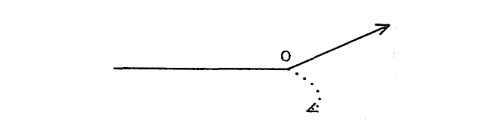
–Ibid., pp. 294–295, n. 23
It shows the arrow of time, with '0' marking the present, where there is a deflection. The arrow below the line represents the virtual path. Following the angle of deflection, the arrow above it represents the actual path taken. Is it possible to say that the diagramme as a whole shows the duration of the event? that is, in both its virtual and actual aspects, or, in St. Augustine's formula, as an event with its own past, present and future?
Cinema exposes the past standing out from the present in recollection, which can be understood as that effect of cinema, of cinematic perception, whereby what lies ahead in images, events and scenes is already in the past. At least we recognise them and in recognising these images of things and scenes, where people move or are still or where there are no people, recognise that they belong to another time, where, although they occupy our present, we can have no part in them: they are ghosts of a former past projected into the future. There are two reasons for this effect. The first is repeatability, the potential, after cinema, any time-unit, scene or event has, for having been shot. The second is the scene, the event, can only follow the path of the editor. That path can follow any image with any other, and still it has to follow it. This marries contingency to noncontingency. Contingency married to noncontingency means indetermination is determined.
The three presents, its past, present and future, of an event all rely on this one effect which has two reasons and is a fact of cinematic perception but it can also, after cinema, be said to be a cinematic condition of real lived experience, that after cinema we see the world this way too. This I believe Deleuze to be saying, his diagnosis.
The Third Schema
Before we return to the first question, was the preexistence of the past assumed by works written 16 and 17 years before this second book on cinema, on the time-image? we might ask about the 'third schema': why did Bergson not feel the need to draw it? Why does Deleuze feel the need to?
For the answer, the note in which the diagramme occurs, includes a reference to Mind-Energy, a collection of Bergson's essays and lectures published in 1919. (English translation as a pdf. online.) In that work, had Bergson drawn it, it would have illustrated the split between perception and memory:
Our actual existence, then, whilst it is unrolled in time, duplicates itself all along with a virtual existence, a mirror-image. Every moment of our life presents two aspects, it is actual and virtual, perception on the one side and memory on the other. Each moment of life is split up as and when it is posited. Or rather, it consists in this very splitting, for the present moment, always going forward, fleeting limit between the immediate past which is now no more and the immediate future which is not yet, would be a mere abstraction were it not the moving mirror which continually reflects perception as a memory.
–Bergson, "Memory of the Present and False Recognition," first published as an article in the Revue Philosophique, 1908, Mind-Energy, pdf. online, p. 165
The false recognition of the article's title, in full "Memory of the Present and False Recognition," concerns déjà vu. (The English title is a direct translation of the original, "Le souvenir du présent et la fausse reconnaissance," which also, although we consider it a French term, makes no mention of déjà vu.) When we look at what is happening in this phenomenon we learn something about the structure of memory and perception. Bergson's Matter and Memory, in 1896, deals in its entirety with distinguishing, first, perception, then memory, and one from the other, moving from their most extreme forms, pure perception and pure memory, to, as here, our embodied response to them. In that work he says the whole of the past coexists with the present. We might think therefore that memory coincides with the past and that perception equals the present.
This is what Deleuze seems to think. He equates the past, the whole past, with memory in general, that is, memory as impersonal. The memory is of no one or thing, being remembered or remembering, in particular, neither is it collective memory. Rather memory is for him transcendental, it exists, coexists and preexists, by being the transcendental field, which is the condition for real lived experience. To make this more solid, memory in general is what we make recourse to in recognition, when we see a thing as that thing, or a word as that word. It comes before we get there. It comes before we get there even if our idea, our identification of daisy as daisy, or of the West as where the sun rises, is wrong. We might say that it is the givenness of the world, and thereby get to the title of Levi R. Bryant's Difference and Givenness, 2008, which gives Deleuze's working through of these themes its fullest account. (A summary of Bryant's take on Deleuze's syntheses of time, by way of the paradoxes they present (most notably that memory, and the past, preexist the present), is given here.)
The memories we carry through our lives constitute our personality for Bergson. They concern the associations we have made at the most fundamental level of sensation, an association formed on our bodies, and language acquisition, as well as those we call on to engage in high performance tasks, so-called, driving a car while listening to the radio as much as solving mathematical or philosophical problems. Our access to memory is by our bodies but what that memory is in itself, for both Bergson and Deleuze, or symbolises is the coexistence of the past in its entirety with the present. A personal memory denotes symbolically the greater past, for Deleuze the transcendental field which suffuses all. However, because of this Deleuze corrects something in Bergson, memory in general is subject to not being remembered. We are in it rather than it being in us.
This last statement could be made by Bergson; but Matter and Memory over its course—although in it we read perception is outside and the brain is neither the container of what is perceived nor of memory, whether our own or memory in general—psychologises memory. What was the general condition for all and included our experience becomes, over its chapters, a fact of interiority, not in the brain, but a fact of experience and of human perception. This we can see in Bergson's article on 'false recognition' or déjà vu, which is replete with clinical examples, including the testimony of William James, whose report on déjà vu Bergson initially prides himself on obtaining. Soon we learn that James, down to the words he uses in his description of the phenomenon, concurs with many of the clinical examples already published. We will come back to James. The point of Deleuze's correction is to rehabilitate memory from being seen as of purely psychological significance. For him it becomes the grounds of experience itself, which we cannot remember, but which allows us to, to remember, and to recognise words, ideas, and to give ourselves, placing ourselves in memory, a place in time.
Bergson, as quoted, writes of life. It is every moment of our life which splits. This life, he says, consists in this very splitting—
... for the present moment, always going forward, fleeting limit between the immediate past which is now no more and the immediate future which is not yet, would be a mere abstraction were it not the moving mirror which continually reflects perception as a memory.
–Bergson, loc. cit.
We are reading here about the deflection occurring in the schema that Bergson did not feel the need to draw, schema 3. It is caused by a 'moving mirror.' We can imagine it moving at the point of the cone. In Bergson's diagramme, schema 1 in Cinema 2, a cone stands on its point, the point is where it is in contact with the present, and so the present is seen to be memory at its most contracted, where, for Bergson it moves. The diagramme also shows a plane, understood, although bounded by lines, to be limitless. Bergson claims that what makes it move is memory: we push ourselves forward by habit, through what we recognise. Deleuze immobilises the point as he does the moving mirror that makes the images that are cinema. Movement and time have separated. Hamlet said it, but for us it can mean something different: in the crystal image, the crystal of time, the separation is complete.
In all three schema Deleuze reproduces in Cinema 2 there is a '0' point or degree. In the cone diagramme it is the point, moving for Bergson, still for Deleuze. In the diagramme showing the circuits of memory, schema 2, it is the shortest loop, also the 'mirror,' moving for Bergson, still for Deleuze, reflecting what is perceived (and Bergson says enriching it) in memory, so that it is recognised. It serves as the base then for the concentric circuits of memory to loop back onto and resembles as much a screen, presenting the successive galleries in a cinema, as it acts as a mirror, reflecting them. In the third schema Deleuze draws but Bergson does not '0' is at the point where the arrow of time is deflected, as if hitting a hard surface and changing course; not before splitting its trajectory, and sending down the little segmented line, which curves back on itself, of the virtual.
False Recognition
For Bergson the present is prolonged and enriched by memory. For Deleuze it is extended as the pure and empty form of time that any event whatsoever, as soon as it succeeds the present, displacing it, as soon as we are plunged into it, can occupy. If the third schema depicts the time of the event, for Bergson its duration, then the segmented line of the virtual that splits off from it at '0' symbolises rather than memory in general, to which Deleuze says it corresponds, the specific memories by which its unique duration is prolonged, and, says Bergson, by recognising what is entailed in it, enriched. What if it is false?
Paradoxically, for Deleuze, this is also what matters, and we would presume it to be the subject of "Memory of the Present and False Recognition." Bergson's article looks at clinical reports of déjà vu, alongside William James's testimony, and concludes that where it does not concur with more general psychopathologies, which in the case of James he infers it does not, déjà vu gives us a false impression of association, that is, recognition, from what is perceived. Déjà vu places us as we would be in order to relate and recall a particular memory. The language Deleuze uses for the event is consistent with that which Bergson uses in relation to memory.
We have to jump into a chosen region, even if we have to return to the present in order to make another jump, if the recollection sought for gives no response and does not realize itself in a recollection-image.
–Deleuze, Cinema 2, online pdf., p. 99
In déjà vu, however, a particular memory, or a recollection-image, is not being recalled, rather we experience false recognition of the present, as if it were already past.
We have, says Bergson, in order to retrieve a memory to fit a situation experienced in the present, if we are to do it consciously (for example, a particular name or word), to take on a position in regard to it. The metaphor is physical, not psychological: it concerns our bodies. Of course, our habitual congress in our everyday interactions with the world does not require conscious action. We live a large proportion of our lives unconsciously, and, if mindful of our actions, we are even less likely to notice the difference between unconscious and conscious recourse to memory, which lies in the similarity.
Mindfulness plunges us into the exterior of movements which are interior—interior, not psychological, not fully mental, since perceptible for relying on this combination of memory (belonging to the body) and movement (belonging to the mind)—producing both recognition, and false recognition. Where it is false, we might say, the mind is overcompensating: it is pursuing its own course without regard for its position in the body or in the combination of perceptions which are going on, the ongoing contribution made by the living body, in its biological composition, constantly allocating and moving around material resources; while the mind, in its pursuit of any number of goals is driven by perceptions, as many goals as it can imagine, philosophical, poetic and literary, practical—perception is always, even when theoretical, practical. What the body is imagining is of course continuing to carry on as that body. This does not mean it is any less imaginative: it made your brain.
Perception-Imagination
At least two attributes of perception concur, one in the autonomic systems of the body, which refer for their duration down to the cellular level, the other or others in mentation, which avails itself of symbolic indexes and logics. These can be those of dream as well as pictorial, poetic, geometric, philosophical, and so on, where their conservation, if it is to be impersonal, is due communication, inscription and circulation. Thought broadly covers the second but thought in each of its aspects has its own duration, a philosophical nonlinear duration, passing through conceptual personae, for example, and each, although all avail themselves of the different capacities of the body, conserves that duration differently. In the philosophical example, these personae refer to the names of philosophers having been inscribed since the 5th century BCE. Shuttling back and forth, for the philosophical example, over two and a half millennia, perceptions gathered under thought and consciousness differ again in their duration, in their relation to the time in which they move, from those of the body and the time in which it lives, breathes and moves. The body's prolongation, conservation and organisation of parts held together by association, equates with memory-recognition, as does that of any body of knowledge. Its movement equates with perception-imagination, as does that of any perception.
In fact, the third schema, splitting time into memory-recognition and perception-imagination, for Deleuze, having immobilised it—like a log on a block, splitting time itself—applies to the living body, as well as it does to any event. We should however be wary of the way it spatialises the distinct duration belonging to the biological perception-imagination of the body, which, Bergson maintains, coexists with that of memory-recognition. There is a reflection at '0' which Deleuze claims to be asymmetrical, because the image as it actualises, of body, brain, central nervous system, sense-organs, skin, is strong and strengthens as it grows in adapting itself to the environment. Of course, it can weaken. That is, the tie between the virtual image and the actual can weaken. The virtual image is neither an ideal nor a set of instructions. Genetics would make it pre-encoded and have it belong to memory-recognition, when it is always a matter of deflection, as the schema shows us, and coexists, is continuous in biological perception with the body, with any body's duration. For cinematic perception, it is continuous as well but duration is discontinuous, so that the virtual image, splitting off at its point of deflection, and reflecting, is limited in its reflection to the duration of the shot. It is a time-unit. The virtual is continuously dividing, assuming on actualisation the nature of memory-recognition, or, otherwise, habit. These habits cells have of cell-growth are not then directed by some force outside themselves. Then, neither is the virtual image they head towards and are always veering away from properly inside them.
The reminder is Bergson's: perception is outside; and, for us, perception-imagination—where imagination is the part of perception producing virtual images—is outside. We can imagine a template, an ideal, possessing symmetries, classical, but it has to be one, in so far as it does endure, enduring, over its duration, continuous alteration to meet the demands, not that the environment makes, that it makes of its environment; or, again, that perception makes, driven towards its biological goal over the course of its life, by imagination. How greatly this differs from Deleuze's event! when, at point '0' time splits and the virtual is siphoned off to become the present of the past, where the virtual is pure recollection, yet preexists, and according to the syntheses in Difference and Repetition paradoxically coexists and exists. For this view of the body as its own event, where a life splits, the segmented line representing the siphoning off corresponds to memory in general, but how can it? It can because Deleuze gives memory-recognition the place perception has for Bergson and perception-imagination has for us, outside.
Memory-Recognition
The third schema applies to the event of the cell as it splits, except that in it Deleuze develops what for Bergson applies to false recognition. Bergson doesn't feel the need to draw it for this reason: in déjà vu we do not recognise the preexistence of the past that cannot be remembered because it belongs to memory in general. There is no transcendental message here. Déjà vu shows us how memory can coexist with perception. From this the message is the material coexistence of the past in general with the present, but it is the subject of a false recognition. Note that the two earlier schema Deleuze takes from Bergson are in Matter and Memory. For the third Deleuze refers to Mind-Energy, a later collection of articles and lectures. Bergson describes the split which it schematises in "Memory of the Present and False Recognition." Bergson's memory of the present becomes Deleuze's memory of the future. It concerns what will have happened and Deleuze retains, because cinema retains, the two senses in which Bergson says the past can be said to coexist with the present and to exist outside of the brain. Although, as I have said, Matter and Memory backs down from the challenge of a memory. He turns memory into a psychological phenomenon when it should be, to be consistent with his theory of perception, outside of the mind.
Perception needs memory so that we can recognise what we see. This is what holds these two, memory and recognition, together. Experiencing déjà vu however we remember instead of perceiving. We have a memory of the present which stands out from its perception. Where we started, the past stands out before the present, is exactly here: in déjà vu we are at our most cinematic. Time in all of its contingency appears repeatable, which, for cinema, it is.
The Power of the False and the Will of the World
The logical steps for Deleuze are these:
- the past exists. It is independent of the mind that remembers;
- the past coexists with the present. This is how the mind can bring it to bear, bring what has happened (memory-recognition) to bear on what is happening (consciously, in the event, or unconsciously, out of habit), in the time it is happening;
- the past preexists. It is what will have happened at point '0' where it will have been reflected (the virtual, the re-collection to find the action required, pre-cognised, by the present event).
The virtual, for this reason, relates to memory, to the past in general, constituting the transcendental field. Reflected in the virtual time will itself have been deflected. Any event does this, operates the mirror that for Deleuze is as still as the facet of a crystal.
Bergson's false recognition is a further demonstration of this operation, since where the action re-collected is not the one required by the event, but another, where it does not follow de jure but de facto, as Deleuze is fond of saying, it acquires the power of the false. By this power it deflects the succession of events, which go to form the memory of the world, away from this world towards another, which we remember, although we have no memory of it, and recognise as being what it is, even when it is not, when that recognition is false. Consciously, we would say this consists in our affirming the event, but we are so inured by, in fact, the succession of movement in time as to be habitually unconscious of most events. It is only the exceptional and the remarkable that shock us out of habit. These turns in events where we have to think about them, for Deleuze, address themselves to us as problems demanding to be solved. We have no choice in what they are, and, caught up in them, we have no choice. We are, in this view of time, like William James experiencing déjà vu.
Bergson writes James tells him,
... that what dominates the phenomenon [of déjà vu] is a feeling of "inevitability," a feeling that no power on earth could stop the words and acts, about to come, from coming.
–"Memory of the Present and False Recognition," pdf. online, p. 135
Bergson reports that James had assumed his experience was unique to him and that Bergson had assumed his testimony to be unique, but when he looks at the clinical cases he finds that the vast majority of them express themselves in the same way, down to using exactly the same words. They do not recognise it as a memory. They perceive it as one that they are living again.
Not only has everything they live now been lived before, every movement, every action which they undertake to take, even down to their refusal to, is and has to be exactly the same. It is inevitable. Although it is not a role, it is more like a scene, they are trapped in it. The scene, in fact, may have arrived before they have in it, as the will of the world, or they may have before it, and be re-remembering it.
Deleuze feels the need to draw the third schema because there is a trap here. It is the way cinema presents time cut up into sensible units. Bergson walks away from it. Deleuze, in taking the third logical step, walks into it.
Time
The trap in each case is for thought. For the thinker of duration, Bergson, cinema is the spatial unrolling of images in succession. While it provides a working metaphor, a technical metaphor for time, cinema does no more than represent time, which is, fundamentally a continuum for Bergson, and absolute.
Cinema deals directly with the problem of time for Deleuze. Duration may be suppressed but cinema expresses time. The time-image is its direct expression. Film directors are thinkers of cinema, so there is a cinematic thought, which is where, in the two books on cinema, Deleuze seeks to place himself, on the assumption that in this way cinema, through works of film, is doing philosophy.
For the thinker of cinema, Deleuze, films fundamentally alter our understanding of time. This alteration reaches its highest expression in crystal images, the crystal of time where past, present and future are simultaneous. There is a present of each, its point of view or peak; and there are pasts, sheets of memory, or loops that come back to the degree '0' of the shortest circuit of recognition. The sheets are the loops or circuits as presented in the first schema. The degree '0' is the base. Like a screen, it doesn't move. The images on it do. If time is like this, we are among them. The question asked here at the start becomes, not was Deleuze in the books before Cinema 1 and 2 already there, thinking the thought which comes from the perception film, explored by its makers, has of time, but were we?
Knowledge
From cinematic works Deleuze constructs a body of knowledge, inherent to which is a perception of time that is cinema's own, but we can expect this to reveal itself to film-makers as the craft develops, as grammars are formed, techniques are established, practical experience is gained. These are tools. Their use becomes habit. Film, like philosophy, forms schools, schools of thought, where practices are standardised. The remarkable and the exceptional are noted, and their contribution to the art form becomes a problem, which audiences address themselves to as much as those producing cinema. They are problematic if and when they are recognised as breaking with the habitual, which, for a body of knowledge corresponds to the autonomic systems we noted are the body's. If they are not recognised we will not proceed with them. In philosophy this is exactly the case of Bergson, whose concept of time being duration is blocked by that which we are discussing, cinematic time. In other words, we have assimilated the habits formed by cinema and perceive time as it does, through memory-recognition.
The trap for us which Deleuze solves on our behalf is that there is nowhere for the new to originate. We would expect it to arise from the transcendental field, but this for cinema is memory. In the present the new cannot be created because the present cannot pass without the preexistence of what is recognised to follow it. The present cannot pass without that recognition.
We might expect the virtual to be a sign of the new but it too belongs to this strange sort of memory of a past which, in preexisting, cannot be remembered. It can only be recognised. And when it arrives, it is the future. It is the future even if unexpected as entirely inevitable. The future for cinema entails the displacement of what is present by a new presence, which is in fact, according to the logic of cinema simultaneously existing, coexisting and, preexisting, a new trap. Even when new we confront it with a sense of déjà vu, or, rather we have this experience with it, the same as which James describes.
The future is essentially frustrating, not because we've seen it before, as is said by those who think we're in some sort of temporal decay, of decadence or in the end times, but because it is not in our power to change it. By the time it comes to us, the change has already occurred. Our experience is as James describes, that no power on earth could stop what is to come from coming. We might as well stop time.
The Labyrinth Made of a Single Straight Line
Time itself consists in its pure, empty, inevitable and ineluctable onrush. In his last published book, in the essay on Kant, Deleuze writes, time,
... becomes unilinear and rectilinear ... insofar as it imposes the succession of its determination on every possible movement. ... In time, there is no longer anything either originary or devived [sic.] that depends on movement. The labyrinth takes on a new look—neither a circle nor a spiral, but a thread, a pure straight line, all the more mysterious in that it is simple, inexorable, terrible—"the labyrinth made of a single straight line which is indivisible, incessant."
–Essays Critical and Clinical, trans. Daniel W. Smith and Michael A. Greco, University of Minnesota Press, 1997, originally published 1993, p. 28 (the quote is from Borges's short story Death and the Compass)
How we escape the labyrinth is the same as the solution to the problem of the future for a preexistent past, that is, the problem of where the new originates and is created. It comes from succession itself, or, in this case from the succession of the nonsuccessive. What at first may seem like a paradox for logic or a contradiction, for cinema, and for machinic perception in general (as we see in the books which Deleuze wrote with Guattari), is not. The pure and empty form of time, the time-image signifies, belongs to how cinema thinks, and how cinematic practitioners work through the problem of time. In cinema this problem is the one we have been addressing: the past stands out before the present, so that there is no future, but only a present and a preexistent past, of memory-recognition, which allows it to pass. It, as used to be said, gives it to pass.
The Machinic Event
The machine recognises what is just before it, its virtual goal or the ideal effect that it actualises. For the body, this is at the level of the cell, and occurs at the event of splitting; but such perception as the body has, holding it, as it were, in its autonomic systems, involves many cycles or circuits, none of which is reducible to the past in general but in each of which exists, coexistent, the past in its entirety. Biological duration is that of a lifetime. This is where Deleuze and Bergson differ the most.
For Bergson we are not in time. Time is in us. It is our time, our lifetime, our little bit of the absolute. You can see from this how Bergson might make duration about us, when each attribute of perception occurs in and has its own duration, even the machinic. A machine's duration concurs with its event. For a typewriter, but equally for the keyboard my fingers are striking now, the event is the registration of the letter on the page, or screen, any letter. It doesn't matter which.
The cinematic event is not the cut. It is the shot. Cinematic duration is that of the shot. The registration of the image is the ideal effect actualised; but this image has, as it were, its own personal duration and is not simply about the length of the shot. Registration here amounts to recognition. It occurs at the degree '0' Deleuze says is at the base, of experience, formed on memory and recognition.
Each event cinema records and recalls has to happen in its own duration. Whether a shot of a car-chase or of wind in grass, that time is recorded and recalled. It is not the time it took, but the time taken from that time, which is the shot in duration, the shot in turn being a kind of entity that exists only in recognition of its effect of registering the image. The kind of entity it is has neither being nor becoming but is time itself, in other words, duration. Because we have adopted it, the shot has ceased to signify for us. It comes before us as existence itself, or as memory.
For cinematic perception, and machinic perception in general, duration is discontinuous. We recall, as cinema does, discontinuous durations, units of time, scenes, and accept consciousness as being discontinuous. Cinema, specifically, involves units of time—separately recorded and capable of editing, for length, to fit the sequence, for the movement represented by the image, and for effect—which do signify. They are what Deleuze calls chrono-signs.
1.
The first consequence of cinematic perception, the first aspect of the problem of time film-makers confront is the noncontingency of contingency. Movement that is, for any other perception but cinema's, contingent, random, erratic, is registered in a totally determined form, as an image that is, virtually, able to be repeated infinitely. This virtual capacity of infinite repetition derives from the way cinema remembers, which is by the image being registered and put in sequence with other images. The image can for the same reason be repeated at any time whatsoever. What was unique and contingent on place and time before cinema arrived is now absolutely noncontingent and completely determined.
There is a view of theatre, implicit in Deleuze, that theatre already frees place in order to be any-space-whatsoever. In theatre we are displaced by the scene which takes place, has taken place and will have taken place, here and now. Samuel Weber explores this in depth in Theatricality as Medium, 2004. (NY, Fordham Press) In the present context, this is to say no more than that theatre, or theatrical perception (medium for Weber), has its own duration. It pursues its ideal object, the scene, which cinema in turn frees from time, in order to be any-time-whatsoever.
That the image, however complicated the movement in it, becomes completely determined is due—the first autonomic cinematic function—to contingency's noncontingency, or what we might call (non)contingency. This goes so far in actual film production as to entail vast amounts of money to be spent trying to win back by technological means what the image already had by nature, using, for example, particle-mapping to reproduce smoke, or animating individual hairs to simulate the movement of real hair. (Non)contingency correlates with the logical step made by Deleuze, which Bergson endorses: the existence of the past. However, Deleuze's claim is that memory in general exists independently, outside of the mind. This correlation is not so important as that existence, contained in memory, pertains to the past.
2.
Coexistence relates to the present, but only as images attain presence, then are gone. Presence is the assurance that things pass. Events come and go. The next autonomic function of cinema is that of a displacement in place. Any place whatsoever is split by the axe of time. Either things carry on as they are or they change, but we know that change is continuous with time. This function, because it installs discontinuity into continuity, we can call (dis)continuity. The present is then, as we have said, immobilised by Deleuze, like a log.
3.
The third function articulates the other two, because it is how in a machine one function follows another. The third is the function of succession, but not that of presence, not of an event or thing happening such as we can say these were the events leading up to it, even when there are random events mixed up in it, as we might experience it in the world; and not of a succession of presences, such as we would get from displacement and one thing following another, or being developed or even enveloping another. Neither sudden mutation nor slow evolution covers it. Rather events proceed as they do in the third schema—and we can see from this why it is so important to Deleuze, and also how the first schema presents sheets of time, represented as loops or circuits, and the second peaks of time, the points of as many cones as there are present moments. The third schema presents, Deleuze writes,
... the most fundamental operation of time ... We see in the crystal the perpetual foundation of time ...
–Deleuze, Cinema 2, online pdf., p. 81
The Foundation of Time
This foundation is the split, represented at the '0' point, where a segmented line loops down in its return, and a solid line is deflected up at an angle. The point of deflection is the same as that of reflection, in this case, Deleuze says, reflection in the virtual, while the actual, although it forks, continues. The actual concerns what actually happens, and we can imagine the path taken by events to be continually splitting and forking; we can imagine a time constituted by forking paths. And we can claim this to be time's fundamental characteristic, that in its nature there is division and that it is perpetual: at each moment things could go one way, or another; and each path is preserved in the virtual, where it constitutes memory in general.
Moreover, if we pursue the image, we see a lattice form, a solid net, that is crystalline, as the infinite operations of time go to build up layer upon layer of crystal. Each line, as it passes over the surface, splits and is reflected in the depths of the crystal, as well as being deflected on the surface by the facets of the crystal, or, as Deleuze writes, its slivers, because there is nothing to say that the crystal is whole. (Ibid., p. 69) In fact, there is not just one, which would be the crystal image, but crystals. Together they comprise the crystal of time which is the foundation of time.
The problem of the new explains why time has this foundation. The past is a labyrinth, we can get lost in its twists and turns, but time is a straight line. In this way time is the perfect labyrinth. We must revisit Deleuze's essay on Kant to find out how time can be both a straight line and a multiplicity of lines. There we read that time becomes unilinear, a single line, and rectilinear, a straight line,
... insofar as it imposes the succession of its determination on every possible movement.
–Loc. cit.
Complete Determination
What comes next has to and can only come next, but it is not supported by any movement in the image. As we saw from the earlier functions of (non)contingency and (dis)continuity, the movement of what happened, which still exists, what is happening which happens, indicating coexistence, and what will happen, is subject to complete determination. The future will have happened according to the succession of images. This succession comprises a single straight line.
As a single straight line however it does not comprise every possible world. We might think then that these are closed off to us in our world and that each world follows its own individual time-line, which comes about when time splits, when this way is taken not that way, in the determined succession of the images making it up, and this is indeed the case for present and past: memory contains only the pasts of our own time-line, not others; while memory in general preserves the pasts of the world's time-line. It is not the case for the future, which is perpetually originating at the immobile point, point '0', of time splitting—time's perpetual foundation.
We should note at this point, point '0', that it is empty. Pure and empty, a pure function, it is the presence in fact of nothing. Yet neither is it the void nor is it negative. This function does not negate anything. It creates by, to requote Deleuze, imposing the succession of its determination on every possible movement.
Succession of the Nonsuccessive
We mentioned the succession of the nonsuccessive earlier, evoking the perfect labyrinth, from which no action could free us, as being time in a single straight line. This is the time we know, but we also said that how we escape from the labyrinth's prison and how we solve the problem for a preexistent past of the origination of the future are the same. The reason for this, although it present itself as a problem to explore and experiment with for film-makers as much as philosophers of cinema, and as a logical paradox, or seems to be a contradiction, is that the image is agnostic. It doesn't know what it represents.
This is quite natural for cinema, as natural as the large language models of artificial intelligence not knowing what the sense-units they produce represent, or the paint not knowing what the painting represents. Machinic perception cannot make an association beyond recognition, which is its degree '0' and stands at the foundation of time, says Deleuze, for us, and is its originary point. To the optical affordances of different lenses, for example those enabling depth of field (which features heavily in Cinema 2 in connection with the time-image), cinematic perception brings only the recognition that they achieve its function, its function being to register the image, recording it to be recalled, with the possibility it may be recalled an infinite number of times. Our means of escape are clear: any image can follow any other. We can jump from any image to any other, from the past way into the future, as from one world to another.
Cinematic perception cutting from one to the next image recognises these as units of time. It is, as well as being content-agnostic, indifferent to the duration of images so that in succession recognition is given equally to each and every one. Their succession, as it does for the single frames of analogue film, achieves continuity in discontinuity. Discontinuous time-units are strung together one after another, and their stringing together on a single time-line amounts to the succession of the nonsuccessive—a function of articulation, since it occurs over the cut, we can call (non)succession. We can say what is true of this image is not true of the image which follows, yet the cinematic machine recognises it. It is as we are in déjà vu and the images brought onto the time-line have the same inevitability as those actions and words in James's report.
The third schema depicts cinema's false recognition. Should the time-line have proceeded horizontally without deflection we would say that it entered the blind field, where it could carry on a ghostly existence in a future which it does not have—"blind field" because cinema is blind to it. The cut is inevitable, as inevitable as the next thing that happens. Over the cut is the new, that cinema is not blind to. Cinema pushes forward into the new as we are impelled forward in time.
Automation
The point of difference between it and us is that cinema is automated. AI is also an automated system of perception, and, as a body of knowledge, we can say that what it knows is subject to the functions—autonomic functions, habits of perception—that are cinema's. It is another instance of machinic perception. These functions are in summary:
- (non)contingency;
- (dis)continuity;
- (non)succession.
(Non)succession is progress and the inevitability of change. Change, the new, the future are freed by the (dis)continuity of time-units but trapped by (non)contingency, by, even if it represents the greatest chaos, the complete determination of the image, and by its inevitability. This however is only to describe one image as true over another that is false, to see one image in light of another or to judge between them, which the machine does not do. The succession of the nonsuccessive preserves the distinction between real and imaginary and between true and false but for machinic perception one cannot be discerned from another. We see here the reason AI hallucinates. It too occupies the time-crystal.
The Solution
If we follow this solution we walk further into the time-crystal. The solution is the false. The true need not continue being true, and the false does not negate it but adds to it. Something new arises from it. As the line passes over the crystal's surface, and over the facets, it is deflected, and from this deflection comes difference. Yet we cannot help thinking, from its reflection, deep in the crystal, that what differs is already completely determined and that the movement of time passing, itself, is also. Time, perfectly separated from movement, is immobilised. While the coexistence of the past pushes us forward, the preexistence of the past completes the trap.
Our solution is a false solution. Time by nature does not produce these effects. These are effects of the cinematic perception of time, functions of the autonomic system it shares with AI and other machinic assemblages. Drawn from the same technical field, this is exactly Deleuze's diagnosis of the cinematic condition, and so we prolong the problem, reproduce the problem, pursue and repeat the problem, in its solution. From the foundation of time, a false world follows a true world, and a true a false, from which it is indiscernible. Given this technical understanding, we cannot make a future that is not a preexistent past.
Last Lines
There is a consistency to the solutions Deleuze finds for us over 17 years in 3 books. In each case it takes the form of a negation that can only resolve itself through contradiction and that presents us with a paradox of just the type we have been considering, of a preexistent past. This is identified with the third schema, of perception, I have put it in this text's title, but for Deleuze it is much more the third schema of memory, where it belongs to the metaphysics of memory, attributed to Bergson (which in fact is a metaphysics of time or duration), and to the transcendental field of the past. (Cinema 2, p. 109)
In the third schema time splits between virtual and actual lines, the virtual going to the past in itself (of pure memory), the actual, which never arrives at the future, only up to and as far as a present of the future. The first schema (from Matter and Memory) shows a cone resting its point on a plane. In that contact Bergson depicts the point of contact with the present. The second schema (also from Matter and Memory) shows the circuits of the past, in the form of concentric lines, all meeting at the plane of the present. It is as if we are given the cone from a different angle. The schema has both internal and external aspects. The lines above are echoed by the lines below, all of them looping back to the present in question, in question because we can say that the top loops are questions being asked of the past by that present, and the loops below are the answers we place ourselves into memory to provide.
The second schema depicts the past. Then we get the third schema which should be that of the future. It is equivalent to the third synthesis of time in Difference and Repetition but there is quite different. There its failure to arrive at the future is due to the failure of the answers provided, to the line breaking, and being caught up by the eternal return. It is as a failed synthesis of the idea, of identity, that it breaks, and is split by the volcanic force of difference.
We can read in light of the ground splitting the ungrounding that sense undergoes in The Logic of Sense, where sense, meaning language and sense, and le sens in French meaning both direction and sense, has a similar destination to that in Difference and Repetition. Sense grounded in the negation of a ground, here nonsense, we can relate to the virtual-actual schema, where succession is of the nonsuccessive and true and false alternate: sense loses ground to nonsense; nonsense gives way to sense. In just this way, the third schema would show a wave, both pushing up, from the ocean, and being pulled down, by the undertow, which is the inescapable past, of false and true recognition alike.
The failed synthesis of Difference and Repetition equates to the false solution, which Bergson did not feel the need to draw but Deleuze does, of the third schema. The amor fati we find in The Logic of Sense equates to the inevitability we experience when, at the automated insistence of the future, we can do nothing to change it, but must simply watch and watch as it machines out recognition. As in memory, as in the preexistent past, we have no agency here.
Deleuze takes the line of memory-recognition from Bergson's metaphysics of time. I take the line of perception-imagination. A handful of lines in Cinema 2 led me to ask the question at the beginning of this text: Is Deleuze's theory of time, most importantly in regard to the future, consistent over the body of work he said he wrote in his own voice, that is, from Difference and Repetition onward? I include The Logic of Sense because the three books, where "idea" refers to Difference and Repetition, "sense" to The Logic of Sense and "time" to Cinema 2, are present in these lines. The last lines are Deleuze's.
He characterises the time-image, belonging to a non-chronological time, as being composed of "the pre-existence of a past in general; the coexistence of all the sheets of past; and the existence of a most contracted degree." (Ibid., p. 99) Then he writes:
And, with Bergson, this time-image extends naturally into a language-image, and a thought-image. What the past is to time, sense is to language and idea to thought. Sense as past of language is the form of its pre-existence, that which we place ourselves in at once in order to understand images of sentences, to distinguish the images of words and even phonemes that we hear.
Refrain:
What the past is to time, sense is to language and idea to thought.