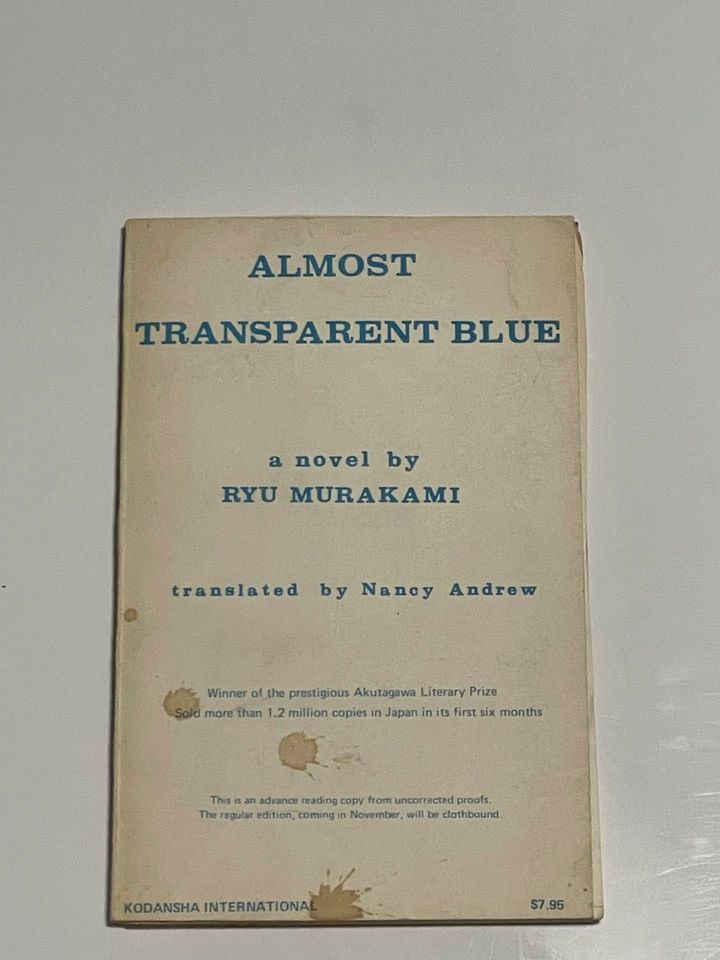
"Wow, that's probably the most truthful and elegant description of the process I've heard. If you write fiction ..." things from Conversations with Steve Erickson*
*ed.s Matthew Luter and Mike Miley, Uni. of Mississippi, 2021
... , it doesn't matter if you're writing about another century or another planet; you can't get away from yourself and your own experience.
SE:
You can't and you don't really want to.
the most elegant and truthful description of the process of writing,
according to Jim Knipfel, in 2018, interviewing Steve Erickson.
SE:
As a novelist yourself [sic.], you'll understand that these things involve navigating an extraordinarily exquisite perspective. You try forging as precise an emotional or psychological relationship to the material as you can manage, to the extent that such a relationship can be managed. One vantage point is too close, another is too far away. One is so distant you can't find yourself anymore—or at least you can't find the reason for writing the book in the first place—and another vanishes right up your own nether regions. Finding a way to be as objective as possible about the intensely personal, to be as coolly appraising as possible about your relationship to where you've come from—as juxtaposed against your relationship to how far you still have to go—it all gets harder the deeper into the work you get, until you don't know anymore whether any of the book makes sense. At that point you have to trust that your instincts were right to begin with. You have to trust that the compass has been showing you true north all along, and you need to follow through with it no matter how alienating the landscape has become.
Capitalism in the arts and culture industry would mean the freedom to fail: that would be a real business model
He can't find his study, bathroom, bedroom, or front door. It looks to him like even the windows are in different places. He keeps hiring contractors to work at putting things right. His wife, who isn't lost in the house, is terrified as she sees him demand that rooms and windows be drastically rearranged in patterns that make no sense to her. Her husband is trying to take his inner journey as far as he can, and that can be damned inconvenient. Earlier in [Rubicon Beach] another character thinks, "By the plain form of my delirium I will blast the obstruction of every form around me into something barely called shadow."
–Michael Ventura, introducing the first interview in the collection, 1986
- I read this, admired it, made a note of it as an epigraph—the quote, By the plain form ... obstruction of every form ... shadow—for something I am writing, and, reading Tony White's brilliantly, gently Oulipo novel (the second in the series which started with The Fountain in the Forest, 2018), Phantom at the Feast, 2026, I read
... he knew that this was one of those moments when everything changed. Not mere historical change of the 'Where were you when Thatcher resigned?' variety, or the collapse of the Berlin Wall. This was change of a greater order of magnitude. Like suddenly and irrevocably crossing your own private Rubicon, whether you wanted to or not. When everything that had gone before suddenly seemed too simple, and too good to have been true, or to have lasted, and you were abruptly shoved—for better or worse—into a different dimension, with its own new multiplying factors of complexity and risk, and maybe eventually some pleasures too, once you'd adjusted, if you were lucky.
- Then there is the small matter of the epigraph and its appeal. (Let's set aside for now—and evermore?—the issue of the multiverse, or Many Worlds Theory, another factor the Steve Erickson interviews book, where it comes up in the Jim Knipfel interview, cited above, shares with the citation immediately above, and with my thinking-through of the implications of another book, Max Lury's No Ghosts—to call it Steve-Erickson-influenced is perhaps an understatement—Lury in personal correspondence said the fingerprints of Erickson's first novel, Days Between Stations, were all over his own novel—in parallel to the implications, to which Lury's novelistic working-out would be the explication, of crystal images and crystal time, here. Which is to say, the prospect of a memory-world such as cinema presents is a condition for the 'state of affairs' that supports the perception of ours as a multiverse, in which there are many worlds, Erickson's endorsement of the idea, in the interview, notwithstanding. And we might consider the role of cinema in Erickson's work—but not today.) Something about Novel November appeals—in the present tense, because I still have 11 hours to sign up to the challenge of writing 50,000 words in 30 days. Several years ago I started a novel, perhaps this is the time to finish it; and it would give me a decent head-start on the 50,000 words. The idea was modules, capsules, of time and space, recreating which would resuscitate the world of which they were a part. And this I want to do, or wanted, now in the past tense, because I realise these modules that are capsules of time and space are also traps—a bit like the time-crystals I describe here, but unlike them for being traps I designed only to trap myself: that other world they capture that is this world, I am its captive. Now I need to blast my way out with this new work, to be no longer a shadow of it, and find my validation no longer coincides with the world's or with the resuscitation of a past world (for which, perhaps, Novel November, no longer has the reach—I now have 9 hours to decide):
By the plain form of my delirium I will blast the obstruction of every form around me into something barely called shadow.
SE:
I'm trying to get at a sense of Los Angeles being an existential blank, a psychological white wall, a geographical neuter.
—within the larger geography of a dream. A dream Erickson identifies with America itself.
SE:
I have a good friend who once wrote me this tortured letter about whatever love affair he was going through at the time, and I wrote back and said, "You've got to remember, Fred, that a lot of people go through their lives never feeling anything at all." And that's what [my] books are about. It's easy to go numb. It's the easiest thing in the world. And these are characters who will not go numb. They'll slap themselves silly to get the feeling back. To keep the blood going. To keep even the worst nightmare alive—because at least that's a dream. It may be a bad dream but it's a dream, and it's better than no dream.
ES:
... in Rubicon Beach, the coordinate that all three parts fall on, is the sixth of June, 1968, when Robert Kennedy died. And I chose that day not because I'm especially convince that Kennedy was a great man or would have been a great leader. I chose it because probably that's the point at which America turned away from the possibilities of redemption.
V:
Redemption?
ES:
... I think what has happened is one kind of dream got displaced with another. The hard dream got displaced with the easier dream. Reagan's great insidious success is that he has persuaded people to redefine the dream, at least for the time being—yet still keep calling it the American Dream. When Reagan had his debate with Carter he said, "Are you better off now than you were four years ago?" which is the sentence people latch on to; but the follow-up sentence was to the effect of, "Can you still go into the stores and buy what you used to buy?" There it was, the essence of being an American ... The real insidious thing is that the current conviction seems to be that being an American should be easy. It shouldn't involve risks. ... I think the guys who invented this country saw it as a long and hard road, and one that was never going to be easy if, as was the ideal of this country, you were going to keep a lot of different interests free and in balance.
... I believe in a culture that has consequences. ...
What someone like Meese wants is a culture of no consequence. The guys in this administration [1986], when talking about economics, talk about freedom to fail, one of the basic tenets of capitalism—you have to have that risk, that's what makes capitalism a vibrant economic system. But culturally they don't want it. So I guess I'm writing about the ways the American idea has failed. ...
V:
... the "hard dream"?
SE:
... the right of individual free speech ... is not a right given to the citizen by the state; it's a right that a citizen has by virtue of being a person. ... God gave you certain inalienable rights; the state cannot take them away. The state doesn't give you the right to free speech; you've got that right; you were born with that right. The only thing the state can do is not take it away.